


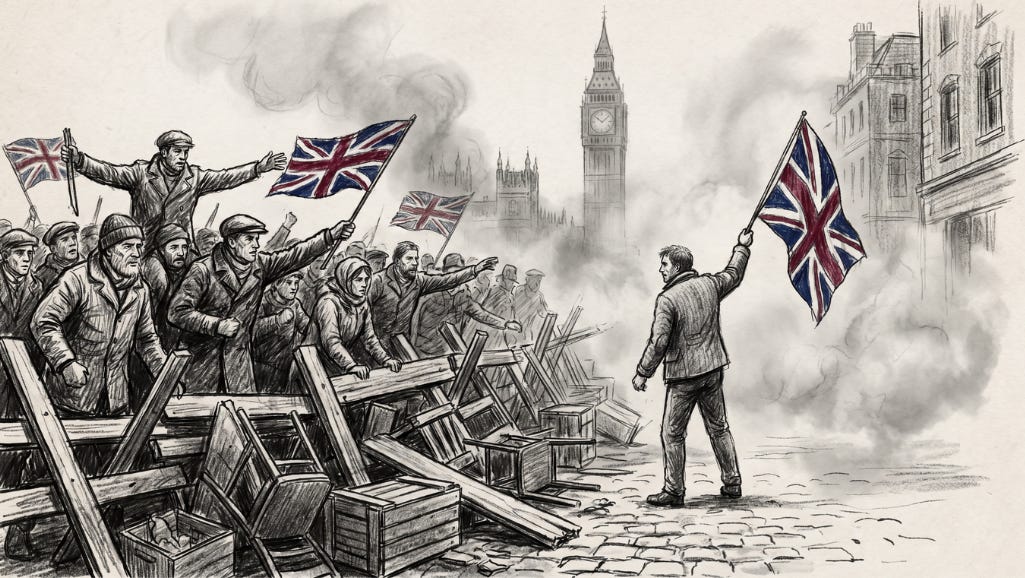
After Keir Starmer resigned as prime minister last week, Britain is now waiting to find out who its seventh leader in a decade will be, not via a general election, but through an internal Labour Party process that most Britons have no vote in and no say over.
This is how the British system works: a prime minister holds power only for as long as they hold the confidence of their own parliamentary party, and when that confidence collapses, no election is required to remove them. The party withdraws its support, the leader goes, and whoever wins the subsequent internal leadership contest walks into Downing Street. Starmer didn’t lose an election, and he didn’t resign over scandal or catastrophe. His own MPs simply decided that he was no longer the one to carry them forward, and so he went. But what led them to that decision is perhaps more interesting than the decision itself.
Starmer had been struggling almost from the moment he took office. The economic growth he promised never materialised, public services remained in crisis, the cost of living didn’t ease, and Labour was bleeding voters in two directions at once - to Nigel Farage’s Reform UK on one side, and to the Greens on the other. A series of missteps compounded the damage, including the appointment of Peter Mandelson - a figure entangled in the Epstein story - as UK Ambassador to the United States. By early 2026, Labour MPs were openly questioning whether Starmer could lead them into the next election.
The Mayor of Greater Manchester was asking questions as well, watching all of this unfold from afar. Fifty-five year old Andy Burnham had himself walked the halls of Westminster, spending sixteen years as an MP rising through Health Secretary, Culture Secretary and Chief Secretary to the Treasury under Gordon Brown. He ran for the Labour leadership twice, coming second in 2015, and when Jeremy Corbyn won, Burnham did something unexpected, and left to run for Mayor, winning the mayoralty three times.
While Westminster cycled through leaders and crises, Burnham was in Manchester doing the unglamorous work of actually governing: bringing the city’s buses back under public control through the integrated Bee Network, building a homelessness program that guaranteed a bed every night for every rough sleeper in Greater Manchester, fighting Boris Johnson publicly and loudly during COVID for fairer furlough funding for northern communities - and winning - earning the nickname the press gave him and that stuck: King of the North.
Watching Starmer flail spurred Burnham on to have another tilt at the top job, but under Labour Party rules, only sitting MPs can challenge for the leadership. To get back in the room, he needed a seat, so in May, Josh Simons quietly resigned his Makerfield constituency - the seat closest to where Burnham had grown up - specifically to create the vacancy. Burnham then had to give up the mayoralty he’d won three times to run for it, because the two roles are legally incompatible. He walked away from nine years of work in Manchester, mid-term, knowing that winning the by-election would strip him of the mayoralty automatically.
He won on June 18 with nearly 25,000 votes, and Westminster immediately understood what it meant. Within days, British media was reporting Starmer would resign, and the same day Burnham arrived at Parliament to be sworn in, Starmer was gone. Nominations for his replacement open next week, and right now, the only declared candidate is Andy Burnham. If no challenger emerges before nominations close on July 16, he becomes Prime Minister of Britain without a contest - a coronation, not an election, making him the most powerful unelected leader in British politics since Gordon Brown took over from Tony Blair in 2007.
None of which is the most interesting thing about Andy Burnham. The most interesting thing is what he said this week, standing not in Westminster but at The People’s Museum in Manchester, delivering his first major policy speech, proposing not a better version of the political pyramid, but something with a different shape entirely.
He called it No. 10 North - a second nerve centre of government, headquartered in Manchester, designed not to replicate Westminster’s power but to redistribute it outward and downward: to regions, to mayors, to the places where people actually live. He named his governing philosophy Manchesterism: place first, not party first; problem solving, not point scoring; built from genuine partnership between public, private, community, voluntary, faith and trade unions, rather than handed down from a distant lectern. The opposite, he said, in every structural detail, of the Westminster top-down way.
Jupiter crossed into Leo for the first time in twelve years the same week Burnham stood at The People's Museum and described a complete rewiring of the British system. Jupiter entering Leo was always going to pull a new wave of figures into the room - voices carrying real fire, leaders who lead from the front with their actual faces showing, the currency of genuine creative authority beginning to appreciate. But what’s striking about Burnham isn’t only the policy - it’s the trajectory. He didn’t emerge from the centre and extend his hand outward as a gesture. He left the centre, spent nine years building something from the ground up in partnership with people, and is now being called back not because Westminster chose him but because what he built proved itself. That’s not the pyramid. That’s what comes after it.
The shadow is worth naming too, because Jupiter in Leo always carries one. It amplifies the ego that mistakes visibility for truth, applause for mandate, performance for sovereignty. Burnham is a gifted performer of authority, and his critics describe him as an ideological shape-shifter, a man who has moved between Labour’s factions with remarkable flexibility and who responds emotionally to issues and leaves the detail for later. The test of whether No. 10 North is genuine rewiring or better-branded centralisation is one the coming months will answer. A network with Manchester at its heart is still a network with a heart, and the question is whether power actually flows, or merely appears to. Jupiter in Leo will reward the genuine article and expose the performance. The sky is not sentimental about the difference.
But in a week when every other holder of power spent their days scrambling to manage the thing quietly giving way beneath them, what Burnham offered was the first clear glimpse this year of someone describing the next thing rather than defending the last one.
The sky has something to say about why.
With his Sun, Moon, Venus and Mercury all in Capricorn, Burnham embodies the archetype of the builder, the long game, the thing that works because it was done properly. A chart like that produces someone who earns power slowly, in unglamorous spaces where nobody’s watching. Right now, Neptune is conjunct his Ascendant, which happens only once in a lifetime, dissolving the boundary between “this is mine” and “this belongs to the work” and creating the aura of the visionary. It also carries the central risk of being idealized beyond what’s real, making commitments from spiritual clarity that practical reality cannot support. The same Neptune is conjunct his natal Chiron - the wound around initiative and self-assertion being healed through dissolution. He is being called toward something he cannot control or claim.
His North Node sits in Pisces in the 12th house. The soul direction pointing toward service without return - ego released into the collective. This has been in permanent tension with the Capricorn stellium that wants to build the career, hold the institution, be the one who endures. The integration of that node - not for me, for the place - is precisely what Manchesterism claims to represent. The sky right now is the moment those two forces are being asked to resolve. Whether they do is the question the coming years will answer.
The UK chart has always carried a tension written in Leo with both Jupiter and Saturn in the sign. Jupiter-Leo says creative authority distributed, everyone’s gifts belonging to the whole. Saturn-Leo says hierarchy, gatekeeping, the established order holding the centre. Every political inflection in British history has been a renegotiation between these two. Westminster has almost always chosen Saturn. What Jupiter’s return to Leo is asking - with Uranus simultaneously tearing at the UK’s natal Pluto in an exact square, with Saturn hammering the natal Sun, with the Mars-Uranus conjunction in Gemini firing across the same degrees on July 4 - is whether the country is finally ready to choose differently.
The Jupiter return opens the window. The Uranus-Pluto square breaks the structure. But Jupiter will pass over UK natal Saturn three times before mid-2027, due to retrograde - three passes, not one clean moment. That’s not a coronation. That’s a test.
The sky has arranged the conditions: a Capricorn builder with a 12th house North Node arriving at the exact moment Britain’s power architecture is cracking open, during a Jupiter return that is asking for the Leo answer that isn’t the throne.
The charts do not vote.
A North Node points toward potential.
Uranus breaks what was fixed.
Neither delivers what comes next.
What comes next belongs to the people who decide whether the energy of this moment gets channeled into genuine redistribution, or absorbed into a new centre that calls itself by a different name.
The sky is making the offer.
The rest is up to us.

My intention in my writing is to lessen the climate of fear around world events by offering clarity and cosmic context for what’s unfolding; to bring context to the chaos. I believe our highest calling right now is to anchor in the vibration of love & truth and call in a more beautiful world, and to do that, we must lean out of fear. I hope you read this with an open, uplifted heart.




Thank you for these fascinating insights! Mayors are having a moment right now - Mamdani in NYC, and now Burnham in the UK ...
Thanks. Watching from Canada. This wasn't even on my radar, but it's a fascinating development. Wonder if he and Mark Carney haven't already crossed paths. It would be interesting to read that room.