


If you’re feeling overwhelmed right now, there’s nothing wrong with you. It just means you’re paying attention.
Seeing brutality in America, massacres in Iran, not to mention Gaza, Ukraine, Congo, Sudan, and the chaos and unrest rippling all across the world - it does something to the nervous system. The mind scrambles for certainty in a world that feels increasingly uncertain, and the impulse to react, to rage, to pick a side and strike back with force can feel almost irresistible.
But it’s also exactly what collapsing systems count on.
Last week in Minnesota, as thousands of masked and armed federal ICE agents moved through the streets terrorizing American citizens at the behest of Donald Trump, Governor Tim Walz laid the situation out clearly, calling it a “campaign of organized brutality against the people of Minnesota by our own federal government.” But notably, he didn’t call for retaliation. He didn’t echo the vitriol of January 6 or urge anyone to rise up with violence against this authoritarian surge. Quite the opposite. He warned: “Donald Trump wants this chaos. He wants confusion. And yes, he wants more violence on our streets. We cannot give him what he wants.”
Walz was channeling something ancient - a kind of wisdom the world has heard before, but often forgets, and as the world faces rising uncertainty and authoritarian oppression, it would do well to remember.
How do you confront what you oppose without becoming it?
How do you meet the dark without losing your light?
How do you stand in the storm without becoming the storm?
This is not the first time humanity has asked such questions or faced such a crossroads, and it’s not the first time a leader emerged who knew how to meet the moment with something more powerful than force.
To navigate this terrain - to make sense of what’s unfolding and chart the path forward - we would be wise to turn to one who has walked it before. Not a politician or a general, but a man who understood exactly how power works when it begins to rot. He didn’t fight force with force. He didn’t match brutality with vengeance. He didn’t seek to conquer. He simply refused to comply with a system that had lost its soul, and in doing so, he helped bring down an empire.
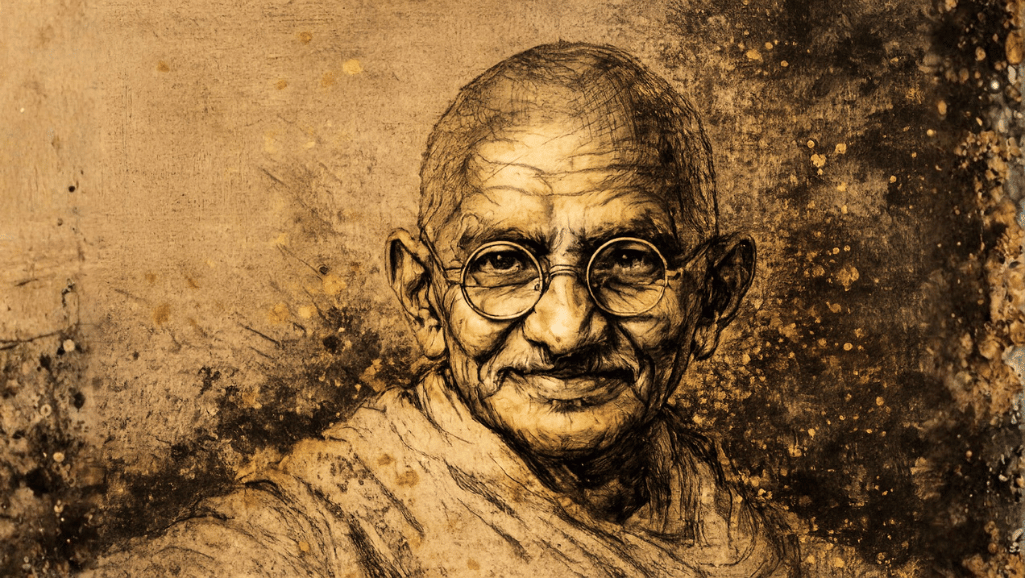
In a moment like this, when the stakes are so high, we would be wise to seek the guidance of Mahatma Gandhi.
This writing leans on the wisdom of planetary pattern recognition. If you’d like to know more - and why I don’t believe in astrology - read all about it HERE
Portions of this piece appeared in January 18 2026 Weekly Wrap-Up

The Original Heart-led Leader
Albert Einstein once said of Mahatma Gandhi that “Generations to come will scarce believe that such a one as this ever in flesh and blood walked upon this Earth,” such was the impact of this great man, said to speak for the consciousness of all mankind.
In 1982, Sir Richard Attenborough made a film about Gandhi’s life starring Ben Kingsley in an Oscar winning performance as the man himself, and the film still holds up now, 80 years after Gandhi’s death. Many of the iconic lines in the film have become so synonymous with Gandhi himself that, whether he uttered them as written in life or not, the spirit of the words captured the miracle of the man so perfectly that they warrant repeating below.
At the turn of the 20th century, Gandhi’s homeland of India was governed by Britain, as it had been for nearly two hundred years - a vast, ancient civilisation of hundreds of millions of Indians ruled through a thin layer of colonial officials. British authority rested on a carefully cultivated belief that order would collapse without imperial control, but in reality, the empire functioned like a siphon. Wealth flowed out; obedience flowed down. The entire system ran on Indian labour, Indian compliance, Indian belief, not unlike modern America, where working-class citizens keep the country afloat while the wealth flows upward to Trump and his billionaire backers.
Gandhi’s response to this arrangement began with a simple observation. “One hundred thousand Englishmen cannot control three hundred and fifty million Indians if those Indians refuse to comply,” he noted.
Gandhi began breaking unjust laws publicly, peacefully, and with complete willingness to be arrested. He refused to resist authority, but he also refused to obey it, and the British didn’t know what to do with a man who courted imprisonment without defiance or fear. His acts of non-compliance soon caught fire and became a national movement.
Eventually, Britain pushed back by passing the Rowlatt Act in 1919, allowing detention without trial. Protests erupted across India, and the response was catastrophic. At Jallianwala Bagh, British troops fired into an unarmed crowd, killing hundreds of men, women and children, and the massacre shattered any remaining illusion of benevolent rule, as the nation erupted in fury toward its colonial masters.
But even if the face of horrific violence, Gandhi pleaded with his people not to answer brutality with retribution. “We must respond not with violence that will enflame their will, but with a firmness that will open their eyes,” he implored. He knew violence would give the empire exactly what it wanted - justification. “An eye for an eye only ends up making the whole world blind,” he warned. Firmness, not fury, was the path forward - a resistance disciplined enough to expose injustice rather than enflame it.
Gandhi called on Indians to peacefully withdraw from the empire entirely - boycott British goods, leave colonial jobs, and withdraw from British schools and courts. He believed if people stopped buying what the empire sold, stopped working where it profited, and stopped obeying laws that violated conscience, the system would collapse under its own weight. No dramatic overthrow was required - only mass withdrawal. Millions responded, and the empire began to grind down, not from attack, but from absence.
Gandhi risked his safety and his freedom again and again through his acts of non-compliance, telling his followers, “They may torture my body, break my bones, even kill me. Then they will have my dead body, but not my obedience.”
“In this cause I am prepared to die,” he declared, “but there is no cause for which I am prepared to kill. Whatever they do to us, we will attack no-one, kill no-one. They will imprison us. They will fine us. They will seize our possessions. But they cannot take away our self respect if we do not give it to them.”
Resistance, as Gandhi understood it, was its own form of fighting - not against flesh and blood, but against anger, fear, and moral collapse. “I am asking you to fight against their anger - not to provoke it. We will not strike a blow, but we will receive them,” he said, “and through our pain we will make them see their injustice.”
The true turning point came when the British taxed salt - a basic necessity of daily life. Gandhi did not write a manifesto or call for revolt. He simply started walking, two hundred and forty miles, all the way to the sea. And there, he made salt himself. The act was simple, symbolic, and technically illegal, but almost impossible to suppress without revealing the cruelty of the law itself. “Make the injustice visible and be prepared to die like a soldier doing so,” Gandhi said.
The response was predictable - arrests, beatings and imprisonment - but the damage was done. Millions followed him to the sea and the law collapsed. British authority cracked, not through violence, but through disciplined refusal.
What Gandhi demonstrated in that moment was something far more dangerous to power than revolt: the peaceful withdrawal of consent. He showed that empires do not fall when they are attacked, but when they are no longer participated in.
Opposing Without Becoming
Gandhi speaks to this moment not by asking us to be gentle, quiet, or agreeable, but by reminding us to go beneath the reflexes of the mind to the place where power actually lives and wisdom truly resides. He did not fight the British Empire on the battlefield of ideology, outrage, or dominance - he refused to meet it there at all.
Authoritarian systems operate almost entirely through the mind, trafficking in fear, narrative, and reaction because these are the tools that keep people mentally engaged and emotionally volatile. Violence serves this purpose perfectly: it justifies escalation, allows repression to masquerade as order, and keeps resistance trapped in the same mental arena as the oppressor. Gandhi understood with terrifying clarity that the moment resistance becomes reactive, the regime has already won.
What Gandhi offered instead was not passivity, but a radical shift of operating system. While empires govern through the mind, he led through the heart. He withdrew consent at the level where fear cannot reach, and in doing so, denied power its oxygen.
When a government begins abducting civilians in unmarked vans, shooting people in the streets, suspending due process, and calling it “order,” the mind’s impulse is to meet force with force, to escalate, to rage, to fracture. Gandhi’s lesson is sharper than strategy: do not give a collapsing system the mental engagement it needs to justify itself. Do not meet it in the mind. Step beneath it, into the heart, and withdraw cooperation from there.
Do not amplify its lies.
Do not normalise its language.
Do not internalise its fear.
Do not obey directives that violate conscience.
Do not offer moral cover to violence masquerading as governance.
These are not moral gestures - they are acts of heart-based clarity.
This does not mean inaction. It means heart-led action: collective non-compliance rooted not in chaos, but in coherence. Gandhi walked willingly into prisons because he understood that when injustice is made unmistakably visible and met with calm, unwavering refusal, the mind of the system collapses under the weight of its own contradiction.
In America today, the test is not whether people are angry enough - anger is abundant. The test is whether we can remain anchored in the heart while refusing to cooperate with brutality, whether we can oppose without becoming, and deny an unraveling regime the emotional volatility it feeds on.
Gandhi did not defeat the British Empire by matching its brutality with his own. He rendered it obsolete - exposing it as morally hollow, logistically unsustainable, and spiritually bankrupt. He did not overthrow it - he transcended it.
And that is the invitation of this moment: not to burn the world down in rage, but to step out of alignment with systems that have already collapsed inwardly, and to do so with enough coherence, courage, and collective resolve that their violence is revealed for what it is - the last reflex of a power that no longer knows how to rule.
Aquarius Season & the Genesis Reset
Right now, we’re walking through Aquarius season, and there is nothing more Aquarian than the story and the strategy of Gandhi.
Aquarius is the sign of withdrawal over confrontation. It doesn’t storm palaces - it starves them. It refuses to play by the rules of the old empire. It steps sideways, out of alignment with systems that no longer deserve our energy. Sounds a lot like Gandhi - he didn’t defeat the British Empire by fighting it, but instead rendered it obsolete. He didn’t outwit the empire of the mind - he stepped into the heart and, in doing so, outplayed it entirely.
Gandhi’s worldview was profoundly Aquarian, and revisiting his life and legacy as we enter this month - and this wild time in history - seems more than fitting.
He was a master of moving beyond the mind’s impulses. He knew the mind, sensing its own impermanence, often reaches for self-protection - lashing out, escalating, matching force with force - and he understood that retaliation only strengthened the oppressor, who counted on the mind to take the bait.
Gandhi was tuned to a deeper signal. He knew nothing was gained by playing along with the empire’s mind games of fear, and that while the mind wanted to fight, the heart spoke more softly, and simply withdrew.
Collectively, we’re caught now in that same battle between mind and heart. The mind wants to lead, as it always has, but more and more, reality is slipping beyond what the mind can hold.
So much of what we’re seeing now in the world feels unreal. It’s like reality can’t keep its story straight anymore - because it can’t, at least not within the mind’s framework. The details of this moment exceed what we’ve been taught reality is allowed to contain.
If it feels like you’re going out of your mind, you’re not actually going mad - it’s just that reality is no longer broadcasting on the bandwidth of the mind. If you try to tune in that way, all you’ll find is pain - not because you’re broken, but because the signal is moving. To walk forward in peace, we have to tune in with a different apparatus.
Only the heart can hold what’s coming next, and Gandhi shows us the way.
Aquarius season isn’t causing this shift in signal, it’s just the clearing before ignition. It’s the moment we disentangle, like the breath before the fire. It teaches us how to step back from systems that have outlived their soul and shows us how to withdraw our consent and starve false power of its lifeblood: participation.
And it leads us straight to the Genesis Reset - the end of February, when Saturn and Neptune converge in Aries. If you want to know more about this transit, you can read about it below:

As a quick overview:
Aries says: Existence begins here.
Saturn says: Make it real.
Neptune says: The old illusion is dissolving.
Put them together, and you get a total rewiring. A shift in the broadcast. A new energetic architecture that can no longer be navigated with the old mental map. It’s a turning point, where we stop reacting from the mind and begin receiving from the heart.
As the old signal collapses, those anchored solely in the mind will feel destabilised, frightened, and unmoored, but those willing to enter the heart, and act from its coherence, will discover they are not lost, but aligned.
This is the path Gandhi lights up for us now, reminding us we’re not here to scream into the void, but to withdraw our consent from it. And once the old world is starved of that consent, something new must be born.
Aquarius asks us to withdraw.
Aries will ask us to begin.
That is the path we are walking now, lit by the wisdom of Gandhi, the original heart-led strategist.
Gandhi’s Heart-Led Path
Gandhi didn’t rush into swift action, reacting to what he opposed with urgency that demanded immediate extermination. He sat in stillness first. He took the slower path of peace, and often, the price was prison. It took Gandhi approximately three decades of sustained non-compliance to lead India to independence from British rule.
Gandhi knew the mind loves a sprint, but the heart doesn’t mind a marathon. He also understood something we’re just beginning to remember: that the first battlefield is within, and the first act of power is choosing not to react. When injustice roared, Gandhi didn’t shout back. He listened. He waited. He moved only when the heart gave clear instruction, and when he moved, it was with the force of a thousand souls aligned.
In this moment, you may feel the pull to act, to post, to argue, to fight, to do something, because the mind is unsettled and wants a release valve. But this is not a moment for impulsive reaction. This is a moment for inner anchoring.
Before you respond to the world, return to your centre.
Before you take action, touch the stillness beneath the storm.
Before you speak, wait for the wisdom that doesn’t come from panic or rage, but from deep, coherent clarity.
This is not a call to silence - it’s a call to source.
When you move from the heart, you don’t just react to the world.
You help to rewire it.
So pause.
Breathe.
Listen.
Let stillness be the place your power begins.
That is the Gandhi way.
And it is the path of the heart-led revolution we are now being called to walk.

My intention in my writing is to lessen the climate of fear around world events by offering clarity and cosmic context for what’s unfolding; to bring context to the chaos. I believe our highest calling right now is to anchor in the vibration of love & truth and call in a more beautiful world, and to do that, we must lean out of fear. I hope you read this with an open, uplifted heart.




You bring such important and conscious insight to this pivotal moment in history. Thank you!
Re-Sourcing and Stillness my impulse right now… thank you as always for your brilliant clarity and insight 🤗🦋🕊️🩵💚