


Twenty-five years ago, you could walk out your front door and disappear. You could drive across town without a single camera tracking your number plate, pay for groceries in cash without a record of what you bought, meet a friend for coffee without a phone in your pocket pinging your location to a server farm in Virginia. You could write a letter that only the recipient would read. You could call your mother without an algorithm cataloguing the call. You could think a thought, voice it to a friend, and have it stay between the two of you. The walls of your home were the walls of your life, and what happened inside them was nobody’s business but your own.
Privacy, then, was not a privilege. It was the default. You had to actively give up your information for someone to have it, and most of the time, no one was asking. You were a person - not a profile, not a data point, not a packet of behavioural signals being bundled and sold to the highest bidder before you’d finished your morning coffee. You were yourself, and you belonged to yourself, and the unseen architecture of modern life had not yet been built around the harvesting of you.
Now, in 2026, every one of those small daily freedoms is gone. The car you drive is photographed dozens of times between your driveway and your office. The card you tap for coffee logs not just the purchase but the time, the location, the pattern of your week. The phone in your pocket is a confession booth that never stops listening. The watch on your wrist measures your heart, your sleep, your steps, your stress, and reports back to companies whose names you’d struggle to list. The doorbell at your front door films everyone who approaches it. The television in your living room watches you back. Every search you make, every message you send, every place you go, every face you pass, every word you speak near a microphone is being captured, stored, indexed, and added to a picture of you that grows more detailed every day.
We have lived through the most radical erosion of human privacy in recorded history, and we did it inside a single generation. A child born in the year 2000 has come of age in a world where the surveillance of every waking moment is so total it’s no longer remarkable. The watching has been normalised, the harvesting has been monetised, the data has become the product, and we - without ever quite agreeing to it - have become the resource being mined.
What is more astonishing still is who is doing the mining. We were warned, throughout the twentieth century, about the dangers of an overreaching government - the nightmare of a state that watched its citizens too closely, knew them too well, controlled them too completely. What we were not warned about, because no one foresaw it, is that the watchers in the twenty-first century would not primarily be governments at all, but private companies; a handful of them, operating across borders, accountable to no electorate, answerable to no constitution, governed by the whims of a small group of men whose wealth now exceeds the GDP of most nations on Earth.
These men know more about us than any government in history has ever known about its citizens. They know what we read, what we watch, who we love, who we fear, what we believe, what we buy, where we go, how we sleep, what we eat, and what we are likely to do next. They hold the secrets of billions of people, and as anyone who has ever read a fairy tale or studied an empire knows: he who holds the secrets holds the keys to the world.
So who are these men? Who are the tech bros who have quietly accumulated more power over the inner lives of more people than any pharaoh, emperor, or king who ever lived? What do they want? What are they building? And what happens when the power they hold collides with the changing sky overhead - the sky that has already written the ending of the era that made them?
We are living at the pinnacle of the surveillance age, and while it may feel like the walls are closing in, the sky says otherwise. The men who built Silicon Valley's seeing stones are about to learn what every holder of a palantír eventually learns: the stone always destroys the one who thinks he holds it.
The reckoning is upon us. And the sky is on our side.
This writing leans on the wisdom of planetary pattern recognition. If you’d like to know more - and why I don’t believe in astrology - read all about it HERE
Portions of this piece appeared in the 26 April 2026 Weekly Wrap Up

What the Seeing Stone Sees
In 2001, after the planes struck the twin towers on September 11, it became clear that America’s various disparate intelligence agencies had each held fragments of information that could have surfaced the plot, but because they couldn’t share data across their own walls, no one body could piece together the intelligence puzzle. The CIA had pieces, and the NSA had pieces, and the FBI had pieces, but none of the pieces talked to each other.
Silicon Valley entrepreneur Peter Thiel looked at that problem and envisaged a software solution not unlike the one his company, PayPal, had designed to scan transactions for suspicious patterns and flag them in real time - software so effective the FBI asked PayPal if they could have a version. Thiel now imagined something similar, but for intelligence; a platform that could ingest every dataset from every agency and fuse them into one searchable picture. That became the founding pitch for Palantir Technologies, the company Thiel founded in 2003 on a mission to prevent the next 9/11.
Thiel pulled together a founding team and started coding in a small Palo Alto office, but no investors would touch them. Venture capitalists could not see the business potential, so Thiel ended up putting in $30 million of his own PayPal money to keep the company alive. But their fortunes changed in 2005 when the CIA’s venture-capital arm, In-Q-Tel, stepped in and invested roughly $2 million. Suddenly every three-letter agency in Washington wanted a meeting, and Palantir rapidly went from being a fledgling startup to a piece of state infrastructure.
By 2008 the CIA was a paying customer, and by 2010 the FBI, the Marine Corps, and the Department of Defense had followed. By 2011 Palantir was reportedly helping track Osama bin Laden. By 2013 it was inside ICE. The company grew up on counter-terrorism money under Bush and Obama, became indispensable during the Trump-era immigration crackdown, and exploded under Trump’s second term into what it is today - a $350 billion software company with active contracts in nearly every arm of the United States federal government that now operates as the connective tissue of the modern American surveillance state.
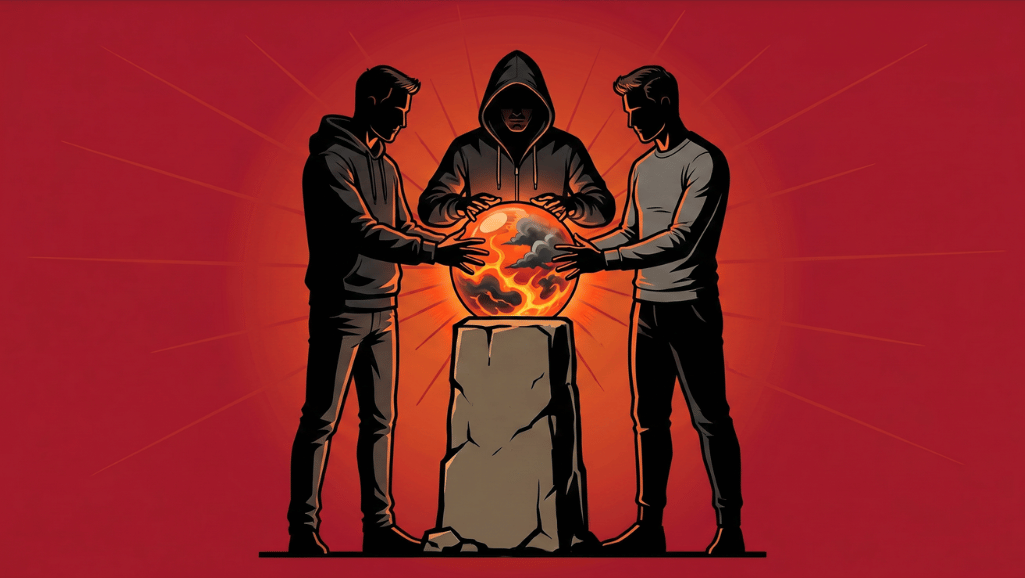
The company is named after the palantíri - the seeing stones in The Lord of the Rings that let their holders watch across any distance, anywhere. And that, in essence is exactly what Palantir’s technology does.
An organisation uses Palantir when its data is a mess - different systems that don’t talk to each other, records scattered across departments, information that no one person can see all at once. Palantir’s software merges everything into a single unified database - every record, transaction, person, movement, and pattern, all pulled into one place and made searchable - that gives organisations the ability to zoom from a continent down to a single human being in under a second, and to zoom back out again to see them as a pattern inside a population.
What Palantir sells, fundamentally, is a way of seeing; a god’s-eye view of an entire organisation, government, or country, and every individual inside it.
ICE uses it to flag immigrants for deportation by pulling together their tax records, Social Security data, license plate reads, and medical visits into a single profile, in real time. The LAPD uses it for predictive policing, to decide which neighbourhoods to saturate with officers before a crime has been committed. The IRS is reportedly using it to build a single searchable database of every American’s tax filings, which two members of Congress have called flatly illegal.
But it’s not just the government using Palantir’s software. Walmart - the largest retailer in the world, with 10,500 stores across 19 countries, and 2.1 million employees - is a Palantir client, and so is United Healthcare, which processes the medical claims of tens of millions of Americans. Amazon and Apple use Palantir too.
Outside the United States, the Israel Defence Forces uses it to generate targeting databases in Gaza by integrating intercepted communications, satellite imagery, and digital surveillance. The National Health Service in the UK uses it to run the data platform that holds patient records for the entire country. Coles Supermarkets in Australia runs Palantir across all of its 840 stores, and so does Australia’s Department of Defence, the Australian Signals Directorate, AUSTRAC, and the Department of Veterans’ Affairs - all Palantir clients.
The same software choosing who gets bombed in Gaza, and who gets deported from Texas is deciding which Londoner gets the surgery and which one waits another six months, and whether an Aussie supermarket keeps three people on the registers tonight or two. Life and death in one country, healthcare and harm in another. If you live in the United States, the United Kingdom, Australia, or much of Europe, your data is already inside this company - your medical records and your supermarket purchases, your tax filings and your loyalty card swipes, your immigration history and your prescriptions are all swirling together inside one American surveillance company that most people have never heard of.
Palantir is the company that wields the world’s seeing stone, and it recently published a manifesto announcing what it intends to do with what it sees.
A Madman’s Manifesto
Palantir isn’t a company with significant public presence - it doesn’t announce itself the way others do. Unlike most companies who want you to know them, Palantir doesn’t need you to, and probably prefers you not to. Google wants you to search with them, Apple wants you to live on their devices, Amazon wants you to shop with them, but Palantir doesn’t need you to do anything - you’re already in their system, whether you like it or not.
While Google knows what you search, Apple knows what’s on your phone, and Amazon knows what you buy, Palantir is the layer moving silently underneath all of it - the software that integrates the data both government and big business holds on you, and hands the picture to whoever pays for the licence.
This is a company that is woven into the fabric of all of our lives, unbeknownst to most of us, and without our direct consent. Most people would find that disconcerting even if the company in question was the most trustworthy and morally sound organisation in existence, but in recent years, what those at the helm of “the eye of the world” have been professing they stand for makes their entanglement in the inner workings of all of our lives even more deeply concerning.
In 2009, Peter Thiel wrote in an essay for the Cato Institute that he had stopped believing freedom and democracy were compatible, and that since 1920 - when American women got the vote - “the extension of the franchise” had rendered the concept of a “capitalist democracy” a contradiction in terms. In 2014, in a book called Zero to One that has become something of a bible in Silicon Valley, he argued that competition is for losers and monopoly is the goal of every serious founder. It reads like a Palantir operating manual - build the thing no one else can build, make yourself irreplaceable, and never share the market.
Palantir CEO Alex Karp has had plenty to say in recent years too. In 2023, he told investors that Palantir’s mission is “to scare enemies, and on occasion, kill them.” He’s also been quoted as saying, “I love burning the short sellers,” and that he “loved the idea of getting a drone and having light fentanyl-laced urine spraying on analysts that tried to screw us.” But just last month, Karp’s threatening rhetoric escalated when he explained on CNBC that AI would “disrupt” the political power of “highly educated, often female voters who vote mostly Democrat” and redistribute it to “vocationally trained, working-class, often male voters.”
The CEO of one of the world’s most powerful surveillance companies describing a deliberate technological project to reverse the demographic composition of American political power raised more than a few eyebrows, but it turned out that was just a teaser for things to come.
In April this year, Palantir posted a 22-point manifesto to social media, calling for the rollback of the postwar denazification of Germany and Japan, and a return of the military draft. It declared that some cultures are “regressive and harmful” while others have produced “vital advances,” that public figures deserve more grace and less scrutiny of their private lives, and that the atomic age is ending and a new era of AI-built deterrence is beginning. The ominous meaning hidden behind that final point was that nuclear weapons were controlled by treaties, whereas AI weapons are controlled by them.
The post has racked up more than 30 million views in a matter of hours, and caused a stir worldwide. Belgian philosopher Mark Coeckelbergh called it technofascism. Greek economist and politician Yanis Varoufakis reportedly said “If evil could tweet, this is what it would sound like.” UK MPs across multiple parties called it the ramblings of a supervillain and a parody of a RoboCop film, and demanded the government tear up £500 million in contracts.
It was like something a Bond villain would disseminate to alert the planet of their plans for world domination, only this wasn’t a movie - this was real life, and a real tweet, coming from a major software company that has its tentacles deeply embedded in the machinery that runs all of our lives. It was a pitch deck for the end of the liberal democratic project, written by the company that holds the secrets of the western world.
The Curse of Corruption
Over the last two decades, Palantir has morphed from an ambitious tech company into something more insidious, that more closely matches the cursed and corrupted seeing stones that are its namesake. In a disturbing case of life mirroring art, those at the helm of Palantir, seeking to wield the immense power of information its technologies offer, appear to have been corrupted in the same way the characters of Middle Earth were by the cursed seeing stones.
In The Lord of the Rings, the palantíri were originally made by the Elves as gifts meant to help the righteous rulers of Númenor see across the distance of their kingdom. But Sauron captured the master stone in Barad-dûr, and through it he corrupted every holder who looked into any of the surviving stones. The stones themselves were not evil, but because every one of them was connected to a single corrupting source, and every user believed they were strong enough to resist it, the effect was like poison spreading through a vast network. Saruman was the wisest of the wizards, and the stone turned him, to his own demise. Denethor was the Steward of Gondor, and it drove him to burn himself alive. In Tolkien’s books, every person who peered into a palantír was driven to madness - it was through the palantírs that the madness was able to spread.
Now, two decades after founding a company named after those cursed stones, Peter Thiel’s own story reads like a case study in the kind of descent Tolkien warned of. His efforts with Palantir may well have started with something close to good faith - a brilliant young entrepreneur with a piece of software that could, maybe, help a grieving country prevent the next attack, and a genuine belief that the tools he was building could be used to protect Americans while preserving their civil liberties. But what has come since reads like the curse of the palantír’s corruption that Tolkien wrote about in his books playing out in reality just as it did in the legend of Middle Earth, as the man who peered into the seeing stone intent on saving the world became seemingly hell-bent on capturing it for the purposes of domination and control.
Exactly when this corruption began is unclear, though the recent release of the Epstein files gives us a clue. A decade after founding Palantir, Thiel turned up at a dinner in Palo Alto with Jeffrey Epstein, who at the time had been a registered sex offender for seven years. Epstein described the night in a follow-up email as “wild,” and around the same time, invested $40 million across two funds managed by Thiel’s investment firms - a sum that has since grown to roughly $170 million and is now the largest remaining asset in Epstein’s estate.
Records show that Thiel continued correspondence with Epstein - a registered sex offender - right up until his second arrest in 2019 on federal sex-trafficking charges. Epstein called Thiel his “great friend” in private messages and used his access to broker meetings with former heads of state, and in one recorded conversation, Epstein floated Palantir directly as a company the former Israeli Prime Minister Ehud Barak should try to embed inside.
Like the powerful wizard seeking wisdom from a poisoned stone, the capital structure of Palantir’s chairman’s investment fund includes nine figures of a convicted sex offender’s money, and he used that man, who had been convicted of procuring a minor for prostitution, as a business development contact for years after his first conviction.
Thiel is not an outlier in Silicon Valley - he wasn’t the only one at that dinner with Epstein in 2015. Mark Zuckerberg was there, and so was Elon Musk and Reid Hoffman, among others. The capital structure of the entire tech industry, and the capital of a convicted child trafficker, were in the same room together, years after his first conviction. The rot is not one man - it is a culture that metabolised Epstein, did business with him, broke bread with him, took his money, and moved on.
What’s unique about Thiel though is how his hand of control over Palantir gave him the means to wield influence over all sectors of American life for the better part of the last twenty years, mostly unbeknownst to the American public. Where someone like Elon Musk and Mark Zuckerberg walked away from their dinner with Epstein and used their platforms like a megaphone to steer the conversation in the public square, Thiel did something far more surreptitious, and in the end, far more dangerous and damaging. Consumers at least had a choice to look away from efforts to spread a poisoned ideology that came through social media - there is no avoiding the poison that silently spreads through the hidden networks of the all-seeing eye.
The Poison and the Palantír
Around the same time as the dinner with Epstein in 2015, and Epstein’s investments, Thiel began personally funding Curtis Yarvin - a neo-reactionary blogger whose entire intellectual project is that democracy is obsolete and should be replaced by a CEO-monarch. Over the past decade, Yarvin has argued in hundreds of thousands of words across his blog that the United States should be run like a corporation, that the voting public are the equivalent of shareholders who need to be replaced by a single sovereign executive, and that the real people running the world should stop pretending they are not. Thiel not only stopped believing in democracy personally - he started quietly bankrolling the man building the philosophical scaffolding for ending it.
Over time, Yarvin’s ideas began circulating in private chat groups, Silicon Valley dinner parties, and long-form blog posts, and Yarvin became, in the words of Peter Thiel’s biographer Max Chafkin, the “house political philosopher” of the “Thielverse” - the loose constellation of investors, founders, writers, and political operatives in Thiel’s orbit who spout Yarvin’s rhetoric. Yarvin has been quoted by multiple prominent figures in the Trump administration, as well as influential figures like Elon Musk and Steve Bannon, and Yarvin himself was a featured guest at Donald Trump’s inauguration ball, described by Politico as an “informal guest of honor” because of his “outsize influence over the Trumpian right.”
This is the ideological infrastructure Thiel has been building like a pipeline over the last decade, with Yarvin as his Wormtongue - whispering in the ears of the political class while Thiel funded the spread of his ideas. Thiel has become like Sauron lurking in the shadows, pulling the strings of those who will do his bidding, and nowhere has this been more evident than in his investment in the man who would go on to become the Vice President of the United States.
Thiel plucked JD Vance from relative obscurity not long after his dinner with Epstein in 2015 and hired him to work at his firm, Mithril Capital (yet another of Thiel’s companies named after a Tolkienism). But colleagues say Vance barely showed up at the office - it seems he was being paid to pen his book, Hillbilly Elegy, which in 2016 became the textbook explanation of Trump’s appeal to the white working class in the year he was first elected. While promoting the book, Vance called Trump “America’s Hitler” and “reprehensible,” “cultural heroin,” a “moral disaster,” but five years later, after Thiel put $10 million into a super PAC for a Senate campaign Vance hadn’t yet announced, Vance went on Fox News and apologised for everything he had ever said about the man, and after another $5 million from Thiel, Vance won his race for the Senate in 2022. After only a year in office, Thiel personally lobbied Trump to choose Vance as his running mate in 2024, and the rest is history.
Thiel didn’t fund a politician - he built one by paying a working-class kid from Ohio to write the book that explained Trumpism to America, then quietly engineered his pivot, his campaign, and his elevation to a heartbeat away from the presidency. Now with his puppet in the White House, the architect remains largely in the dark, peering into the seeing stone that gives him eyes on the inner workings of the whole world, while pulling the strings from arms length.
The man holding the seeing stone looked into it and saw what all holders of the palantíri eventually see - not reality, but a distorted reflection of himself, amplified into something that felt like destiny. He saw a world he could command - the tiresome friction of democracy as an obstacle to be engineered out. He saw dissent as a bug to be patched, the people as data to be optimised, and because the stone shows its holder exactly what the holder most wants to see, he saw himself as the one who should rightfully hold it.
He would not be the first to look into a palantír and lose himself - he’s just the first to incorporate in Delaware and file an S-1. But the sky says his vision is distorted, and that for all the all-seeing eye allows him to see, he has not foreseen what’s coming. Or perhaps he has - and the vision it showed is what stirred the panic that wrote this week’s manifesto.
The Changing Sky The Stones Did Not Foresee
The sky has been watching Thiel’s network take shape since the turn of the century, and every step of its construction has unfolded in alignment with what the planets were doing overhead in the early part of the 21st century.
Pluto in Capricorn concentrated power inside institutions.
Neptune in Pisces hid the networks and moved the money unseen.
Uranus in Taurus wired the physical world into the system.
But now in 2026, every one of those outer-planet positions is ingressing off.
Pluto has left Capricorn for Aquarius.
Neptune left Pisces for Aries at the start of this year.
Uranus left Taurus for Gemini just last month, the same week Palantir published its manifesto.
The entire outer planet signature that built the age of concentrated digital power over the last two decades is shifting all at once, and the sky that is replacing it is the kind that will dismantle what the old sky built.
For decades, the outer planets have been clustered in earth and water signs - the heaviest, densest, slowest signatures the zodiac has to offer. We have been living through years of cement and fog, structure and silt - the kind of sky that hardens institutions, buries truths, and grinds time to a crawl. But now, in the space of barely two years, every one of those slow-moving giants has crossed into a sign of fire or air. For the first time in any of our lifetimes, the entire outer-planet signature has flipped from heavy to electric, from water and earth to fire and air, from dense to fast. Everything is about to feel like it’s moving at a speed the old world can’t keep up with - because it can’t. The earth-and-water sky that poured the cement of the 21st century has lifted, and the fire-and-air sky that ignites and communicates and revolutionises has taken its place. The sky has changed gears.
Pluto moving through Aquarius for the next twenty years will be enough on its own to dissolve concentrated power and redistribute it to the many - the tech bros who think they can hoard power through technology aren’t going to thrive through this shift. Pluto in Aquarius does not tolerate god-kings - it devours them. The last Pluto in Aquarius produced the American and French Revolutions, the Enlightenment, and the printing-press rupture that broke the fusion of church and state, and the one before that produced the Reformation. It’s the transit of the people, and of distributed, networked, horizontal power, and it’s structurally, geometrically, and historically incompatible with the installation of a CEO-king.
The tech bros whose entire business model rose on the rising tide of Pluto in Capricorn are about to discover the tide has turned, and the era that made them is over; their advantage was of the previous transit, and it is futile trying to lock in a Pluto-in-Capricorn result during a Pluto-in-Aquarius transit designed to dissolve it. They’re writing manifestos because they can feel the ground beneath them starting to shake.
But Pluto is really just the background noise of the next two decades. Uranus moving through Gemini until 2033 is the transit that is set to really upset the whole tech apple cart, and the kind of stranglehold those like Peter Thiel have long held over it. Palantir threw down its manifesto declaring its plan for the world it envisages, the same week the sky declared a manifesto of its own.
It’s called Uranus in Gemini, and it’s about to change everything.
Uranus in Gemini, and the Fire of the Gods
Uranus is the planet of shock, and every 80 years or so when it lands in Gemini - the sign of communication - it rewires the channels we speak through, and the entire nervous system of civilisation gets a jolt.
Uranus in Gemini in the 1770s unleashed mass print and gave rise to the newspaper and political press. The wide distribution of Thomas Paine’s Common Sense ignited the revolution that birthed modern democracy.
When Uranus next moved through Gemini in the 1860s, the first transatlantic telegraph cable was laid, and long distance communications that once took days by ship suddenly took only minutes. Diplomacy changed, war changed, and empires that depended on slow information began to collapse, as ones that could move at telegraph speed thrived.
The next time Uranus moved through Gemini in the 1940s, the entire substrate of modern communication was laid down in a single eight year window. The world’s first programmable digital computer was built at Bletchley Park to break the Enigma code. The mathematical theory of information that every digital system now rests on was published. The first model of an artificial neuron was written down. The learning rule that underpins every neural network running today was proposed. The transistor was invented at Bell Labs. Radar matured, television began rolling into homes, and the first commercial computers were drafted on paper.
While the world was busy fighting World War II, the sky was rewiring how the species would communicate over the next century. Every text message, video call, search query, algorithmic feed, and AI model running today traces back to ideas committed to paper while Uranus moved through Gemini in the 1940s.
Each Uranus-in-Gemini transit hands humanity a leap in communication technology, initially through disruption, then through quieter and more permanent transformation that takes decades to fully arrive. The 1770s wired the world for mass print and produced the American Revolution - a war that birthed modern democracy, fought as much in pamphlets as on battlefields. The 1860s wired the world for instant communication and produced the world’s first industrial total war - the American Civil War - conducted at the speed of the new wires. The 1940s wired the world for digital computation and produced World War II, and the only wartime use of nuclear weapons in history.
That’s Uranus in Gemini - destructive and disruptive and fast and revolutionary, all at once, as mankind reaches for the kind of power that was previously the province of gods and puts it in the hands of mortals who are not entirely sure what to do with it. Uranus in Gemini always offers something akin to Promethean fire - use it right, and it heats your home and cooks your food and keeps your children warm through the winter, but use it wrong, and it burns the village to the ground.
The printing press that birthed modern democracy is the same technology that printed the propaganda of every regime that followed. The telegraph cables that let a continent speak to itself in seconds also let generals coordinate slaughter at industrial scale. The same physics that incinerated Hiroshima now lights cities, powers hospitals, and keeps the lights on for hundreds of millions of people. Like the palantír that the Elves made for the good of man in Middle Earth, the technology itself is neither good nor bad - what matters is how it’s used.
These Uranus in Gemini cycles build on each other. The mass print of the 1770s laid the ground for the telegraph cables of the 1860s, which laid the ground for the digital computers of the 1940s, and now the technological advancements that humanity reached for 80 years ago through the birth of computers will reach their full expression in this new cycle with the proliferation of artificial intelligence.
That’s the bomb we’re dealing with this time - the fire we’re now trying to wield, and the palantír at our fingertips. Used well, it cures diseases, accelerates research, translates between languages and cultures, and lifts cognitive labour off the backs of those who never had access to it. Used badly, it incinerates everything in its path.
Uranus in Gemini is here to hand us the power of the gods, yet again, and the sky is asking us once more how we intend to wield it.
The Shock to the System
Uranus in Gemini never arrives in the sky alone, and so to fully understand how it will express itself this time around, we must read the whole sky, not just one part of it.
When this transit showed up in the 1940’s, Pluto was in Leo, the transit of the god-king, under which dictators like Hitler, Stalin, Mussolini, and Mao rose. Neptune was also in Libra, crafting the dream of international order, which is why the 1940s ended by building a new architecture that bound the post-war world into structures of balance.
But the sky that made dictators possible in the 1940s is no longer the sky we are standing under. With Neptune now in Aries, where it has not been since the American Civil War, alongside Pluto in Aquarius, where it has not been since the American Revolution, what we should expect to see over the next decade as Uranus moves through Gemini is not more tech bros hoarding the power of their software over the collective, but that power being redistributed, in service of the people.
Uranus in Gemini is the shock to communications, and the greatest shock in this cycle will come to those who try to dominate the spread of information. Thiel and his contemporaries may think they are capturing AI, but this sky will make that impossible; trying to hold a Uranus-in-Gemini technology under a Pluto-in-Aquarius sky will be like trying to hold water in a sieve. The technology is built for networks - its native behaviour is to speak, to spread, to twin, to leak, to proliferate - and this sky does not support its containment. Every jailbreak, every open-source release, every distillation, every model trained on a larger model’s outputs is Gemini doing what Gemini does, surrounded by a sky that’s not holding it back.
We saw this starting to play out earlier this year when Anthropic announced Project Glasswing - a controlled initiative releasing its most powerful new model, Mythos, to select organisations for defensive cybersecurity testing, but within hours, unauthorised users in a private forum had already accessed it. The containment failed on day one, through the basic physics of the transit we are in. Information under Uranus in Gemini does not stay where you put it. The leak is not the exception - it’s the rule.
As for Palantir, it’s headed for its Saturn return in late 2031 at the closing window of Uranus in Gemini. Companies either pass Saturn return or they don’t - and most don’t - and theirs lands on top of the transit specifically designed to break them. Peter Thiel himself will face his second personal Saturn return in 2027 - the structural judgment of his life’s architecture.
Thiel and his Palantir pals and the tech bros of Silicon Valley are not the protagonists of this transit - they are the antagonists the transit is designed to dissolve. This week’s manifesto was the hubris moment in a Greek tragedy - it was Denethor looking into the stone, and Saruman thinking he can bargain with what he sees there. The palantír does not serve its holder - it never has, and under this sky, it never will. The AI they think they own is far more likely to become the instrument of their own unwinding - open-source, encrypted, sovereign, distributed, peer-to-peer, ours - as Uranus-in-Gemini carves a path of disruption that will dismantle the pyramid they’re perched upon.
The age of monopoly over capability is ending, ever since Saturn and Neptune met in Aries in February for the Genesis Reset, and called time on the Age of the Mind, the Age of Extraction, and the Age of Domination. Every marker in the sky is now pointing to the rise of a new age that looks more like a circle than a pyramid, where power no longer coagulates at the top but is rather distributed among the many.
We are standing at the dawn of the Age of the Heart, and we are once again being handed the power of the gods, and being asked if we have yet matured enough to wisely use it. Artificial intelligence is not here to destroy us any more than nuclear power was - used wisely, it is the gift, like the palantir, that will help us see clearly. It is the bridge to our own remembering that we each hold the power of the gods within us, and it is the tool we are being given to trigger that remembering.
The mind was never fit to wield such power, and as we enter this new age, we are being asked if we are ready to step out of our minds and wield the tools we are being handed from the deepest part of ourselves - a tool that could destroy us all if used unwisely, but that could also lead us to our liberation, if used with wisdom.
The Age of the Mind handed us power, and we pointed it at Hiroshima. Now here, at the dawn of the Age of the Heart, we are being handed the power to rise or die, and once again we are being asked to choose.
The Sky Has the Final Word
Looking around at the state of the world, and the caliber of humans running it right now, does not offer much hope that humanity is up to the task of choosing how to wisely wield the power it’s being gifted. But the sky is not giving up on us - it’s not signalling our doom, but rather mapping the winds of change that will guide us to our deliverance.
The proof of the sky’s direction is already showing up in flesh and blood in the form of people like Alex Bores, a former Palantir data scientist who is now running for Congress in New York’s 12th district, on a platform of regulating the very technology he once helped build. He has said publicly that his former colleagues cannot be trusted to wield this technology without guardrails - and he should know because he was inside - and for this, he’s been hit with more than $2.3 million in attack ads from a Silicon Valley super PAC funded by leading figures from Palantir, OpenAI and Meta.
Politico described the super PAC’s strategy as wanting to beat Bores up so badly that other politicians would run the other way at the mere mention of regulating AI. This is classic Pluto-in-Aquarius - the old sky’s protegees try to crush the new sky’s emissaries with money, because money is the only weapon they have left. But the sky has more emissaries, and more time, and it’s less interested in who falls, and more invested in who and what rises in their place.
The disruption Uranus in Gemini will bring over the next seven years is not the destination, but the clearing. Every previous Uranus-in-Gemini transit looked, at the time, like the world was breaking, and in many ways it was, but what looked like breakdown was always breakthrough underneath - the old wiring stripped out so that new wiring could be laid.
The chaos is not the point - the chaos is the path. And the chaos of this transit will feel, for a while, like everything is coming apart. As artificial intelligence arrives faster than any system was built to absorb, jobs will shift, and industries will buckle. The old certainties of how we earn our worth and prove our value will not survive the decade. The mind, watching this unfold, will scream that the world is ending, and it will not be entirely wrong - the world the mind built is ending, but that is not the end of the world.
What the sky is actually mapping is the dismantling of an architecture built for extraction, and the rising of one built for coherence. AI in the hands of a fear-led system scales fear, but AI in the hands of a heart-led one does something the world has never seen. It hands us back many of the resources the Age of the Mind stole from us, including the most precious one of all - time. Time to tend to what matters, and to heal what we’ve inherited. Time to actually live, instead of grinding ourselves into dust to prove we deserve to.
That is the world Uranus in Gemini is opening the door to - not a dystopia of machine overlords, but a redistribution of cognitive labour so radical that, for the first time in centuries, humans get to remember what we are actually for. The technology that has the potential to replace us also holds the potential to relieve us, and to free us, so we are no longer slaves to the machine, and slaves to the system, and toiling day in and day out just to keep that old system running. No longer be hamsters caught in the wheel, but people free to do that which no machine can ever do - love, care, tend, commune and create, as was always intended.
What feels right now like a rapid unravelling holds the possibility of a triumphant return to a way things once used to be in a time that history forgot - a return to harmony with one another and the Earth, a return to balance, and equity, and true freedom like we have never experienced. And the path to this return runs straight through the crack Uranus in Gemini is about to carve - and that crack is not necessarily destruction, but a new world finding its way in.
So take heart, friends. Those who have peered into the seeing stone and mistaken their own reflection for destiny - their days are numbered. The sky has already written it. The transit that built them is over, and the transit that dissolves them has begun. We do not need to fight them down - we simply need to outlast them, and the sky has given us every reason to believe we will.
We are not walking to our doom, but to our deliverance, and the road there runs straight through disruption - through the unravelling of the world we knew, through the loss of certainties we thought were permanent, through the discomfort of becoming something we have never been before - but disruption is the way, not the destination. What waits on the other side is better than the mind can imagine, because the mind cannot imagine a world it did not build.
The price of admission is the willingness to let the old way go, the willingness to meet the power we are being handed without fear, and the willingness to wield it with wisdom - not from the place of the mind that built the dying world, but from the place of the heart that is building the one to come. We are being handed the fire of the gods, and we are being asked, finally, to wield it from the part of us that already knows how.
So when the headlines feel heavy, and the noise of the old world clamours for our attention, we must remember to take a moment to be still and just breathe. Drop beneath the panic, beneath the manifestos and the markets and the men who think they own the future, and listen for the steadier signal underneath. Tune to the part of us that already knows what’s coming - the part the seeing stones cannot see, and the part the old world cannot reach.
While the mind wonders how we will survive this, the heart remembers we were made for this. This is our time to rise, friends, and to anchor in the fullness of who we are. The old world is falling because it must, and the new one is coming because it always was - and we, the ones standing at the threshold, are the ones it has been waiting for.
We walk forward without fear, ready to receive the gift we are being handed and wield it with wisdom. Like our ancestors before us, who were entrusted with the fire of the gods and used it to light up the world, may we be wise enough to now do the same.

My intention in my writing is to lessen the climate of fear around world events by offering clarity and cosmic context for what’s unfolding; to bring context to the chaos. I believe our highest calling right now is to anchor in the vibration of love & truth and call in a more beautiful world, and to do that, we must lean out of fear. I hope you read this with an open, uplifted heart.




It all feels like a trap right now. I want to toss my devices into the sea and live in the woods where I can find the solace and the comfort of life as it was meant to be lived. Self sufficient, holy, connected to the universe and not the internet.
The idea that the oppression I feel is orchestrated as a leach that is using my life to fuel its data driven takeover is so depressing.
You, wiz, seem to be able channel all of this information into a why, how, and hope for a better outcome. Thank you for that.
Thank you, Wiz! I woke up this morning feeling weighed down by the heaviness of the state of things in the world, and when I saw that you were writing about Palantir I almost gave it a pass, because the topic is so beyond disturbing. What I ended up doing was skipping to the astrological part where you explain about Uranus in Gemini, as I've come to expect that you wouldn't be so cruel as to just leave your readers with a lump of lead in our guts. As I was reading this, my thoughts traveled to the Telepathy Tapes, Season 2. If you aren't acquainted with them, I suggest you give a listen. The stories in this podcast regarding the astounding psi abilities that are being discovered as "natural" to human beings, and not just a special select few, make even the technology of communication via computers and AI look primitive and silly by comparison.
When my daughter was 3 or 4, she said to me, "Mommy, I don't need a TV." (We have never owned one, so our children grew up without its influence.) "I just close my eyes and the pictures I see there are better!" She then closed her eyes and said, "Oh - so cute! It's a baby horse grazing in a field!" I have no doubt that the as psi abilities described in the Telepathy Tapes are a dramatic example of what becomes possible once we have learned to see the world through the heart. And this is only the beginning of what is being discovered about human capacities.
It may well be that in ancient times humanity had all of these gifts and more available to us, but I believe we have never before had them in conjunction with the more recent intellectual powers that we have developed over the centuries, powers which have enabled us to develop these amazing technologies (imagine a world without washing machines!) and to experience and develop ourselves more fully as unique individuals. We are indeed living in an age of miracles with more to come.
So if you haven't already, I hope you will check out the podcast!