


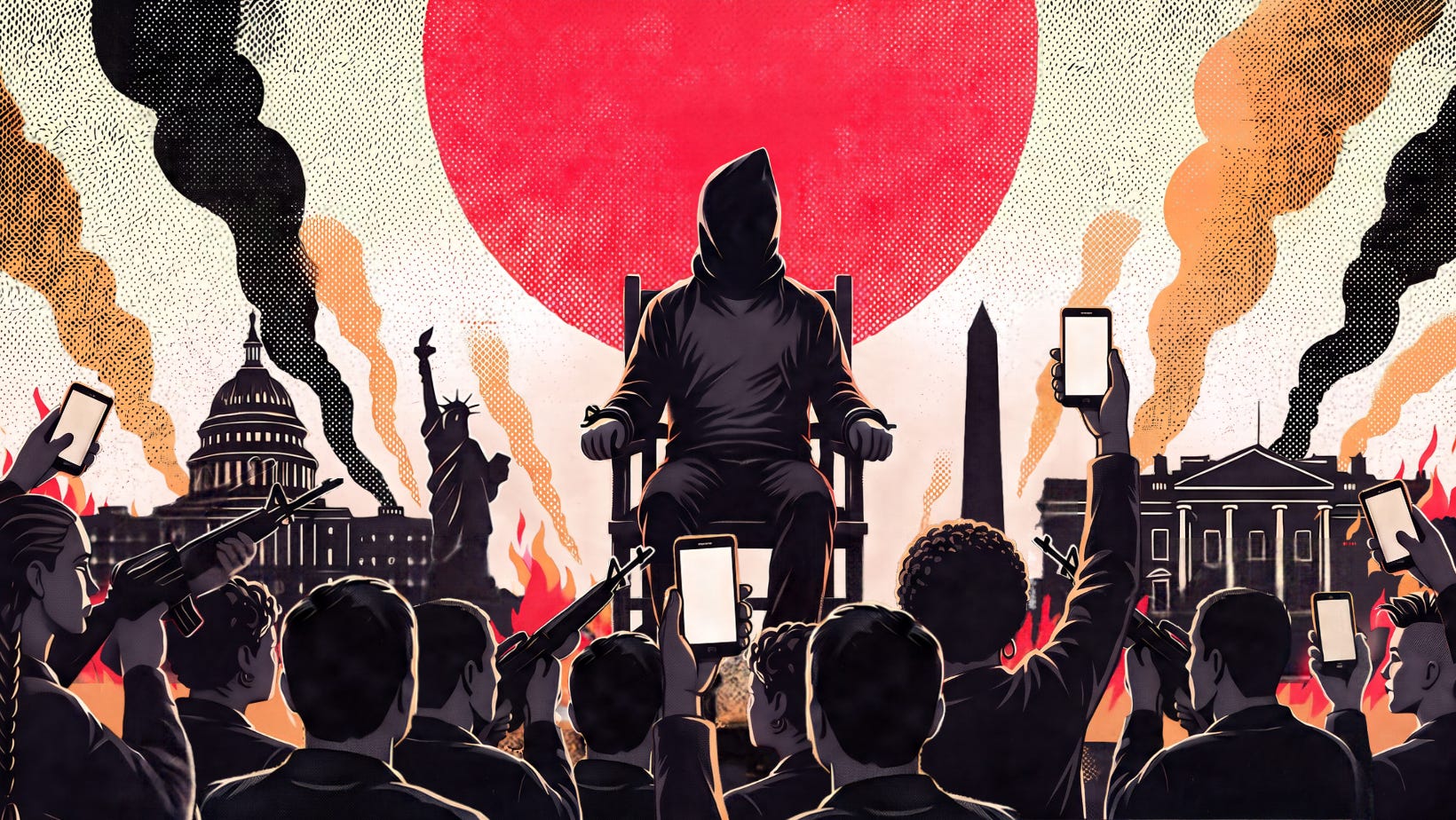
This week, everywhere we looked, pain was being passed along, from one pair of hands to the next, landing on whoever happened to be standing closest. From one side of the globe to the other, everyone seemed busy handing it on, and hardly anyone seemed willing to hold it.
With the midterms less than a month away and his approval down around 31%, Trump handed the bill for his unpopularity to the taxpayer. Seniors were promised $90, Obamacare customers $500 refunds, and he renewed his pledge of a $5,000 “Trump Dividend” for every adult if Republicans can manage to hang on to control of Congress. Voters were having none of it. Democrats opened a nine-point lead in one national poll, and House Republicans are said to be privately in “triage mode.” Trump keeps saying people should vote like he’s on the ballot, and Republicans are worried that’s exactly what they’re about to do.
As Trump crisscrossed the country, holding rallies in half-empty stadiums where he was booed and heckled, he told a crowd in Nebraska that the price of fuel was a little bit high, “a small price to pay for keeping the world safe, keeping our country safe…..They could take out a city…Let them take out Los Angeles. Let them take out San Diego.” The crowd cheered in the moment, but condemnation came swiftly from both sides of the aisle. “No American city is expendable,” said one Republican, and California’s governor called the comments “dangerous, if not treasonous.”
Then, with diesel above $6 a gallon, Trump announced he was lifting sanctions after striking a deal with Putin to buy millions of tons of Russian diesel - American money will now flow to a Kremlin that US officials say has been helping Iran target American troops in the war Trump is fighting, not to mention it will help fund Putin’s war on Ukraine.
Hours after the announcement, Russian strikes killed 20 people in Ukraine’s south-east, three of them children. “Today, Russia expressed its thanks for the lifting of sanctions on diesel exports,” Zelenskyy said, “by dropping five glide bombs on residential buildings in Zaporizhzhia.” Trump blamed Zelenskyy for America’s high diesel prices, because Ukraine keeps bombing Russian refineries, and said Ukraine needs “a new leader who can make a deal.” His envoys had reportedly already raised cutting off American intelligence to Kyiv if the refinery strikes didn’t stop.
Meanwhile, on both sides of the Atlantic, students rose up and made their voices heard. In France, the high school protests over teacher shortages kept spreading, and so did the force used against them. Nearly 7,000 people have now been arrested, most of them minors - a 15-year-old had his hand blown off, a 16-year-old may lose the sight in one eye, and a 14-year-old’s family says a tear gas canister fired at close range broke his jaw and smashed his teeth. Around 700 police have been injured too, and 24 schools have been burned or ransacked, but one French researcher called the level of force used against the students “unknown in contemporary history.”
And at Cornell University, students smashed windows and staged a seven-hour sit-in after records emerged of a fraternity “damage control” effort following the alleged sexual assault of a female student by seven fraternity brothers over several hours in 2024, when she was 20 and too incapacitated to consent. New York’s governor handed the case to the state attorney general, but online, people have been taking the matter into their own hands - first the crowd named the seven men, then another crowd turned on the young woman who sued them, and her lawyer says she’s “under siege,” with death threats and strangers trying to work out who she is.
Also in New York, ICE officers shot a man driving in a parking lot with his 5-year-old son in the back seat. The boy wasn’t hurt, and the man survived - he was taken from hospital into ICE custody that night. The officers’ body cameras were rolling, but ICE hasn’t released the footage. New York’s governor called for ICE to stand down, while Homeland Security Secretary Markwayne Mullin said, “We’re not putting a pause on enforcement.”
While the world felt like it was at war, this year’s Nobel Peace Prize was awarded to Navi Pillay, an 85-year-old South African judge who defended anti-apartheid activists, presided over the tribunal that tried the architects of Rwanda’s genocide, and later served on the International Criminal Court. Trump, who thinks he deserves the prize for peace despite instigating war with Iran, wrote: “I know nothing about this woman, and neither does anyone else,” calling the decision “an indelible stain on Norway.” The same day, his administration hit the International Criminal Court with its most sweeping sanctions yet, cutting the entire court off from American banks, American technology and the American dollar.
In the middle of it all, the man in charge of America’s military promised the country a picture it hasn’t seen in 90 years: a man put to death in public, for anyone who wants to watch.
Underneath nearly every story was the same old reflex: hurl what hurts rather than hold it, and name a villain that validates the hurling. It’s one of the oldest moves we know, and this week America offered its people a front-row seat to the oldest version of it there is. The last time it did, in a field beside the Ohio River in 1936, a whole country found out what that seat really costs. It’s a story the world has long since forgotten, but now is the time of remembering. Painful, necessary remembering.
If you’re feeling exhausted by the news or like nothing makes sense any more, or you’re worried for the future, then read on, dear friend. As always, the sky is showing us exactly what’s going on - and why - and exactly what’s coming next.
Receive this Wrap-Up in your inbox every Sunday!
The cosmic insights shared here are mapped to the real movements of the heavens during the past week. If you want to know more about planetary pattern recognition, read about it here


A thought before we begin. It’s difficult to write about world events at the moment without touching on topics that are unsettling. This week, we’re delving into some territory that may stir discomfort, so take it at whatever pace feels right, and put it down for a while if it gets to be too much. The road leads somewhere better, and the last stretch is the reason for the whole walk, so stay to the end if you can….there's light waiting there.
Death Makes a Holiday
Before dawn on Friday 14 August 1936, around 20,000 people gathered in a field beside the Ohio River in Owensboro, Kentucky to watch a 22-year-old Black farmhand named Rainey Bethea die.
People had flocked from surrounding states to witness the spectacle. Every hotel in town was full, every bar had been packed to the doors the night before, and families had thrown what the papers called “hanging parties” in their living rooms. Vendors moved through the crowd selling hot dogs, popcorn and drinks. People had brought their children.
Bethea had confessed to raping and killing Lischia Edwards, a 70-year-old white widow, in her bedroom that June, though he later said the confessions were forced out of him. He was arrested, tried and sentenced inside 18 days, and the jury took four and a half minutes to choose death. By that time, Kentucky had moved its executions indoors to the electric chair, but the town wanted a hanging - since rape was the only crime on the books still punishable by hanging, in public, the prosecutor charged Bethea with the rape and left the murder out, and the town got its wish.
The charge was chosen for the crowd. For generations, Black men accused of harming white women had been put to death in front of crowds across the American South, and the people gathering by the river that morning were the tail end of that tradition.
The sheriff of the county was a woman, Florence Thompson, a widow who’d taken over the job when her husband died earlier that year. By law the trap was hers to spring, and the national press went wild at the idea of a female hangman. Reporters and photographers poured in from across the country, but in the end she hired a former policeman named Arthur Hash to pull the lever for her, while she watched from a car.
That morning, as the sky over the river began to lighten, two deputies walked Bethea out of the jail and through the crowd, up the stairs of the scaffold where he made his last confession. They put a black hood over his head and strapped him tight, and then Phil Hanna, the veteran hangman brought in to supervise, fitted the noose and gave the signal, but nothing happened. Arthur Hash was drunk. “Do it!” Hanna shouted, and in the end a deputy leaned on the trigger himself.
The trap opened and Bethea dropped 8 feet, and his neck broke, but it was a quarter of an hour before they could pronounce him dead - a hanged man’s heart can keep beating long after the rest of him is gone. Papers reported that while they waited for the doctor’s final word, people pushed forward and tore pieces off the hood to take home as souvenirs.
Headlines rang out about the event, with one paper blazing the words “Death Makes a Holiday: 20,000 Revel Over Hanging.” Editorials called it a “carnival of sadism,” and readers wrote in to say they were ashamed of Kentucky, and ashamed of America, but whether it really was a carnival is still argued over in Owensboro. Some came away remembering a lovely day out. “Everybody went,” one man told the local library in 2013. “Everybody had a wonderful time.” But others carried a very different memory.
Rachel Abbott was a little girl in the crowd that morning, dogged by nightmares for years. “It’s like his spirit was just hanging all around me,” she said. She was still talking about it 80 years later, not long before she died. Even after all those years, she couldn’t let go of it. “That’s part of my childhood. I can’t.”
Florence Thompson was haunted by the event she herself had overseen. “I suppose I will spend the rest of my life forgetting,” she said afterwards, “or trying to forget.” But she never did. She carried it until she died in 1961, and her son said it was quite a burden on her for the rest of her life.
The nation was largely horrified by the appalling spectacle - the picture of itself that America saw in the papers that weekend was enough. Two years later Kentucky - the last state still conducting public hangings - outlawed public executions entirely, and nobody in America has been put to death in front of an open crowd since.
The gallows in Owensboro disappeared, and for the best part of a century, the town has barely spoken of it. “Wanting to suppress and deny,” said the writer Sonya Lea last year, whose grandmother had stood in that crowd as a newlywed, “wanting to silence the fact that we were a part of an event like that.” The local NAACP still calls it “a stain on our community that we need to acknowledge and not hide.”
That’s the toll of watching. It didn’t make anything better. It didn’t bring Lischia Edwards back, and it didn’t lighten anyone’s grief. All it did was pass the pain on, to a sheriff who couldn’t forget, a little girl who couldn’t sleep and a whole town that couldn’t talk about it, haunted by what they’d stood by and watched the state do to one of its citizens. And the ones who had a wonderful time carried something home too, even if they never felt the weight of it.
It was 90 years ago that a country looked at the photograph of itself and flinched at what it saw. This week, all these years later, it’s preparing to take another look.
Want the Wrap-Up sent to your inbox each Sunday?
Public Punishment
This week, Pete Hegseth, the man in charge of the American military, went on the right-wing network Real America’s Voice and said that when Nidal Hasan is shot by a firing squad at Fort Hood in December, people will be able to watch. “We’ll make sure….that it’s public,” he said. “People need to understand that there’s serious consequences for these types of things.” The Pentagon later confirmed the execution will be livestreamed.
Hasan was an army psychiatrist who walked into a processing centre at Fort Hood in 2009 and shot 13 people dead and wounded 32 more. He was weeks away from being sent to Afghanistan, had come to believe America’s wars were a war on his Muslim faith, and at his trial he said he’d switched sides. He’s been on death row ever since, and if he’s shot as planned on 3 December, it will be the first execution the American military has carried out in 65 years.
There’s a reason they’re so rare. Almost every execution in America is carried out by a state, but a military one can only go ahead if the president personally signs off on it, and in 65 years only one president has - George W. Bush in 2008 - and that execution was stayed and never went ahead. This week Trump gave the go-ahead, on Hegseth’s recommendation, and if Hegseth means what he says, it will also be the first time since that field in Owensboro that America has killed a person in front of anyone who wants to watch.
The news landed a week after Tennessee’s botched execution of Christa Pike, condemned for the 1995 murder of 19-year-old Colleen Slemmer, when two doses of the lethal injection burned into the flesh of her arm instead of her bloodstream and left her six days on a ventilator. When Pike came round this week, her first words were a question. “Where am I and who are you?” Her lawyer says she’s walking again. The woman sentenced to death who wouldn’t die.
A week to the day after Pike survived the drug, Texas used the same one on Jamaal Howard, and it worked - he became the 30th person America has executed this year.
Most of the Western world gave up killing its citizens decades ago. America’s the odd one out, though support has been sliding for 30 years, and only 41% of Americans under 35 now back the death penalty. The country is slowly changing its mind, but this week its government went the other way. Now it plans not only to kill, but to do so in public. If December goes ahead as Hegseth describes, America would join Iran and the Taliban among the small handful of governments on Earth still known to put people to death in front of a crowd.
It’s worth asking why those two still do it in the open, because neither of them hides the answer. In December 2022, at the height of the protests that swept Iran after a young woman died in the custody of the morality police, the regime hanged a young man from a construction crane in the city of Mashhad. The judiciary’s own news agency published the photographs, as a warning to anyone else thinking of taking to the streets.
That same week in Afghanistan, the Taliban filled a sports stadium in Farah for their first public execution since taking back power. Government ministers sat in the stands while the victim’s father fired three shots from an assault rifle into the condemned man. The supreme leader had ordered judges the month before to bring back public executions, stonings, floggings and amputations. “It was terrifying,” one man in the crowd said afterwards. He left early - he couldn’t bear to see any more.
That’s the purpose of a public execution, and the regimes that still use them say so plainly. The man on the gallows is already finished; the message is meant for everyone watching. It’s a lesson in fear, delivered to a whole population at once: this is what happens to people who cross us. Which is why Hegseth’s explanation lands so coldly. “People need to understand that there’s serious consequences for these types of things” is a sentence that would sit comfortably in Tehran or Kabul, and this week it was spoken in Washington.
When Hasan is shot, 13 people will still be dead and their families will still be missing them. All the execution does is move the pain along, from the condemned to the people who kill them, to the people who watch, and have to live with it afterwards. Nothing is given back. There’s just another death, more grief to carry, and blood on more people’s hands.
A public execution teaches the people watching something about the condemned, and something about themselves. In Tehran and Kabul the lesson is fear. In Owensboro, and on the sofa in December as the world watches from home, the lesson is quieter and older, and it rests on a single word.
Want the Wrap-Up sent to your inbox each Sunday?
The Permission Slip
The urge to eradicate those who cause harm is both ancient and simple; for as long as humans have been walking the planet, the simplest way to deal with something unwanted has been to just get rid of it.
When a fly or a spider makes its way into our house, most of us don’t think twice about killing it - it’s the quickest way to be rid of the problem. But when the problem is another human causing harm, the equation gets more complicated. So we reach for justifications that make ending another life warranted, and for thousands of years, time and time again, we’ve reached for the one label that absolves us of everything - evil.
Once we’ve decided something is evil, anything we do to stamp it out starts to feel righteous. The label turns a person back into a pest, something we can swat without a second thought.
In Rwanda in 1994, radio broadcasters spent months calling Tutsi people “inyenzi” - cockroaches - and when the killing came, around 800,000 people were murdered in 100 days, many by neighbours who’d been taught that what they were killing wasn’t human.
In Salem in 1692, a village convinced itself the devil was loose among its neighbours. Around 200 people were accused of witchcraft and 19 were hanged, and the people who’d known them all their lives watched them die and went home to dinner, because a witch is no longer a neighbour.
Every time, the label was the permission slip. Sometimes we sign it even when no harm’s been done - the Tutsi and the villagers of Salem had done nothing at all. It’s much easier to sign when the harm is real - Bethea, Pike and Hasan were each convicted of something terrible, so some might say they’d earned their label. When that happens, hardly anyone stops to ask what the label does to the hand that writes it.
The people gathered around the scaffold in Owensboro believed they were watching good triumph. The state that pumped poison into Christa Pike’s arm believed it was stamping out darkness. Those who tune in to see Nidal Hasan shot will think they’re watching things being made right. If we label the other person evil, then by contrast we must be good, even when we’re killing them. Even when we’re doing to them exactly what they did.
Years after Salem, one of the chief accusers, Ann Putnam, stood up in church and apologised for the deaths she’d helped cause. She blamed them on “a great delusion of Satan.” And in the oldest sense of the word, she was right, in a way she never meant.
The word “devil” comes from the Greek “diabolos”, which means the slanderer, or the accuser, from a verb meaning “to throw across.” Ann Putnam was the accuser. The devil she blamed was the accusing itself: the hurling reflex, the pain flung across the room at somebody else so we don’t have to hold it.
A devil outside us is a comforting story, because it means nothing we do is ours. It passes the buck to a being that will never pick it up. It makes us powerless in the exact place where all our power is.
Humans don’t need an outside devil to do terrible things. Bad choices, made over and over, do the whole job on their own, as we take one step after another away from the light of the heart. Our humanity was made to carry our divinity, the way a lamp carries a flame. Cut off from it, a human being is a vessel with no light in it - it can’t see where it’s going, or who it’s hurting. Evil is what humanity becomes when it’s cut off from divinity entirely. No outside force required. We are the force, when we choose to stand far enough from our own light.
So evil is real - it’s the dark place we find ourselves standing in after a long walk away from the light of our own heart. And any one of us can end up standing in it, which is why the people who had a lovely day out in Owensboro are the more frightening half of that story. The little girl who couldn’t sleep still had her light on, and it showed her what she’d seen. A crowd that’s dimmed its own light can stand so comfortably in the dark that it feels like a holiday.
When we see others standing in the darkness, divorced from their own light, it serves nothing to snuff out our own to go and meet them - that only makes the world more dark. To kill a man in front of a crowd for killing people in a crowd is meeting evil with evil. To strap a man into a chair and fire into him, or to sit on the couch and watch it happen, we have to extinguish our own light to punish him for extinguishing his, and that only leaves us standing in the dark. An act like that, meant to destroy evil, requires the very thing evil is.
It’s only human to want those who cause harm to pay - that’s what love does when what it loves is taken. But when we meet evil with evil, we join it, every time.
The truth most of us would like to avoid is that the people we call evil are built exactly the way we are. Solzhenitsyn, who spent eight years in the gulag and had every reason to believe in monsters, came out of it writing that the line dividing good and evil cuts through the heart of every human being, and that it shifts. Hasan had a mind, a heart and a set of choices. So did Christa Pike. So does whoever signed the order for December, and so will every thumb that scrolls to watch when the day comes. Same equipment, different choices, and a different number of steps down the same road.
The wounds are real, too. Christa Pike was abused from the time she was in kindergarten, and nobody came to help her. Hasan’s family said he was taunted for his Muslim faith in the army after 9/11. None of it excuses what Pike did to Colleen Slemmer or what Hasan did to the people at Fort Hood, and all of it shows us how the choosing works.
A wound is a moment of choice.
Hold the pain, or hand it on.
We descend into evil one closed door at a time. Every time we close the door to our heart a little further rather than feel what’s asking to be felt, however small the moment, we take a step along the road the people we fear have walked further down. Nobody becomes a monster in a day. It happens, step by step.
But a road walked one step at a time can be walked back the same way.
Want the Wrap-Up sent to your inbox each Sunday?
The Justice of Compassion
The system of justice that most of our world runs on is built on the notion that the only way to deter the darkness is with the threat of darkness itself. It’s a system of deterrence - we see someone who has done a bad thing being punished for it, and that deters us from doing bad things ourselves. It’s a system built on watching, the same lesson as the crane in Mashhad, delivered more quietly.
Seeing a person suffer for the pain they caused may feel like justice, but it sets very little right - it just holds them in the dark as punishment for standing in the dark, with little effort made to bring them back into the light. And it’s easy to say they don’t deserve the light after what they’ve done, but without restoring them to the light, the light of the whole world is diminished.
There are other ways of delivering justice that don’t deliver more harm. “Compassionate justice” may seem like an oxymoron to some - like a prison with cuddles, a court with no accountability, doors left open, harm waved away. But compassion means “to suffer with,” and justice means to put right what was made wrong, so compassionate justice means putting things right while staying with the pain, instead of handing it on. Some countries have tried it, and what they chose to do in public tells us everything.
In 2011 a man set off a bomb in Oslo and then shot his way through a youth camp on an island, killing 77 people, most of them teenagers. Norway’s answer was to fill the streets with roses. Around 200,000 people marched in Oslo, and the prime minister quoted a young survivor who’d said that if one man could show that much hate, imagine how much love a whole country could show standing together, and the nation kept its laws as they were. Anders Breivik got the maximum sentence, 21 years with containment that can be extended for as long as he’s dangerous, and he’s still locked up. Norway chose to grieve in public and to punish in private, which is the exact reverse of what Hegseth proposed this week.
In South Africa, after decades of apartheid, the new country could have filled the prisons and the gallows. Instead it set up the Truth and Reconciliation Commission, where those who’d done terrible things could receive amnesty on one condition: they had to tell the whole truth, in public, in front of the people they’d harmed. The deal was truth for mercy, and the whole thing was built on the idea that a country heals when its pain is fully seen, and festers when it’s hidden.
And then there’s Rwanda, the country whose radio once taught neighbours to call each other cockroaches, which had more reason than almost any country on Earth to reach for the gallows. After 1994, the architects went before an international tribunal, the one this year’s Nobel Peace Prize winner, Navi Pillay, sat on. That left around a million people implicated in the killing, far more than any court could try, so the country turned to an old tradition: community courts held in the open air, in fields and marketplaces, with the whole village there to hear the truth told. Many of those who confessed served part of their sentence building homes and schools for the families they’d harmed.
It was far from perfect. The accused had no lawyers, some of the judges were later accused of taking part in the killing themselves, and plenty of survivors felt that building a house was no kind of punishment for taking a life. Some still feel that way. But a country that had every reason to keep killing chose to try to live together instead, and in a handful of villages, killers and survivors now live side by side.
In one of them, Nkundiye Thacien lives near Mukaremera Laurence, whose husband he killed with a machete. He wrote to her from prison to ask for her forgiveness, and it took her three years to give it. “We can’t forget; it’s impossible to forget,” she says. “We live in peace now, but we remember it and always will.” Thacien knows nothing he does can bring her husband back. “I want her to feel safe with me,” he says.
In Owensboro, a crowd gathered in a field to watch pain inflicted, and went home with nightmares as souvenirs. In Rwanda, a village gathered in a field to hear pain told, and in a handful of places it went home able to live beside the people it once feared. Same open air, same crowd, opposite purpose.
That’s the difference between a spectator and a witness. A spectator comes to see pain done to someone. A witness comes to see the truth of what was done, and stays with it. Norway, South Africa and Rwanda all put the grief and the truth in the public square, and found no need to stage further suffering. What a crowd gathers to see is what a crowd becomes.
Forgiveness, in the end, has very little to do with forgetting. It’s letting go of the need for the past to have been different, and choosing to move forward without needing to harm those who wronged us. It asks that they be held to account, and asks for nothing more. Whether forgiveness comes, and how long it takes, belongs to the person who was harmed. It took Laurence three years. It takes some of us a lifetime, and some of us never get there. Harm can’t be undone - it can only be healed. Reaching for the light isn’t always neat or even comfortable, but what matters is that we’re reaching.
Compassionate justice is that reaching at scale - an effort to hold the truth fully, in the open, with nothing hidden. It keeps the harmed person at the centre, instead of the body of the condemned. It holds safety firmly, with locked doors where locked doors are needed. Its mercy is the refusal to add new pain to old. And it asks the one question we almost never ask about a punishment, which is what it does to the people carrying it out and the people watching.
Norway asked it.
Kentucky, in 1938, asked it.
This week Washington asked it too, and decided the watching is the whole point.
Want the Wrap-Up sent to your inbox each Sunday?
Be part of our community. Join the Inner Circle
Under the Floorboards
If compassionate justice is holding the whole truth fully with nothing hidden, then what’s happening in America right now is the beginning of a long-hidden truth rising so that it may be held. We can’t heal what we can’t see, and what’s happening now is something done in the dark for a very long time finally coming into the light, where it can be fully seen.
It’s tempting to see a public execution as something brand new - America suddenly stepping off a cliff - but we only have to look back at who was standing on that scaffold in Owensboro, and who was watching, to see that this story is as old as the nation itself.
The crowd by the river that day belonged to something much bigger. Between the end of the Civil War and 1950, nearly 6,500 Black Americans were lynched, and a great many of those killings were public events. In Waco in 1916, a crowd of around 15,000 watched a 17-year-old farmhand named Jesse Washington tortured and burned outside city hall, and a local photographer sold the pictures as postcards. So many lynching postcards went through the mail that the Post Office banned them in 1908, and people simply started sending them in envelopes. The scraps the papers said were torn from Rainey Bethea’s hood were the same kind of keepsake, carried home in a pocket. Congress tried more than 200 times to make lynching a federal crime. It wasn’t until 2022 that it finally managed it.
So the appetite Hegseth is feeding with his promise to broadcast an execution is an old one. It’s been under the floorboards the whole time, and this week it was dragged up into the light.
That’s exactly the work the sky has been doing too.
The Stage and the Scales
Right now, Venus, the planet of love, is walking backwards through Scorpio, the sign of everything kept behind locked doors. She turned around last week to go back over the ledger, and this week she’s been going through the vault: what was buried, who buried it, and why. Love walks into the locked room and asks a simple question….was I here? An appetite for watching a man die, kept under the floorboards for 90 years, is exactly the kind of thing she finds there.
Venus also holds the scales. Libra, the sign of justice and balance, is hers, and Saturday’s New Moon in Libra reset those scales while the one who holds them was still down in the vault. So the question of what justice weighs is being asked fresh, from the dark, before anyone has the whole picture.
Meanwhile Mars, the planet of force and fury, is moving through Leo, the sign of the stage. Leo is the spotlight, the show and the crowd looking on, and Mars there wants its fight to be seen. That’s the voice behind “we’ll make sure people are able to watch.” But Leo is also the sign of the heart, and that’s the choice this sky hands us. Fury can step into the spotlight and perform, or it can step into the heart and be felt.
On Saturday, under that same New Moon, Venus in the vault and Mars on the stage locked horns: love asking what’s true, and force demanding to be seen. The scales were always meant to weigh the truth, held fully, and a heart that needs to watch someone suffer to feel level has stopped weighing anything at all.
Over all of it stood Saturn, the planet of judgement and consequences, which has been moving through Aries, the soldier’s sign, since February. The week opened with the Sun standing directly across from it. “Serious consequences” is Saturn’s own language, and the military reaching for its first execution in 65 years is about as plain a picture of Saturn in Aries as the sky could offer.
And underneath everything, Pluto, the planet that digs up whatever’s been buried, is moving through Aquarius, the sign of the crowd. The last time Pluto was in Aquarius, the guillotine drew its crowds in Paris. Now, the crowd is being handed its power again, and the question under every story this week is what the crowd will choose to gather around.
None of this is easy to look at. Every instinct we have wants to turn away: change the channel, scroll past, tell ourselves it’s somebody else’s country and somebody else’s problem. But that’s us trying to rebuild the wall Saturn and Neptune tore down earlier this year, when they met in Aries for the Genesis Reset - the wall between the mind and the heart. For generations, that wall kept the hardest truths out of sight because seeing them hurt, and so the wounds underneath never got the air they needed. They just sat there under the floorboards, quietly festering.
Letting the truth rise means letting it hurt. It means sitting with a photograph of a crowd at a hanging, with a woman waking up after the state tried to kill her, with a government promising a killing on camera, and feeling all of it, all the way down, instead of pushing the feeling away. It burns, but a wound that’s never seen can never be cleaned. That’s the witness’s work, and it asks far more of us than the spectator’s seat ever will.
And what can be seen can, at last, be healed.
Want the Wrap-Up sent to your inbox each Sunday?
Keeping the Flame Lit
On 3 December, at Fort Hood, a man is due to be strapped into a chair and shot, and if Pete Hegseth keeps his word, it’ll be shown to anyone who wants it. None of us can stop that. What happens at Fort Hood is in the hands of a president, a secretary and a firing squad. What happens in us is in ours, and that’s the part of this story that truly belongs to us.
The scaffold has always had a second home, inside each of us. Each of us carries a short list of people we’ve quietly decided should pay. Some are in the headlines, but some are much closer: the ex, the parent, the boss, the one who hurt someone we love. Plenty of us already watch them suffer, in our heads, at 2am, over and over.
We’ve all felt the feeling before, when a headline lands, or a name comes up, and something in us hardens. Monster. Evil. They deserve whatever’s coming. It feels like strength, or like clarity, or like justice even. That’s the permission slip being written, and if we stop right there and look, we can watch ourselves write it. That’s the moment that matters most, because it’s where we choose which way to face.
When it comes, the first thing is simply to notice it and catch the label as it forms. Then, instead of following the feeling out towards them, we can turn it round and follow it in - drop out of the noise and into the deepest part of us, and ask what’s actually there.
Almost always, underneath the wish to see someone pay, there’s something we love that got hurt. Thirteen people who went to work at Fort Hood and never came home, and everyone still missing them. Colleen, and a mother who’s waited 30 years. A child we once were, or a child we’re afraid for now. The belief that the world should be fair. The fury is real, and it’s love with its armour on. Underneath it there’s grief, and very often fear: the fear that as long as they’re out there unpunished, none of us is safe.
That’s the pain asking to be felt, and it’s ours. Throwing it at them is the oldest reflex we have, the one the Greeks named “diabolos.” Feeling it is the work. It hurts, and then it moves, and it’s the only thing that’s ever made any of this lighter. From there, we can look at them again and ask the same two questions Christa Pike asked this week.
“Where am I?” Right now, in this moment, am I standing in my own light, or have I stepped away from it to get a better look at them?
“Who are you?” Is this a monster, a different species from me? Or is it a person built exactly the way I’m built, with a wound I can’t see, who walked much further down a road I know a little of myself?
None of this lets anyone off. What was done still has to be answered for, and forgiveness belongs to the people who were harmed, in their own time. Keeping our light on towards someone who’s done something terrible asks just one thing of us: that we refuse to put out our own flame to punish them for putting out theirs.
So when the moment comes in December, we don’t have to watch a killing to look straight at what it’s showing us. We can take a minute, wherever we are, and sit with everyone this story has hurt:
The 13 who died at Fort Hood.
The 32 who were wounded.
All the families still carrying it.
Colleen, and her mother.
Lischia Edwards and Rainey Bethea.
A sheriff who never forgot.
A little girl who couldn’t sleep.
And another little girl, years later, whom nobody came to help.
The man in the chair.
We let all of it be felt, and keep the flame lit.
That’s the front-row seat worth taking.
Ninety years ago a country needed a photograph in the paper to see itself. We get to see ourselves sooner, every time the label rises, and choose, right there, which way we face. Every time one of us turns towards what we’re feeling, and keeps our light on even while looking at someone who’s lost theirs, one more lamp is lit, and the dark has one less place to stand.
That’s how the Age of the Heart rises.
One light at a time.
If you need a place to land after reading this, or if you want some support as we navigate the days ahead, come join me in the Daily Lighthouse. I’ll be there, each day with you, or if you’d rather listen to it, head over to the Resonance Room.
If anything written here has stirred something heavy in you, please reach out to someone who can sit with you in it, whether that's a person you love or a crisis line where you live. The heart can hold a lot, but it was never meant to hold it all by itself.
See you in the stillness, friends.
Onwards!

If this writing resonated with you, please share it with your friends.


Heavy heart message. My heart feels more than ever in my entire life. Breathe. My breathing doesn’t need me to function, but I’m relying heavily on it now to help me function. Onward we must go. As difficult as it is, we must also send our light to those causing the most harm in our world now. “There are no idle thoughts. All thoughts create form.” A Course in Miracles.
If we are in a completely dark room, and we open the door, the light comes in. The darkness doesn’t show its shadow in the hallway. We will keep the light burning, no matter how tiny it feels in this time of transition 🔥♥️🪴