


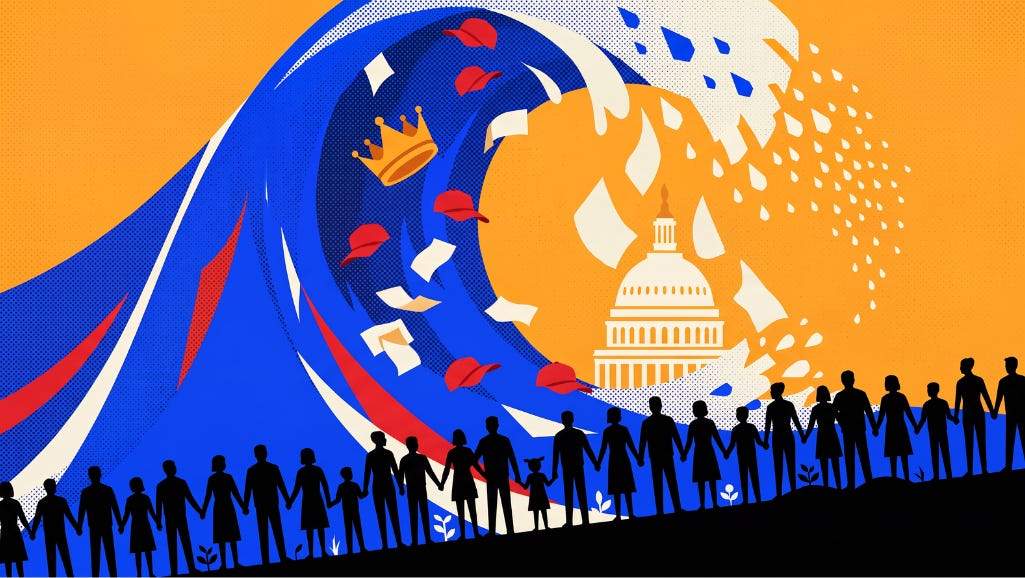
Most weeks this year it’s felt like the news has been coming at us like a fire hose - this week, it was a tsunami. The ground that’s been groaning under us for years finally moved, and everything that had been held down too long came up with it - the anger, the grief, the sheer exhaustion of waiting for someone at the top to listen. All week, crowns slipped on both sides of the world, and the people who’d been holding them up discovered just how much weight they’d been carrying. It was loud, and frightening, and strangely hopeful all at once: the feeling of a world finally letting go of something it couldn’t keep holding, without yet knowing what it’ll reach for next.
A colossal blue wave broke over America on Tuesday night, as voters turned out in record numbers to deliver both houses of Congress to the Democrats - the first time both chambers have changed hands in a single night since 2006. Democrats look set for around 258 House seats, the most they’ve held this century, on a national margin of about 13 points, the biggest since the 1970s. In the Senate they flipped 7 seats to reach 54, with Alaska and Mississippi still too close to call.
The wave brought a string of firsts. Georgia elected Keisha Lance Bottoms, the first Black woman elected governor anywhere in America, New Mexico elected Deb Haaland, the first Native American woman to run a state, and Texas chose Gina Hinojosa, its first Latina governor. Michigan sent Abdul El-Sayed to the Senate as its first Muslim senator, New Hampshire sent Chris Pappas as the first openly gay man elected to the Senate, and in Mississippi, if the last few dozen votes hold, Scott Colom will be the state’s first Black senator since Reconstruction. Hakeem Jeffries is now in line to be the first Black Speaker of the House.
Underneath the Washington headlines, the wave landed in the states. Democrats won the governor’s mansion and both chambers in Michigan, Minnesota, Nevada, Pennsylvania and Wisconsin, and now hold a majority of the governorships for the first time in 16 years.
And some of the biggest names in the Republican Party were swept away by the blue wave. Susan Collins conceded in Maine after nearly 30 years in the Senate, beaten by Troy Jackson by about five points. In South Carolina, Darline Graham, appointed in July to fill the seat of her late brother Lindsey Graham, lost it to Annie Andrews, a paediatrician, in a state Trump won by 18 points. Roger Marshall lost Kansas to Adam Hamilton, a Methodist pastor, Jon Husted lost the Ohio seat JD Vance left behind to Sherrod Brown, Ken Paxton lost Texas to James Talarico, and Greg Abbott, the three-term governor of Texas, lost his bid for a record fourth term. Even Richard Hudson, the congressman in charge of getting Republicans elected to the House, lost his own seat. Elon Musk spent somewhere around $474 million trying to hold the line, about $224 million of it in Texas alone, and more than 90% of it went to candidates who lost.
The exit polls told the story behind the story: 74% of voters said the war in Iran was a major factor in their vote, 89% said the cost of living was, and three quarters of the country said they were angry or dissatisfied with how things are going. Two years into his second term, the midterms had become a referendum on Trump, and the nation answered loud and clear.
Trump initially took the whole thing in his stride, saying he was “absolutely willing to accept” the result, but within hours he posted a photo of himself in a red VETO hat, blamed Fox News, called the Governor of Texas a RINO, and said Republicans would have won in a landslide if his name had been on the ballot. His first public appearance after the vote was a tour of the ballroom he’s building on the side of the White House where he touted the extravagant marble embellishments. Even King Louis XIV cringed from beyond the grave.
By the time the results were in, Trump’s own side had turned on him, and the race for the White House in 2028 had already begun. JD Vance posted 600 words on X saying “the reason we lost is the war,” and Trump called that “largely true” but said he wouldn’t change a thing. Ron DeSantis called the election an “extinction-level event” for Republicans, Marjorie Taylor Greene called Trump a cult leader, and Mike Johnson announced he won’t run to lead House Republicans again, with the fight for his job starting next week.
Sending the signal that he and his administration learnt absolutely nothing from the election, Trump answered the loss by ditching his chief of staff, Susie Wiles, and handing her job to Stephen Miller, the man who designed his mass deportation drive. Then Trump offered the job of White House press secretary to Dana White, the head of the UFC, America’s biggest cage-fighting league.
The Democrats responded with a message of their own, making it clear what they plan to do with the power they’ve been handed. On election night Robert Garcia, the congressman set to take over the committee that investigates the government, tweeted “Lawyer up,” while Senator Ron Wyden posted one word: “Subpoenas.” Hakeem Jeffries has promised to go after corruption “beginning on day one” and to “run Pete Hegseth out of town,” and the list of targets already runs from the Trump family’s business deals to the Epstein files and the war in Iran. Alongside it they’ve promised to bring down the price of groceries, petrol and housing, restore the health subsidies that lapsed, and end Trump’s tariffs, and so far nobody has ruled out impeachment.
Trump’s people saw it coming. His aides started lawyering up months before the vote, and senior staff have been scrambling to lock in the lawyers they want before a colleague gets there first. Some former officials are now refusing to come back to the White House at all, for fear of being swept up in it.
The wave that swept over the United States this week didn’t stop at American shores; the same swell was running under the rest of the world - the anger over prices and wars and people at the top who won’t listen - and everywhere it reached the shore, something gave way, or someone dug in against it.
In London, Russell Brand was found guilty of rape and three counts of sexual assault. Brand was one of the biggest comedians in Britain during the early years of this century, before reinventing himself online as a wellness guru and anti-establishment truth-teller with millions of followers. Since moving to Florida in 2024 he’d made himself at home at the heart of the MAGA world: a guest at Trump’s Mar-a-Lago, a speaker at Turning Point USA events, and just six weeks ago, a panel host at a “Make America Healthy Again” summit that also featured RFK Jr. and JD Vance. When the allegations first surfaced in 2023, Elon Musk rushed to defend him - “That man is not evil” - but since the verdict, his famous friends have gone strangely quiet. He’s in custody until sentencing on Monday.
In Israel, after last week’s election gave neither side a majority, and Netanyahu’s claims of election fraud fell on deaf ears, the ultra-Orthodox party that’s propped him up for years declined to back him, and the Arab-led parties threw their weight behind his rival, Gadi Eisenkot. Israel’s president, Isaac Herzog, sided with Eisenkot, so now come weeks of deal-making to see whether he can actually form a government, and until then, Netanyahu stays in charge. Meanwhile, Trump announced that the $4 billion a year America sends Israel in military aid will end by Christmas, catching Jerusalem completely off guard.
And in Gaza, as the politicians bargained, the first winter storm flooded thousands of tents in the camps where displaced families are still living, with rescuers taking 1,500 calls for help in just 10 hours.
In the Gulf, the war that decided the US election raged on, with tankers still hitting mines in the Strait of Hormuz and a US aircraft disabling a cargo ship that tried to break America’s blockade of Iran, even as talks inch towards a deal.
In Ukraine, Russian guided bombs hit a school in Komyshuvakha that was being used to hand out aid. At least 40 people were killed, dozens more are still under the rubble, and Russia followed it with 289 drones and 17 missiles in a single night that left Kyiv without power or water. Peace talks are set for Abu Dhabi next week.
In Paraguay, regulators seized a bank with close ties to President Santiago Peña, and millions of ordinary people found their accounts, pensions and health funds frozen. The water reached all the way to the presidential palace: Peña tried to resign on Thursday, but Congress refused to accept it, voted unanimously to impeach him, and within minutes he was under house arrest in the capital, Asunción. His vice-president, Pedro Alliana, was sworn in the same day.
Across Europe, the same swell of anger over the cost of living kept rising: hundreds of thousands marched in France for a “dignified wage”, Gen Z marches spread in Germany, and Belgium’s prime minister handed the King his government’s resignation after the budget talks fell apart, only for the King to refuse it and send him back to the table.
In Spain, the transport minister resigned over the train crash near Toledo that killed 69, and in Congo the Ebola outbreak passed 5,300 deaths. In Australia, the Reserve Bank raised rates to the highest they’ve been in 18 years, and New Zealand went to the polls in an election that’s still too close to call.
Like any tsunami, the wave that washed over the political world this week started long before it landed, deep down, under years of pressure nobody would let move. To make sense of it, we need to know why the ground gave way now, what the water revealed as it pulled back, and what we get to build on the bones, and the sky, as always, has the answers.
So if you’re feeling wiped out by the week, or wondering what on earth happens next once the waters recede, read on, dear friend. The sky is showing us exactly what’s going on - and why - and how to hold what’s coming next.
The Wrap-Up makes sense of the week
through the sky - free in your inbox every Sunday.
The cosmic insights shared here are mapped to the real movements of the heavens during the past week. If you want to know more about planetary pattern recognition, read about it here

The Nature of a Tsunami
On the morning after Christmas 2004, a ten-year-old English girl named Tilly Smith was walking along Maikhao Beach on the island of Phuket in Thailand with her mum, her dad and her little sister. It was a perfect holiday morning - blue sky, warm sand, families spread out on towels, kids splashing in the shallows - until the sea started to behave strangely.
The water went frothy, fizzing like the head on a beer, and then it began to slide away from the beach, far faster than any tide, hundreds of metres in a few minutes, until the seabed lay bare and glistening and boats out in the bay sat tilted on the sand. People wandered out onto it, curious, picking up the fish left flapping where the water had been.
But Tilly stopped dead.
Two weeks earlier, back home in Surrey, her geography teacher had shown her class a video of a tsunami in Hawaii that looked exactly like what she was watching now: the sea drawing back like a breath being taken in. She told her mother a tsunami was coming, but her mother didn’t understand the word, so Tilly kept saying it, louder and more frightened, until her father believed her, walked back up to the hotel and told the staff, and they cleared the beach.
Minutes later the sea came back as a wall of water that kept coming and kept rising, pouring over the sand and through the hotel’s ground floor and on into the streets behind it. Along that coast, thousands of people died that morning, but on Maikhao Beach, because a ten-year-old remembered her geography lesson, around a hundred people were up on high ground, and nobody on that stretch of sand was killed.
That morning, the same wave was crossing the whole Indian Ocean, striking 14 countries from Indonesia to Somalia, and by the time it was over it had taken almost a quarter of a million lives.
Most people alive today have never seen a tsunami, and most of us never will, because they’re rare: we get only a handful of truly great ones in a century. But when one comes, it comes like nothing else on Earth.
Where regular waves are made by wind pushing on the surface of the water, a tsunami isn’t caused by wind at all - it starts at the bottom, deep under the sea. Down there, two plates of the Earth’s crust are pressing against each other, and in a healthy fault they slide past one another a few centimetres a year, so quietly that nobody ever feels it. But some faults lock. The two sides catch on each other and stop moving, and the pressure that should have been released a little at a time builds instead, for decades, sometimes for centuries, until the day the fault lets go all at once. The seabed lurches, and the whole column of water above it, all the way to the surface, is lifted with it. And that’s the tsunami: the ground moving, with the sea on top.
Out in deep water, it’s invisible. In the open ocean a tsunami passes under a ship as a swell less than a metre high, travelling at the speed of a jet, and nobody on deck feels a thing. The word itself is Japanese for “harbour wave,” named by fishermen who’d spent the day out at sea in calm water and came home to find the harbour destroyed. The people furthest from shore, in the deepest water, were the last to know.
And it’s never just one wave. A tsunami is a train of them, and the first is almost never the biggest. They arrive ten minutes apart, half an hour apart, for hours, and the people who die are often the ones who went back down to the beach after the first one.
It only becomes real at the shore. The wave that’s invisible in the deep rears up when it reaches the shallows, when the water runs out of room underneath it and the whole column has nowhere to go but up, landing in the harbour, in the village, at the level of the ground, flooding inland, and dragging everything back out with it. When the water finally goes down, what’s left is a levelled shore.
A tsunami is Mother Nature’s way of releasing pressure from a system that’s refused small movements for too long. The strain was always going to be released - the only question was whether it came out a centimetre at a time or all at once, and the longer it’s held, the higher the price. A tsunami clears the ground - violently, chaotically, ruthlessly, mowing down everything in its path, homes and land and lives - and it’s almost always the people on the shore who pay, far from the locked fault that caused the rupture. There’s no fairness in it, and no justice either. It’s renewal through upheaval, a cataclysmic resetting of balance.
Aceh, at the northern tip of Sumatra, had been at war with the Indonesian government for nearly three decades when the Boxing Day tsunami came. Peace talks had come and gone, a ceasefire had collapsed, and the province had just come out of a year under martial law, about as locked as a place can be. Then the tsunami took about 170,000 people in a single morning, and there was nothing left to fight over, and no one left with the stomach to fight, so in less than a year the two sides had signed a peace in Helsinki that has held ever since. One monstrous wave ended what thirty years of war couldn’t.
Two and a half centuries earlier, on All Saints’ Day 1755, an earthquake under the Atlantic sent a wave into Lisbon, then one of the richest cities in Europe, and together with the fires that followed, it destroyed most of the city. Lisbon had been a crowded medieval tangle for centuries, and the King’s chief minister, the Marquis of Pombal, rebuilt it from the ground up: wide streets on a grid, and buildings with flexible timber frames hidden inside their walls, designed to sway when the earth moved so the next quake would pass through them and leave them standing. The wave shook something deeper too, breaking Europe‘s faith that the world was ordered from above by a God who rewarded the good. Voltaire wrote furiously about it, and the argument that followed fed the Enlightenment. A city, and a way of thinking, that had been locked for centuries both moved in a single day.
That’s what a tsunami does - it sweeps away what couldn’t have been moved any other way. The pressure was too great and the fault held too fast, and the change that had been refused a little at a time arrived all at once. Nobody wished for the devastation, but once it’s passed and the waters recede, it reveals the bones on which something better can be built.
We don’t choose the wave, only what gets built after it.
Next Sunday’s wave is already building.
Get the Wrap-Up free in your inbox.
Political Faults and Wave Elections
This week, we lived through one of these waves at the ballot box, and it turns out the political kind behaves a lot like the real thing.
Politics has its plates, just like the Earth - two great blocs of a country pressing against each other, every one of them carrying its own fears, its own loyalties, its own picture of what the country should be. In a healthy democracy they slide past one another a little at a time. Every election a handful of seats changes hands, a few ideas cross the aisle, and the strain gets released in small, survivable movements that most people barely notice.
That’s the kind of fault America‘s founders set out to build. When they sat down in Philadelphia to draft the Constitution, the thing they feared most was a crowd swept up in a single passion, so they designed a government that could only move slowly: two chambers that have to agree, a president who can be overruled and courts that can overrule them both, and elections staggered so that only a third of the Senate ever faces the voters at once, so the whole government can never be turned over in a single night.
The story goes that when Thomas Jefferson came home from Paris and asked George Washington why they’d bothered with a Senate at all, Washington explained it was for the same reason he poured hot tea into a saucer - to cool it. The House, elected every two years, would carry the heat of the moment, and the Senate, elected for six, would let it cool before anything became law.
The American machine was designed for small movements, much like the new Lisbon the Marquis of Pombal built after the tsunami of 1755, where timber frames hidden inside the stone walls let each building sway when the earth moved, so a quake could pass right through and leave it standing. The founders built that same give into the government: many ideas gathering, reaching across the aisle, giving a little every election so the strain never builds - a fault built to creep.
But over the last few decades, the creep has stopped.
Voting maps have been redrawn so most seats can never change hands.
Party lines hold on almost every vote.
In the Senate, nothing passes without 60 votes, so very little passes at all.
When every small movement is blocked, the only movement left is the big one. A crisis comes that the people in power won’t move on, or can’t, and the pressure that should have been let out a little at a time builds instead, until one election night the whole thing lets go at once, in what’s commonly known in America as a wave election.
The greatest of them came in 1932. America was three years into the Great Depression, a quarter of the country was out of work, and Herbert Hoover‘s government kept insisting that prosperity was just around the corner and the market would fix itself. The fault held, and held, and then it went - Franklin Roosevelt won 42 of the 48 states, his party picked up around 97 seats in the House and 12 in the Senate, and what got built on those bones was the New Deal: Social Security, the minimum wage, the right to join a union, the safety net that most Americans still stand on today.
In 1964, a century after the Civil War, Lyndon Johnson‘s landslide brought the Voting Rights Act, Medicare and Medicaid in its wake. In 1994, Newt Gingrich‘s Republicans swept 54 seats and took the House for the first time in 40 years, and what they built on the bones was a politics of total war: government shutdowns, impeachment, and the idea that the other side was wicked as well as wrong.
In 2010, two years after the Obama wave, the Tea Party swept 63 House seats, the biggest midterm swing in 70 years, and the most important thing it did happened at the shore, in the state legislatures, where Republicans took control of around 20 chambers in a single night and spent the next year redrawing the voting maps so that the seats couldn’t move again. That’s a fault being locked on purpose.
What decided whether a wave left something lasting behind was what the winners did with it. 1932 spent its wave building a net under people. 2010 spent its wave locking the fault.
And for twenty years now, the swings have come faster. 2006, when a war in Iraq handed both houses to the Democrats. 2008, when Obama swept in. 2010, when the Tea Party swept his party out of the House. 2014. 2018. 2024. And now 2026, the country swinging one way and then the other, election after election. The early ones were the tremors of a fault under strain. The last two came after the ground had already moved, and they tell the story on their own.
Two years ago, the country broke one way, and this week it broke the other. In 2024 the crowd rushed to vote red because it was done with team blue: the prices, the border, the sense that nobody in charge was listening. This week it rushed back to blue because it was done with team red: the war, the prices, the ballroom, the sense that nobody in charge was listening.
Both times the winners called it a mandate.
Both times the losers said the voters had been fooled.
And both times, within hours, the pundits were lining up the next contest.
The crowd rushing from one crown to the other, hoping the next one will finally fix it, is the water sloshing back and forth in the harbour after the ground has moved. It feels like the event, but it’s really just the oscillation.
And when a wave comes, it feels like victory - a win by a landslide - but a landslide is also dominance, the kind the system was built to avoid: one side holding every lever, the other side locked out, and the whole country waiting two years to hurl the levers the other way. A wave releases the strain, but when the winners use it to grab every lever, or to redraw the maps the way they did in 2010, they lock the fault all over again, and the next wave starts building the moment the last one breaks. That’s top-down power with a different hand on it, and it’s exactly the thing the sky is in the business of dismantling right now.
So as much as this week’s wave will hold Trump to account, and it will, what it’s telling us is much bigger than that. Two swings in two years are the sign of a locked fault: a system that stopped creeping a long time ago, that’s been building strain for decades, and that now releases it all at once every time it’s touched. Underneath the feeling of victory, it’s evidence that the whole system is broken, and that what’s needed is something a lot bigger than a change of hands.
And before anything better can be built on the bones, we have to be honest about what’s been buried in the deep all this time - whatever it was that locked the fault and brought the wave in the first place.
What the Water Revealed
When the water went down this week, it showed us something that’s been sitting on the seabed a long while. Many of the people who voted blue on Tuesday voted red two years ago, knowingly, for a convicted felon who’d boasted about grabbing women, been found liable by a jury for sexual abuse, and bragged that he could shoot someone on Fifth Avenue and not lose a vote. They looked past all of it, hoping the businessman from the television would run the country like a good business and make them richer.
Two years ago, voting for him didn’t hurt, because the people his promises would harm were somebody else’s family, somebody else’s neighbourhood, somebody else’s country. This year the pain reached their own door, at the petrol pump and in the fear that it’d be their own child sent to fight in a war they never voted for, and only then did they feel it.
The question underneath both votes was the same one: what’s it costing me? In 2024 the answer pointed one way, and this week it pointed the other. That question is the fault underneath the fault. The redrawn maps and the party lines are what locked the fault, and the question is what keeps it locked, whoever holds the levers.
Millions of people knew exactly who Trump was, and knew his promises would cost their neighbours - the immigrant family down the street, the woman who needed a clinic, the family whose son would be sent to fight a war. They knew it without ever having to feel it, and voted for him anyway, because it looked like it would work for them. That’s the wound underneath the wave. A country can change who holds the levers every two years, but if it doesn’t face that, it’ll rebuild the same house on the same fault, and the next wave will find it.
It’s easy to point fingers at voters who decided someone else’s harm was a fair price for their own comfort, but each of us does the same thing in different ways every day. We buy the cheap shirt without asking who sewed it, or what they were paid. We click for the parcel that arrives tomorrow and don’t think about the driver who isn’t allowed a toilet break. We stay quiet when a colleague gets treated badly, because speaking up might cost us. All of it makes us human, doing exactly what the people in that polling booth did, only smaller - every time, asking the same quiet question: what’s it costing me?
That question belongs to the mind - our human capacity to think - which calculates, and protects, and keeps the books on the self, and in a frightened country it’s the question almost everyone reaches for first. The heart, the part of us connected to something far bigger than ourselves, asks something different: who’s being harmed, and what do they need? But to reach that question we have to stay with the fear we hit at the edge of the mind, because that fear is the door into the heart. Most of us flee rather than feel, and that’s what keeps bringing the wave - a blue one this week, but it could just as easily be a red one in two years’ time, and then a blue one two years after that, the water sloshing back and forth in the harbour for as long as the fault stays locked.
The wave can’t magically make everything better - all it does is expose the pressure that’s been building in the fault all along, and clear the ground so we can start again. What gets built on the bones is up to the survivors, and it comes down to where we build from.
If we build from the mind, asking what’s it costing me?, we’ll rebuild the same house on the same fault: a new crown, a new promise to protect the wallet, and the next wave already gathering out in the deep.
If we build from the heart, asking who’s being harmed, and what do they need?, then we’ll be building on the wound instead of over it - facing what was buried, so the fault can finally start to move, and we stop getting wiped out by a fresh wave every few years.
The Breaking and the Building
The sky has a surprisingly precise blueprint for what could be built in the wake of this wave, and to read it, we have to go back to where the ground first moved.
The tremors that had been rattling our politics for years finally became a rupture in January 2020, when Saturn met Pluto in Capricorn. Saturn is the shape of things, the structures we live inside. Pluto is death and rebirth, the planet that takes what’s finished back into the ground. Capricorn is the sign of governments and institutions and everything built to last. Those two meet about every 35 years, and every time they do, an era ends. That was the earthquake under the seabed. The pandemic was the first wave, and we’ve been living in the train of waves ever since, with Tuesday’s election the latest to reach the shore.
Then in February this year Saturn met Neptune at the very first degree of Aries, the point where everything begins again, for the first time in recorded history. Neptune is the dream underneath everything, the ocean of feeling, and at the Genesis Reset a seed was planted in the ground the quake had cracked. As it sprouted it broke everything in its way, including the wall inside us between the mind and the heart - the one that lets us know a thing without ever having to feel it - and every wall we’ve built in the world to match it. That’s why 2026 has felt like a world on fire, because truth that’s felt for the first time burns, and this week’s wave broke on a country whose walls are coming down.
And all the while, the slower planets are telling us which way the water’s flowing.
For the next two decades, Pluto is in Aquarius - the sign of the many - and every time Pluto walks through it, the crowd takes the crown. Last time, between 1777 and 1798, America threw off its king and France took the head off one. So the direction of power right now runs from the top down to the ground and from the crown out to the crowd, and it doesn’t stop at one crown.
A wave election passes the crown from one head to another, but under Pluto in Aquarius, the crown is coming down to the ground. Pluto takes apart whatever’s sitting on top - it took the Republican Party apart this week, and it’ll do the same to whoever tries the throne next, including the ones who just won. Under this sky the answer can’t come from above, because above is the thing being dismantled.
At the same time, Uranus is in Gemini for the next six years, where it’s been three times before in American history, each time presenting the country with an existential test - from 1775 to 1781, the War of Independence, from 1858 to 1865, the Civil War, and from 1941 to 1948, the Second World War. Gemini is the sign of the mind and of things splitting in two, and Uranus is the great disruptor, so every pass has been America pressed to its limit and torn down the middle. And each pass has laid the ground for a new foundation that was written into law after Uranus crossed from Gemini into Cancer, the sign of home.
The Constitution was signed in September 1787 with Uranus at the last degree of Cancer.
The three Reconstruction amendments that abolished slavery, promised equal protection and gave Black men the vote were ratified in 1865, 1868 and 1870 with Uranus in Cancer the whole way through.
And after the war, the Geneva Conventions of 1949, the amendment that limits a president to two terms in 1951, and Brown v. Board of Education ruling school segregation unconstitutional in 1954 all came in with Uranus in Cancer.
Every time, Gemini is the breaking, and Cancer is the building.
As Uranus reaches the final degrees of Gemini six years from now, it’ll meet Saturn in the sky before they both cross into Cancer, where they’ll be on election day in 2032. That same year, Pluto returns to the exact place in the sky where it was when the Constitution was signed in 1787 - a Pluto return is when a thing dies and is reborn as whatever it was always meant to be. The Constitution’s own Pluto return brackets the 2032 election, with its last pass landing five days before the inauguration in January 2033.
2032 is also the year the senators elected this week are up again, so the presidency, the whole House and this week’s Senate class will all be on the ballot at once. The sky says that’s when the building begins, with the founding document itself up for rebirth, under Uranus and Saturn in the sign of home.
The road to 2032 runs through every Sunday between now and then.
Get the Wrap-Up free.
The Demolition Days
What this week’s tsunami delivered is not the solution to all our political problems but the problem itself, laid bare for everyone to see. These next six years will not be the building of something better as much as they will be the end of the demolition, clearing the ground so the building can begin.
However much the mandate feels like a licence to build, the sky gives the people who won on Tuesday a different job, and it’s one that matters: hold the line, keep the count honest, drag the truth into the light, and clear the ground.
America‘s been here before.
After the War of Independence ended in 1781, the new country spent six years living under its first attempt at a constitution, the Articles of Confederation, and they didn’t work. The states fought each other over money and trade, the central government couldn’t raise a dollar or a soldier, and in 1786 a farmers’ revolt in Massachusetts frightened the founders badly enough that they called a convention to start again. The Constitution we know was the second draft, written on the bones of a first draft that had failed in public, under Uranus in Cancer and Pluto in Aquarius, the same two signs they’ll be in again from 2032.
The wilderness came first. It always does.
From here, the next couple of years look like a stretch where very little works. It starts with a government running out of money before Christmas, and with Mars walking backwards from January to April, every fight turns inward on the fighters: a shutdown, a standstill, the courts slow and the noise relentless. Both parties will come apart along the same seam, because the seam runs through the war and through Israel and through who the machine actually serves, and that seam doesn’t care which jersey we wear. Schumer and Jeffries are already reaching for the gavels while their own new members refuse to kneel. And underneath all of it, Pluto walks steadily towards the degree where the Constitution was born.
That’s the demolition finishing. It’ll be loud, and often frightening, and it’ll take everyone’s attention, but it will also take the strain out of a fault that’s been locked for decades.
Then comes 2028, the next wave in the train, and a louder one. On the old pattern, the water would simply run back to red, the crowd tiring of the crown it’s just chosen the way it has every few years for two decades, and some of it may well do exactly that. The sky, though, is pointing at something much bigger than another swing.
In the two years leading into that vote, Uranus comes back to the exact place it stood when America declared independence in 1776 - the country’s Uranus return, which comes around once every 84 years. The first time it came back was 1860 - that spring the Democratic Party split in two at its own convention, four men ran for president that November, and within weeks of the vote South Carolina had left the Union.
That’s the shape of the wave building now - both crowns are already cracking along the same seam, and Uranus is walking through Gemini, the sign of things splitting in two. So the louder wave looks set to break on the two parties themselves - MAGA and the old Republicans pulling apart, the Democrats and the democratic socialists pulling apart, more names on the ballot and more factions inside every crown. The last two times Uranus passed through Gemini, the splinters eventually re-formed into two parties again, because the voting rules pull everything back to two. This time Pluto is in Aquarius as well, the first time the two have walked together since 1777 to 1782, before America had any parties at all - which is why 2032, with the founding document itself up for rebirth, matters so much.
The first wave is almost never the biggest, and on Boxing Day in 2004 many of the people lost were the ones who walked back down to the sand once it had passed, sure the danger was over. That’s the temptation for all of us now: to breathe out, trust the new Speaker and the new Senate to put things right, and pin our hopes on the right president in 2028 finishing the job. That’s the walk back down to the beach, back to waiting on a crown, with a louder wave still on its way.
Survivors stay on the higher ground until the last wave in the train has passed, and over the next six years, the higher ground is much closer to home than Washington.
The Rising Hive
Under this sky, nobody up there is coming to save us. Pluto is seeing to that, one crown at a time, as the people at the top of the crumbling tower cling on for dear life. We can keep standing at the foot of the tower, begging the kings to do something for us on their way down, or we can turn around and see what’s been rising at our feet the whole time.
Because it’s already there, and the first shoots of it were in this week’s news.
The truest part of this week’s wave landed at the shore, in the towns. In about 30 of them, people voted on whether to let a tech company build a data centre nearby - one of the giant warehouses of computers that power artificial intelligence, drinking huge amounts of water and electricity and giving back very few jobs. In 29 of them, the answer was no. Left and right voted side by side, looked at the most powerful companies on earth, and said no way, not here.
In Mississippi, one of the reddest states in America, a Democrat named Scott Colom may yet win a Senate seat with almost no money and no help from his own party. His campaign was mostly him walking up to people with a camera - at one point into a Trump rally - and asking what mattered to them.
It even showed up outside America, in Paraguay, where ordinary people whose savings were frozen when regulators seized a bank tied to the president filled the streets until Congress threw him out.
All of it came from the shore, from people acting on what they could see and feel right in front of them: their own bills, their own town, their own neighbours. Something was felt, close to home, and people moved, with no plan handed down from anyone.
For the whole of the age that’s ending, we’ve organised ourselves as pyramids, one person at the top and the many holding it up, fighting every few years over who gets the capstone. A hive is built the other way round, with no top, every member load-bearing, millions of people feeling the same thing at the same time and acting on it without being told, the same way the heart works. Where the mind plans from a distance and waits for instructions, the heart moves when it feels something, and it feels most clearly what’s near.
The mind builds pyramids, because the mind can only hold one thing at a time and it wants someone at the top to hold the rest. The heart builds hives, because the heart can feel the whole, and the whole can only be felt up close. We can’t feel a person from the Capitol, but from where we each stand we can feel our neighbour, the woman at the school gate, the man whose brother got taken on his way to work, and once we can feel a person we can’t harm them, and we can’t ignore them either.
That’s why care has always been local by nature, and why the building, when it comes, starts at home. Cancer is the sign of home - the hearth, the kitchen table, the home town. The last time Uranus walked through Cancer, after the Second World War, it gave the world public health systems, social housing, pensions, the first draft of a civilisation built around care. That draft was written top-down, from the capital, with the mind holding the pen. The second draft gets written from the ground up, from the heart.
Where people have a net beneath them - a clinic that’s open and a wage that pays the rent - they can look at the world with something other than fury, because care calms fear. The wave of 1932 understood that when it spent itself on a net. And when enough of us are calm, the crowd stops looking for a crown.
That’s the work of the next six years.
Higher Ground
A new world is blooming beneath our feet, the way green shoots come up through the bones of a flattened shore, and it doesn’t need anyone’s permission to grow - it only needs tending. It’s in the town halls and the 29 towns that said no, in the neighbour who checks on the old man next door, the teacher who stays late, the people who turn up with food and shovels when the floodwater goes down. While the demolition roars on overhead, we tend to what’s rising. We build the hearth now, so that when the frame goes up in 2032, the fire’s already lit.
And while we’re looking up for a saviour, what we’re far more likely to find is each other - across the room, across the kitchen table, across the hall at the town meeting. Someone with a different face, a different race, a different gender, who maybe voted the other way, but underneath it all, the same heart, wanting the same things: a safe home, a fair shot, the people they love kept close and kept well.
So every time the news tells us to look up - and over the next six years it’ll tell us every single day - we can stop, and breathe, and drop out of the noise and into the deepest part of us, and then look around and ask the heart’s question instead of the mind’s: who’s being harmed, and what do they need? The answer’s just across the room.
That’s what the Moken sea nomads did on Boxing Day 2004, the same morning Tilly Smith was walking on that beach in Phuket. A few hours north along the same stretch of coast, these people who’d never had a geography lesson in their lives knew exactly what was coming when they saw the sea pull back, because for centuries they’ve lived on the water in the islands of the Andaman Sea, and their elders carry an old story, handed down through generations, about a wave that comes to eat people, and about how, before it comes, the sea pulls back.
Nobody from the capital had warned them what was coming - the people in the deepest water are always the last to know - and nobody needed to. They’d lived close enough to the water for long enough to feel it change, and they trusted what they felt. They told everyone to run, and the whole village climbed to high ground together. Their homes were swept away, but almost all of them lived.
That’s what survivors do - they gather on the higher ground, they look after each other, and they stay up there together until the last wave in the train has passed. And when the water finally goes down, they start to build - one hearth, one street, one town at a time - until the light is burning in so many places that nobody needs to look up for it anymore.
That’s what lies ahead of us, friends.
Onwards, to higher ground, together.
And so rises the Age of the Heart.
If anything written here has stirred something heavy in you, please reach out to someone who can sit with you in it, whether that’s a person you love or a crisis line where you live. The heart can hold a lot, but it was never meant to hold it all by itself.
If you need a place to land after reading this, or if you want some support as we navigate the days ahead, come join me in the Daily Lighthouse. I’ll be there, each day with you, or if you’d rather listen to it, head over to the Resonance Room.
I also post daily mantras on my social media accounts each day, so you can follow along on all the platforms - Facebook, Threads, Instagram, Bluesky, TikTok and Youtube.
And just a reminder, if you’re wanting to order an astro-chart reading as a Christmas gift for a loved one, the cut-off to place orders so I can get them done in time is NEXT WEEKEND November 15. Order yours here!
See you in the stillness, friends.
Onwards!

Know someone wondering what happens next?
Send this their way.
The Moken knew the wave was coming because they’d learned to read the signs. The Week Ahead reads them with us every week.
Come up to higher ground with the Inner Circle.


Thank you, dear Wizard, for your uplifting and inspired message of tsunamis and what we’re living through. It is a profound metaphor, and provides a tangible way to see why real change will take many years as much deeper forces shift in our culture. Very grateful for your perspective and vision. Thank you.
Thank you, dear Wiz for this writing. Puts so much into perspective and quiets the soul.