


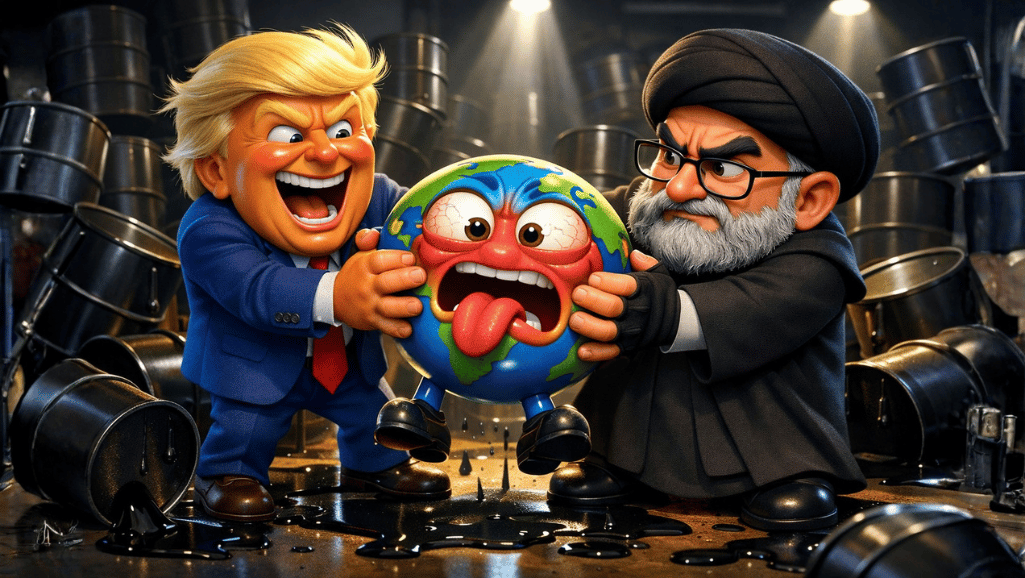
This week, the war without a plan met a world without a floor, as the smoke cleared just enough to reveal that no-one at the top has a clue what comes next, and the old world began to learn what it costs to run on empty.
When six US soldiers killed in the opening days of the Iran war were brought home in dignified transfer this week, President Trump attended the solemn ceremony wearing a white USA baseball cap, available for purchase from his campaign merch store. Fox News, apparently recognising that this looked bad, quietly swapped in old hatless footage of Trump from a similar ceremony during his first term and aired that instead. When caught, they admitted the error, but still didn’t show the real footage.
And that’s the vibe of this war - everything is smoke, mirrors, bluster and distraction, to cover the reality of the unplanned chaos. While the White House is posting hype videos of US military strike footage spliced with clips from Call of Duty and Grand Theft Auto, it’s apparent to anyone paying attention that the war in Iran is not going as planned.
After a classified Senate Armed Services briefing this week, Democrats came out fuming, with Senator Blumenthal calling it the most unsatisfying briefing in fifteen years in the Senate, and Senator Rosen saying she does not know what the endgame is, that Trump has shown no plan for the day after, and that the Middle East cannot simply be unwound back to February 27 by wishing it so. Senator Elizabeth Warren confirmed that Republicans are privately expressing frustration with Trump, and even Vice President JD Vance is now distancing himself from the war.
It seems Trump’s intention going into this war was to strike Iran hard, knock out the Supreme Leader, and install a puppet the US could work with - a repeat of the strike on Venezuela that enabled the capture of President Maduro, leaving behind a vice president willing to play ball and hand over oil access. But if that was the plan, it went to hell from the start.
After the initial strikes killed Iran’s Supreme Leader, along with most of the people the administration had pencilled in as his replacement, Iran named the late Supreme Leader’s son Mojtaba as his successor. Trump called it “unacceptable” and labelled him a “lightweight,” but the so-called lightweight’s first act was to threaten every country hosting US military bases and vow to keep the Strait of Hormuz closed, causing oil to surge past $100 a barrel and fuel prices and airfares to rise immediately. The Trump regime didn’t seem to see this coming, and have no plan to fix the mess they’ve made, beyond dropping more bombs.
Trying to catch a sense of Trump’s war plan is maddening - this week he told reporters the war is “very complete” and “ahead of schedule,” then hours later he told House Republicans that “we have won in many ways, but not enough. We go forward more determined than ever to achieve ultimate victory.” When asked if the war would be over this week, he said, “no,” and that he’ll know the war is over “when I feel it in my bones,” before rambling about soldiers “walking around with no legs” as a result of the bombings.
When asked about the school in Minab that was struck by a US Tomahawk missile in the first days of the war, killing approximately 160 children, Trump first tried to blame Iran, then he said it could have been other nations, but when confronted with reporting that confirmed US responsibility, he said he hadn’t seen the report and declined to accept fault. That’s the Commander-in-Chief, folks - riffing like a madman.
So far, the strikes on oil depots and refineries in Tehran have created conditions that residents are describing as apocalyptic. Oil-laden black rain has been falling across the city, storm drains have reportedly caught fire and thick black smoke has blanketed the capital. People are fleeing, while authorities are urging them to stay indoors. Desalination plants in Iran and Bahrain have also been struck, meaning the infrastructure that provides drinking water to millions of people in the Gulf is now a target.
Israel, the war’s co-architect, has not escaped the consequences of what it helped start. Iranian missiles have struck residential areas across the country, with the deadliest single strike killing 9 people in Beit Shemesh. Israeli airspace was closed for days, Lebanon is being bombed again with over 800,000 displaced, and the country is fighting on multiple fronts with no clear endgame. Meanwhile, swirling rumours this week that Netanyahu may be dead or gravely injured have refused to die down despite official denials. Releasing a video of the Israeli Prime Minister giving a speech to the nation whilst appearing to sport six fingers did little to quell the speculation.
With journalists across the spectrum holding the Trump regime’s feet to the fire over the chaotic war, FCC Chair Brendan Carr warned this week that broadcasters’ war coverage could affect their licence renewals, echoing Trump’s attacks on the Wall Street Journal and the New York Times for reporting on Iranian strikes damaging US aircraft.
At a Pentagon briefing this week, Defence Secretary Pete Hegseth said the sooner a right-wing Trump ally takes over CNN “the better,” and that a “patriotic press” would report that Iran is weakening, suggesting that headlines the war is widening and that the administration underestimated Iran’s ability to close the Strait were “patently ridiculous” because Iran “can barely communicate, let alone coordinate.” He called for “no quarter, no mercy for our enemies” - though the refusal to take prisoners and execute everyone instead has been a war crime for over a century - and closed his briefing by invoking God’s providence over US military leaders and asking the nation to pray.
And prayer might well be in order, as Iranian national security official Ali Larijani has vowed Iran will not rest until it retaliates against Trump “in kind.” After US officials intercepted encrypted radio transmissions believed to be an operational trigger for Iranian sleeper cells abroad, this week the FBI warned California law enforcement that Iran may be planning drone attacks from a vessel off the US coast. Trump has reportedly discussed deploying special forces for a targeted mission to secure Iran’s supplies of 60%-enriched uranium which could be used for making multiple nuclear bombs.
Though Russia has been providing Iran with intelligence to help it target US forces in the Middle East, the Trump administration this week lifted sanctions on Russian oil shipments, breaking with the G7’s unified sanctions framework, maintained since Russia’s invasion of Ukraine in 2022. German Chancellor Friedrich Merz said he “would like to know what additional motives” drove the decision, while Senator Angus King put it plainly: “There is a clear winner in this war….Vladimir Putin. Russia has reaped $6 billion of benefit from this war since it began.”
Meanwhile, the first six days of the war cost US taxpayers more than $11.3 billion, with $5.6 billion worth of munitions expended in the first two days alone. Lawmakers are now worried about US military readiness for other conflicts and bracing for an upcoming White House request for more war funding. Though Senate Democrats have filed legislation to prevent Trump from launching another war without congressional approval, Trump is now threatening a military “takeover” of Cuba, confirmed by Senator Lindsey Graham on Fox News, when he declared to a laughing Maria Bartiromo that “Cuba is next!”
His popularity plummeting ahead of the midterms, Trump took to social media this week to announce he will refuse to sign any legislation until Congress passes the SAVE Act - a nasty little piece of Republican legislation designed to hamper voting by requiring voter ID and proof of citizenship. Senate Minority Leader Chuck Schumer said Democrats will not help pass it under any circumstances, and since Republicans don’t have the votes to force it through, Trump’s threats now ensure this is gridlock meeting gridlock.
Elsewhere in Washington, the Department of Homeland Security has now been shut down for 27 days and will remain so after Senate Democrats blocked a House-passed bill to reopen it, arguing the bill funds ICE and Border Patrol without any reforms attached.
Over at the Department of Justice, chaos reigns as the release of the Epstein files still remains incomplete, with FBI interview records involving allegations against former banker Jes Staley and billionaire Leon Black still missing. Though both men deny wrongdoing, this week Epstein’s accountant named Black as one of several wealthy clients who allegedly paid Epstein millions in fees, alongside Les Wexner, Glenn Dubin, Steven Sinofsky, and the Rothschilds. What’s been hidden is steadily emerging, as authorities this week began searching Epstein’s New Mexico property looking for possible buried bodies. Meanwhile, the FBI’s New York field office, it has emerged, was breached in a cyber attack three years ago, with Epstein files among the potentially accessed material. Hackers, or foreign actors, may now be holding what the Trump regime refuses to release.
Far from the chaos of war in Iran and politics in Washington, violence found its way into middle America this week when a gunman opened fire inside a Virginia university classroom, killing one person and injuring two others before being killed, while in Michigan, a man drove a vehicle loaded with explosives through the front of Temple Israel synagogue, crashing down a hallway before being confronted by security.
And in Gaza, a powerful sandstorm swept the Strip this week, battering the tents and makeshift shelters where millions of displaced Palestinians are living, with aid organisations warning that severe weather is now compounding conditions that were already catastrophic for civilians who have been living this way for months.
If it feels like the ground is shifting beneath our feet - like the world we woke up in at the start of this year is not quite the same world we’re living in now - that’s because it isn’t. Something has cracked open, not just in the headlines, but in the texture of ordinary life. In the unease at the petrol bowser. In the price tag at the checkout. In the look on people’s faces when someone brings up the news.
There is a hollowing underway in the systems and structures we have spent our entire lives trusting to hold. The feeling that everything is happening at once - that too many things are breaking in too many places for any one person to hold - that feeling is accurate, and it deserves to be named rather than dismissed. It was always going to feel that way under a sky that looks like this.
If you’re frightened by what’s happening right now - if you can’t sleep at night for fear of what might come next - you won’t find solace in the news or by doom scrolling social media. The comfort you’re looking for is written in the sky.
Let’s sift through the clatter of this current chaos, and look back to understand what we're looking at, and up to see what's coming. Take a deep breath and we’ll wade through the noise, and face what’s coming, together.
**The cosmic insights shared here are mapped to the real movements of the heavens during the past week. If you want to know more about planetary pattern recognition, read about it here**

War on a Way of Life
While the world watched on in horror as the United States and Israel began bombing Iran a fortnight ago, many feared this was the beginning of World War III. Historically, for the last seventy years or so, wherever America goes militarily, the rest of the Western world follows, driven primarily by the NATO alliance formed at the end of World War II, designed above all else to prevent such a global conflict from ever occurring again.
But since Trump returned to office a little over a year ago, he has all but withdrawn the United States from NATO. His threats against Greenland - a sovereign territory of NATO ally Denmark - and his questionable adventures in the Caribbean have flown in the face of international law and the expectations of every ally America has cultivated since 1945. The recent military action in Iran has been the strongest indication yet of how deep the fracture runs.
France’s Emmanuel Macron declared the strikes were conducted “outside international law, which we cannot approve of.” Germany joined a joint UK-France statement calling for a return to diplomacy and stating plainly that neither government believed in “regime change from the skies.” Spain refused to allow the United States to use its military bases for offensive missions against Iran, even when Trump threatened economic retaliation. China called the strikes “unacceptable” and condemned the killing of a sovereign leader. Russia called it an “unprovoked act of armed aggression against a sovereign UN member state.” The UN Secretary-General condemned the military escalation and a dozen UN human rights experts formally denounced it as an act of aggression that placed the US and Israel “above international legality.”
The coalition of the willing has become a coalition of the deeply unwilling; what the rest of the world has offered instead is a lesson in the difference between loyalty and liability. Australia deployed a surveillance aircraft and a stock of missiles to the UAE to help protect Gulf states from Iranian counter-strikes, but Prime Minister Albanese made it clear no Australian troops would set foot in Iran. The UK allowed the US to use its bases for defensive operations and scrambled RAF jets for air defence, but Keir Starmer explicitly refused to join the offensive campaign, taking a rebuke from Trump for the privilege. France and Greece sent frigates to Cyprus and Italy sent naval assets to the Mediterranean, all of it positioned not to prosecute the war but to manage its fallout, to protect civilians and allied bases from Iranian retaliation, to be seen doing something without doing the thing itself.
So far, this war is not showing signs of becoming a global conflict as much as its showing signs of becoming a global catastrophe - not missiles flying through every sky, not troops crossing borders worldwide, not the bomb shelters filling up, but something different entirely.
An economic bomb.
A missile to the heart of our systems.
A war not on our territory but on our way of life.
What comes next isn’t tanks and troops, but a strangling. The very thing that has been flowing beneath almost every part of modern life for the last century or more - through our economy, our systems, our industries and institutions, and through every area of daily life - is being choked off at its source.
Our modern world runs on one thing more than any other. Oil.
And because of this war, the oil is drying up.
Strangling the World
Trump and Netanyahu barrelled into this war on Iran with no clear strategic objective and no coherent plan. It's not like when the United States invaded Iraq in 2003 and at least went through the motions of building a coalition and obtaining congressional authorization before deploying. This military action came seemingly out of nowhere, with no buy-in from any other legislative branch or any explanation given to the American or Israeli people. This was just a shoot-em-up on a whim, it would seem - an escalation without an exit strategy in a part of the world where every move matters. No-one in charge seems to have considered the implications of attacking Iran, and now they’re finding out in real time that they’ve kicked a hornets nest, and the hornets are real mad.
Iran may not be as large a country as the United States - it’s roughly the size of Alaska and Texas combined - but its position astride the Strait of Hormuz gives it enormous strategic leverage that it appears the Trump administration did not adequately consider before bombing the place to smithereens.
The Strait of Hormuz is a vast body of water sitting between Oman and Iran, through which a third of the world’s fertilizer exports is transported by ship to farmers in India, Brazil, Southeast Asia and the American midwest who depend on it to grow the food that feeds the planet. A single body of water standing between the world and its dinner table.
But the Strait carries more than just fertilizer. It’s the shipping channel through which 20% of the world’s oil supply is transported every single day, travelling from the Middle East primarily east to China, Japan, South Korea and India, who depend on this single waterway for the overwhelming majority of their oil supply, which they in turn process it into petrol, diesel, jet fuel, and industrial feedstock, and then sell the finished product outward again: to Australia, to Southeast Asia, to Europe, to East Africa, to the American West Coast. The Strait of Hormuz does not merely supply Asia - it supplies the supply chain that supplies the world.
Put simply, it is the jugular vein of modern industrial civilisation, and the blood that flows through it is worth more than most nations produce in a year.
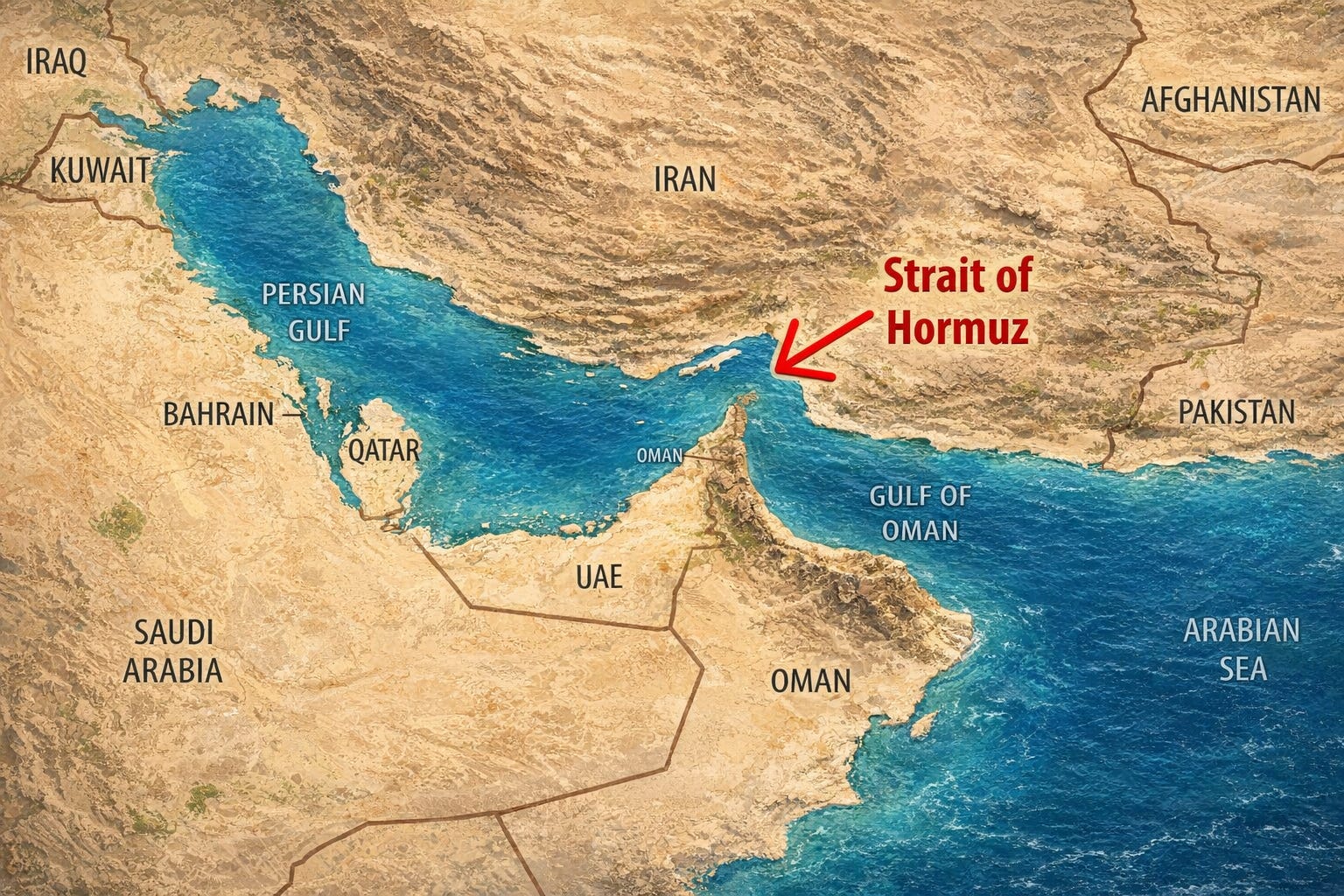
Backed into a corner after being bombed relentlessly for the last two weeks, Iran did what cornered nations with access to a global chokepoint have historically done, and made the chokepoint unpassable. They seeded the waters of the Strait with naval mines, the kind that detonate on contact with a ship’s hull, making it next to impossible for any ships to move out of Saudi Arabia, Iraq, Kuwait, the UAE, and Qatar - effectively cutting off the supply of oil to the world.
Naval mines are among the most asymmetric weapons ever devised - they can be calibrated to ignore minesweepers and detonate only for the magnetic signature of a fully laden supertanker, so clearing them requires locating each one individually, and neutralising it without triggering it. In a waterway with strong currents, heavy sediment, and a seafloor that swallows objects whole, that process is not measured in days, but in weeks, months, even years, and that’s assuming the clearance operation is not being actively opposed by the nation that laid the mines in the first place. No good sending in a minesweeper if they’re just going to get bombed in the process.
Within 48 hours of the first confirmed mining reports this week, insurance coverage for Strait transit was either voided or repriced into the stratosphere. Lloyd’s of London and the major marine insurers suspended cover for any vessel attempting the crossing. Without insurance, no commercial ship can legally sail, and without ships, the oil doesn’t move, and without the oil moving, the engine of the modern world begins, very quietly, to stall, bringing the modern world to its knees.
When the tankers stop moving, the storage tanks fill up, and the pumps have to stop, bringing the oil trade to a halt. At current prices, the oil alone usually moving through the Strait represents over $460 billion dollars of trade annually - more than a billion dollars a day, every day, year after year - feeding a global supply chain worth close to a trillion. The closure of the Strait is rocking economies worldwide.
But apart from the economic effect, there’s the simple reality that without supplies from the Middle East, the world essentially grinds to a halt. We need fuel for our cars, trucks, planes and ships - without it, produce cannot be transported from farmers to grocery stores, and without fertilizer for the farms, soon enough, there won’t be much to transport anyway. This isn’t just about the oil company’s going broke, or us not being able to get about in our cars - it’s about the very real potential for empty shelves in the grocery stores.
Thanks to Trump and Netanyahu’s war, the world’s circulatory system has been blocked at the heart, and there’s no quick way to unblock it. Even if the United States and Israel were to withdraw today, those mines in the Strait would still remain. No matter what happens now, this brief blitz in the Middle East has caused a multi-trillion dollar problem that’s about to ripple around the world. Global fuel prices have already spiked in the days since the Strait was essentially closed, and the sky says that’s just the beginning.
The Unfolding Calamity
You hardly need to be able to read the map in the stars to know what comes next. If the flow of oil is blocked then the oil can’t move, then refineries process less, then petrol becomes scarce, then trucks that run on diesel begin to cost more to operate, then food that travels by truck becomes more expensive, then harder to find, and then the ordinary machinery of daily life - getting to work, keeping warm, buying food - begins to stutter in ways we have not seen in our lifetimes.
This is the pandemic without the pandemic - COVID without the coordination, the emergency response, or the sense of collective purpose. What’s looming is the same kind of grinding systemic disruption, caused not by a virus but by the shortage of a resource on which the entire architecture of the modern world was built.
By now, you’re probably panicking reading this, and plotting a quick trip to the grocery store to buy up tins of tuna and bottled water, before hightailing it to the gas station to fill your car and every spare receptacle you can find, and then heading into the back yard, digging yourself a bunker and hiding inside it until Pluto’s moved out of Aquarius in the 2040s.
But before you do, take a breath.
The sky is not telling us we need to freak out.
Fear is a choice, and not the path we must take.
What’s looming ahead is challenging, for sure, but it’s not pointless pain with no purpose. The sky is saying clearly that the way of the old world has run its course, and it’s time for a better way. We’re not doomed - just evolving.
To chart the path from here and to fully understand what comes next in this evolution, we need to look back to see where our world became so dependant on the liquid gold in the ground, and then look up, to see what the sky says comes next. Where we’ve been helps us know where we’re going, and there’s a map in the stars to light the way.
Drill, Baby, Drill
Humans have been utilising crude oil for thousands of years. The Babylonians used it in construction, ancient Persians used it medicinally, and ancient Mesopotamians used it to waterproof boats, seal baskets, and mortar bricks.
For most of human history, people only ever encountered oil where it bubbled up through the ground naturally. Nobody ever thought to go down and get it until 1859, when a man named Edwin Drake drilled a well in Titusville, Pennsylvania, looking for a replacement for whale oil, which was the dominant fuel for the lamps that lit the homes and streets of the Western world at the time. By using a revolutionary steam-powered drill to go straight down into the earth and bring up oil, Drake’s well produced up to 25 barrels a day. Within two years, Pennsylvania had hundreds of wells, and within a decade, John D. Rockefeller had established Standard Oil, which by 1880 controlled 90% of US oil refining.
For the first forty years or so, oil was used almost exclusively for lighting, in the days before electricity. Petroleum was initially considered a useless byproduct of the refining process that only became valuable when the internal combustion engine arrived in the 1890s, when Henry Ford made the car something ordinary people could own.
In 1908, oil was struck in Persia, and Britain, whose Royal Navy was in the process of converting its fleet from coal to oil, immediately recognised what was at stake. By 1914, the British government secured control of Persia's oil fields by purchasing a majority stake in the Anglo-Persian Oil Company that would eventually become British Petroleum, pumping oil from the ground in what would become known as Iran. From that moment, the Middle East ceased to be a region with its own history, culture, and internal logic, and instead became a resource deposit whose people - living above the oil - were an inconvenience to be managed.
By 1916, Britain and France drafted a secret agreement to carve up the entire Middle East into artificial states once the Ottoman Empire fell. The borders drawn on that map - that created Iraq, Syria, Lebanon, Jordan, and Palestine - were not drawn around ethnic communities, ancient territories, or the preferences of the people living there, but around the oil fields and transit routes that would get that oil to European ships.
Every conflict currently tearing the Middle East apart has its deepest roots in those lines drawn in 1916. The people of the region were handed borders designed to serve someone else’s resource extraction, and have been living inside those borders, and dying along them, ever since.
The Petrol Wars
But it’s not just the conflicts in the Middle East that have their roots in the pursuit of oil. Almost every war fought in the last hundred years ties back to humanity’s mad scramble for dominance through the monopoly of oil.
World War I was the first war ever fought with a mechanised army, and the first time in history that military victory required a continuous supply of petroleum. World War II, at its core, was almost entirely about oil. Japan expanded across the Pacific after the United States cut off its oil supply; it needed the oil fields of Southeast Asia or its war machine would stop. Hitler’s most critical strategic decision - the eastward drive toward the Caucasus - was aimed at the oil fields of Baku. The North Africa campaign was fought primarily to control the Suez Canal route to the Middle Eastern oil that Britain’s war economy required. The war was won by the side that kept its oil moving and denied the other side theirs.
By the end of World War II, the United States emerged as the dominant power on earth because it was the only major industrial economy that hadn’t been bombed to rubble, and its vast, domestic, cheaply produced oil reserves gave it the means to build the bomb that ended the war and then rebuild Europe on the other side. The Marshall Plan - the $13 billion program America launched to rebuild Western Europe - saw Europe rebuild itself buying American goods with American money, and by the time the rubble was cleared, Western Europe was America’s largest export market and its most reliable political ally. America’s generosity and self-interest, perfectly aligned.
Underpinning all of it was the system agreed at Bretton Woods in 1944, when the Allied nations sat down and designed a new global financial order whereby every currency in the world would be pegged to the US dollar, backed by gold at a fixed rate. That’s how the dollar became the world’s reserve currency that every nation had to hold, trade in, and settle debts with. American financial dominance was written into the architecture of the post-war world.
It worked beautifully for a few decades, until America started running up staggering debts - Korea, Vietnam, the space race, the Great Society - printing dollars to cover them, until by 1971 there were far more dollars in circulation than America had gold to honour them with. When other nations began presenting their dollars and demanding gold in return, Nixon’s response was simply to cancel the deal by declaring the dollar was no longer convertible to gold - he and Henry Kissinger hatched a plan to anchor the dollar to the price of oil.
In return for a security guarantee, the Saudis agreed to price all oil sales exclusively in US dollars, which meant any country who wanted to buy oil - which was every country on Earth - they needed dollars, which meant they needed to maintain economic relationships with the United States. From the mid 1970s onwards, the entire global financial architecture was built on the “petrodollar” - the dollar backed by the barrel - which is why every US administration since, regardless of party, has treated the free flow of oil from the Persian Gulf as a core national security interest worth going to war over, because it’s not just about fuel, but the architecture of everything.
In 1990, when Iraq invaded Kuwait, within months, half a million American troops were in Saudi Arabia, not to liberate Kuwait but to protect the petrodollar and America’s supremacy by ensuring Kuwait’s oil fields didn’t fall under Saddam Hussein’s control.
In 2003, when President George W Bush launched an invasion of Iraq looking for weapons of mass destruction that did not exist, what he was really looking for was Iraqi oil - the second-largest proven reserves in the world - sitting under a government that had begun pricing its oil in Euros rather than dollars. That experiment in petrodollar circumvention ended with regime change.
In 2011, Libya’s leader proposed a gold-backed African currency for oil transactions and lobbied African and Arab nations to price their oil outside the dollar system, and within months, NATO was providing air cover for the rebels who killed him.
Every one of those wars, however brutal or cynical, followed an internal logic: protect the flow, protect the dollar, protect the architecture. There was a method to the madness, even when the madness was catastrophic.
And then came Trump.
Not a strategist protecting the system, but a wrecking ball who didn’t understand what he was swinging through. Where every previous administration had treated the free flow of oil through the Persian Gulf as sacred, Trump bombed the country sitting astride the world’s most critical oil chokepoint with no plan, no coalition, no exit strategy, and apparently no awareness of what would happen next. And now, his reckless actions have blocked the Strait of Hormuz and begun the unravelling of the very system every American president since Nixon has gone to war to protect.
The irony is total. The last war fought to preserve the oil order has, by its own incompetence, begun the end of it.
The Age of Oil, the Age of Neptune
The story of humanity’s dependence on oil - from the first moment Drake drilled for it back in 1859, through the establishment of Standard Oil, the world wars, the creation of the petrodollar and the battles to protect it - has all played out under a single Neptunian cycle.
Neptune is the planet of what is hidden - buried, diffuse, dissolved, invisible until extracted. In mythology, Neptune rules the deep. In astrology, Neptune rules oil.
The entire extractive, hidden-beneath-the-earth, refineable, shippable liquid economy is Neptunian by nature. Oil is Neptune made physical: black, oceanic, ancient, dissolving all boundaries between nations and economies, creating both dreams of endless abundance and the fog of dependencies we didn’t know we had until they disappeared.
Neptune takes 164 years to move through the zodiac - from Aries through to Pisces -and complete one orbit of the Sun. The last time Neptune entered Aries to begin its cycle around the Sun was in 1861, two years after Edwin Drake drilled his well in Pennsylvania - and that 164-year cycle completed earlier this year when Neptune once again made its way back into Aries, just one month before the US and Israel began bombarding Iran, inadvertently blocking the world’s oil supply.
The age that was born under the last Neptune in Aries is ending under this one. The sky completed a full 164-year circle, and what was seeded at the beginning is now being composted at the end.
When Neptune met Saturn in exact conjunction at zero degrees Aries on February 20 this year, the structure built on the Neptunian resource met its own dissolution as the plug was pulled on the Age of the Mind, run on extraction, control, hierarchy, and the top-down management of resources and people.
On the day of that conjunction, former Prince Andrew Mountbatten-Windsor was arrested and the US Supreme Court struck down Trump’s tariffs - two seismic events on opposite sides of the planet, both pointing in the same direction, signifying the rules of the game have changed. The Strait of Hormuz is the physical world catching up with what the sky announced in February - what was protected is no longer protected and what was untouchable has become touchable.
The sky is telling us clearly that everything we built our world on during the Age of the Mind is now sinking sand. There’s a new frequency in town - a new energy source - and it’s not interested in petrodollars, or pulling oil out of the ground, or waging wars for economic supremacy. That’s the old world, the one that’s currently dying. Something new is rising; something the mind can’t make much sense of, and that - for the first time in centuries - doesn’t require oil.
The Turbulent Skies Ahead
As Neptune begins its journey through Aries, Uranus - the planet of sudden disruption - is about to enter the sign of Gemini, the sign of networks, trade routes and transport; the flow of information and goods, and the interconnected web of supply chains, shipping lanes, and communication systems that we call globalisation.
The last time Uranus was in Gemini was in the 1940s, a decade that began with the global trade system destroyed by world war and ended with the construction of an entirely new global order. The world that went into Uranus in Gemini was entirely different to the one that came out of it - the United Nations, the IMF, the World Bank, the petrodollar, the American-led post-war order.
As Uranus prepares to move through Gemini again, the global network - the centralised, hierarchical, oil-dependent global supply chain - is being completely rewired, against the backdrop of one of the most turbulent and transformative skies seen in lifetimes.
In April, Mars joins Neptune, Saturn, Chiron, Sun, Mercury, and the Moon in Aries - seven bodies in the sign of ignition, creating a pressure wave moving through the world’s systems in a surgical sequence, striking every major nation’s chart. What detonates here moves through economic systems, supply chains, and the everyday lives of ordinary people, as the cost of decisions made in the fog of war lands on the shelves, at the pump, and on the kitchen table.
By July 4 - the 250th birthday of the United States - transiting Mars and Uranus meet in exact conjunction in Gemini at the precise degrees where the American birth chart holds its own natal Mars and Uranus, switching America’s revolutionary DNA back on. Something seismic breaks open on that day - a leak, a document, a transmission - that cannot be unsaid once it enters the air.
By the end of July, the four generational planets align at the same degree across four signs simultaneously - a configuration with no modern precedent, producing a long-term imprint that dictates what can and cannot grow from this point forward. The volatility passes and the signal settles, but the world does not return to what it was - it discovers what it has become.
The skies over these next few months do not speak of a world war. The signature that was present in the skies in the early 1900’s - the signature of co-ordination, of the scramble for land and for dominance - is not present in today’s sky like it was during the world wars. This year’s sky speaks of something equally volatile but structurally different - of collapse, of chaos, of calamity, and of the deconstruction of systems and institutions that eventually paves the way for something better to be born.
The Better Way, Beneath the Rubble
What we are watching right now, whether we realise it or not, is the steady collapse of the global oil supply chain - a crisis that will dismantle the global order and from which there will be no return to normal as we have known it.
This is the end of the system that required an uninterrupted supply of a finite, increasingly scarce, geographically concentrated resource to function. Remove the resource, even temporarily, and the system doesn’t just pause - it begins to fail in cascading ways it was never designed to manage, because it was designed on the assumption that the oil would always flow.
This is the global calamity that finally forces humanity to stop raping the Earth of its resources and turning to natural energy sources that are clean and boundless, not out of some sense of conscience but out of the need for greater stability that oil can no longer provide. The technology to harness these alternative energy sources and free us from oil has existed for decades, quietly bought, buried, and sat upon by the very industry that needed it not to exist.
In the 1990s, General Motors built one of the first modern electric vehicles, but then recalled every single one and crushed them after the battery that powered it had its patents acquired by Chevron, who sued others to prevent them from using it. The battery that could have changed everything sat locked in an oil company’s patent portfolio, legally unusable, for years.
The oil companies were never ignorant of the alternatives. BP, Shell and ExxonMobil all had solar divisions funding research that they quietly abandoned, systematically choosing to walk away, divest, or litigate rather than allow anything to threaten the barrel.
This goes all the way back to Henry Ford’s original Model T, which was capable of running on ethanol - plant-derived, renewable, and abundant - until Rockefeller, whose entire empire depended on gasoline having no competition, reportedly became a significant financial backer of the Prohibition movement, which made ethanol production extremely difficult at precisely the moment the automobile age was taking off. What was sold as a moral crusade against alcohol was also the moment oil bought itself a century of monopoly.
The system we have been living inside was deliberately organised to prevent better from becoming possible. The sun and the wind have always been there, and the technology to harvest them has existed for longer than most of us have been alive. It was never an absence of solutions that kept us here, but the presence of people who needed us to stay.
The Shrinking World
Our world’s dependence on oil has required the world to be big. Oil had to be extracted in one place, refined in another, shipped across vast oceans, distributed through layers of intermediaries, priced in a single currency controlled by a single nation, and protected by the most expensive military apparatus in human history. Oil was not just a resource, but a mandate for globalisation - a reason the world had to be organised at the largest possible scale, under the fewest possible points of control.
The alternative energy sources - solar, wind, tidal, geothermal - have none of these properties. You cannot mine the sun, or block the strait through which the wind blows, or embargo a country’s access to rainfall. Renewable energy is inherently distributed, inherently local, and inherently ungovernable by any single empire or cartel.
The transition from oil to renewable energy that the current chaos is nudging us towards is not merely an energy transition, but a transition in the fundamental organisational model of civilisation. The oil world was big, centralised, hierarchical, and controlled from the top down, but the new world that is powered by clean energy is small, distributed, local, and controlled from the ground up.
The world getting smaller does not mean the world getting worse - just more local. More reliant on the person next door than on a shipping container from the other side of the planet, and more invested in the soil beneath our feet than in the extraction happening beneath someone else’s.
And once again, the sky tells us the story. Once Uranus finishes its journey through Gemini, it will move into Cancer in 2032 - the sign of home, community, the hearth, the local ecosystem, and the things that sustain life at the level of neighbourhood and family rather than nation and empire. Uranus in Cancer will revolutionise how we feed ourselves, shelter ourselves, and organise the basic practical infrastructure of daily life - not from the top down, but from the ground up.
By 2038, when Neptune moves into Taurus - the sign of earth, embodiment, practical material reality - the dream of a new earth-connected economy will begin to take physical form. Solar panels on every roof. Wind turbines on every ridge. Food grown close to the people who eat it. Water systems managed at the community level. The diffuse, distributed, ungovernable abundance of a civilisation that no longer needs to mine the deep to survive.
That’s the future the sky is laying out for us, but the corridor between here and there - April through July this year, and then through the years beyond - will ask more of us than we are accustomed to giving. The world getting smaller will, in the first instance, feel like loss: loss of the easy abundance, the global supply chains, the sense that anything could be ordered from anywhere and arrive on the doorstep.
But underneath the loss is something older and truer. The reconnection of human life to human scale. The rediscovery that what we actually need - warmth, food, water, community, meaning - was never inside the global supply chain. It was always here. Next door. In the garden. In the neighbourhood. In the hands and knowledge of the people living alongside us.
What lies ahead is not some sort of ramshackle existence where we live in makeshift huts and forage for food - we’re not walking into 28 Days Later or A Quiet Place or some dystopian nightmare. We take our technology with us where we are going, we just learn to run it more ethically, more humanely, and in way that harmonises with Earth, and doesn’t harm her.
We are standing on the edge of change - not disastrous change, not a downgrade, but a shift to something entirely different. Something better for us, and better for our planet, something sustainable, more harmonious and in alignment with the rising Age of the Heart.
The Heart Knows The Way
The heart does not run empires - it doesn’t manage global supply chains or protect petroleum transit corridors with aircraft carriers. The heart pumps locally. It distributes, and keeps everything moving through circulation and connection, not extraction and control.
As we leave the Age of the Mind, the world is being asked to become more like a heart and less like an oil well, and that process has already begun, with a mined strait and rising fuel prices and the first tremors of a cascade that will move through every system the old world built.
The sky has known this was coming for longer than any of us have been alive. The Neptune cycle told us that what was born in the oil age dies in the next Neptune-in-Aries. The Uranus cycle told us that the global network built in the last Uranus-in-Gemini gets rewired in this one. The Genesis Reset when Saturn met Neptune in Aries told us the structure built on the dream of endless extraction meets the moment when the dream ends.
We are not watching civilisation collapse. We are watching one form of civilisation complete its arc, and another begin to emerge from the space it leaves behind.
Right now the noise of collapse is loud, and the green shoots of the new world are small, but they will become more and more visible in the silence that follows the noise. And that silence is coming, where finally, we will be able to hear what has been trying to reach us all along.
But first - the unbearable noise.
What’s coming will not arrive all at once. There will be no single morning we wake up to empty shelves and dry pumps and the sudden knowledge that everything has changed. That’s not how systems die. Systems die the way the tide goes out - gradually, almost imperceptibly, until one day we look down and notice the waterline is nowhere near where it used to be.
It will be the grocery bill that keeps climbing, a little more each month, until the shop feels like a different place than it used to be. The pump price that never quite comes back down. The business that quietly closes. The service that takes longer than it used to, then stops working properly, then stops. The job that keeps paying but slowly loses its meaning as the machinery it was part of hollows from the inside out.
This is what institutional death actually looks like - not a dramatic collapse, but a slow leak of legitimacy. The old world won’t end with a bang that gives us permission to grieve it. It will end the way it began - gradually, and then all at once, and most of us won’t notice the turning point until we’re already past it.
What is coming will be loud before it is quiet, and hard before it is better. We will feel it in our wallets and at the petrol station and in the faces of people around us who don’t have the map we have. There will be moments of fear - that is human, and we don’t need to shame ourselves for it - but fear is the language of the mind, and the mind built the world that is currently falling. The heart speaks a different language entirely, and that is the one we are being asked to learn.
Our task is to release our grip on what is falling away. We must not scramble to preserve what was never meant to last, or mistake the death of the old world for the end of the world - because it is not. It is the end of one story and the beginning of another, and we are the ones standing at the threshold between them, which is terrifying and sacred in equal measure.
We will face what is coming with our eyes open and our hearts steadier than our minds, together, as we have always moved through the unsurvivable things that turned out, in the end, to be survived.
The noise ahead is real, but so is the silence waiting on the other side of it, and the stillness we can anchor ourselves in when we drop into our hearts as we walk the path from here to there. We were not born at this moment in history by accident. We were built for exactly this. We came to be the ones who stood at the end of the age, and watched the world fall apart, while we stitched a new one together with love and our bare hands.
Let us not be paralysed with fear for what is to come. Let us be prepared and proactive - not in the frantic, hoarding way, but in the quiet, deliberate way of people who know a storm is coming and choose to build shelter instead of hiding under the bed.
Keep our loved ones close. Not just physically, but emotionally. Have the conversations we’ve been putting off. Say the things we mean. Be present in the ways we’ve been too distracted to be. The currency of what’s coming is not money or petrol or tinned food - it’s trust, and we build it now, in the ordinary moments, before we need it.
Look out for our neighbours - especially the ones who don’t have the map we have. The elderly woman on the corner who doesn’t understand why her grocery bill has doubled. The young family stretched thin before this crisis even started. The person two doors down who is scared and alone and doesn’t have language for what they’re feeling. We are not just preparing ourselves - we are becoming the people our community needs.
Plant something. A vege patch if there’s space, herbs on a windowsill if there’s not. Something that grows, something that feeds us, something that roots us in the reality that the earth still knows how to give. There is something quietly revolutionary about growing food right now - it is a small, dirt-covered act of sovereignty. And share what we have. The abundance of the new world is not hoarded - it circulates.
This is the practice: local, human, grounded, generous.
Less scrolling, more showing up.
Less catastrophising, more cooking.
Less waiting for the system to save us, more becoming each other’s system.
This is not a time for feverishly stocking up on gas and raiding the shelves at the store in the hope that we can stock our garage so full of two-minute noodles that we don’t have to feel the discomfort of this transition. We’re all going to feel it, in different ways, and the feeling is the way through. We’re not meant to outrun it, but run right through it, together, hand in hand, holding on through the storm.
The world we are walking into will ask more of us than the world we are leaving. It will ask us to be more present, more honest, more generous, more willing to be uncomfortable and uncertain and still show up anyway. It will ask us to care about the person next door as much as we care about ourselves, and to measure our wealth not in what we’ve accumulated but in what we’ve contributed. These are not small asks, but they are the right ones, and somewhere underneath all the noise and the fear and the grief of what’s passing, we already know it.
Take heart, dear friends, and have courage. This is not the terrible end, but the bright new beginning.
If you need some support navigating the days ahead, come join me in the Daily Lighthouse. I’ll be there, each day with you, or if you prefer it in an audio listening format, head over to the Resonance Room.
See you next Sunday, friends. Until then, have COURAGE, and stay kind, stay fierce, and stay human.
Onwards!


I woke up today hoping for your grounding wisdom Wiz! Not only did you provide that, but your historical outline on the role of oil is so illuminating. You truly do have the gift of synthesis that my heart knows and my mind appreciates how you are able to convey this in words. Most importantly, your words always reignite the love in my heart to keep walking straight into the purifying fires. Thank you. Bless you. 🙏🏻
Your words have always helped to bring me peace. You’ve helped me frame what’s coming in a way that I can hold steady for. In fact, dare I say, I’ve come to look forward to a world where people are more connected to their hearts, and less concerned about extraction. 🌿