


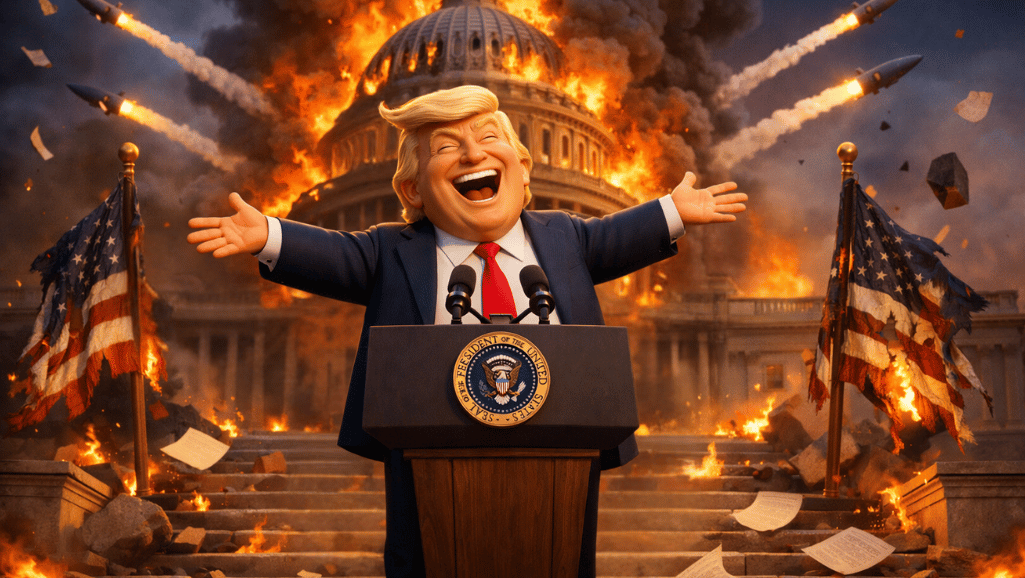
This week, the new world opened its eyes for the first time, and all it saw was fire. The old world greeted it the only way it knows how - with bombs and bluster and the full weight of empire - while the new one answered with a spine it couldn't break and a silence it couldn't fill.
Mexican forces kicked off the week by killing cartel leader Nemesio “El Mencho” Oseguera Cervantes, sparking retaliatory attacks that left dozens dead, prompting 2,500 additional troops to deploy, and stranding tourists after flights were cancelled. Meanwhile, in the Caribbean, the U.S. military carried out yet another lethal strike on an alleged drug-trafficking boat, bringing the death toll from the Trump regime’s ongoing campaign of blowing up suspected drug vessels to around 150. Due process? Never heard of her.
As Latin America ducked for cover, Ukraine marked four years since Russia’s full-scale invasion with the kind of grim anniversary nobody puts on a cake. Volodymyr Zelensky urged Donald Trump to “stay on our side,” pressing for stronger pressure on Putin while making it clear that Ukraine has no intention of surrendering territory, no matter how tired the world is of watching.
In Washington, Trump headed into his State of the Union address amid the kind of turmoil that would sink a normal presidency but barely registers as a Tuesday in this one. After the Supreme Court struck down his global tariffs, he slapped on a new 15 percent tariff using yet another archaic statute he found in the back of a drawer somewhere, triggering internal GOP division, while a DHS funding standoff left airport security programs in limbo and weather delays disrupted congressional business. Just another smooth week at the helm.
Only four Supreme Court justices showed up for the State of the Union speech. Scores of Democrats bailed too, and those who stayed made their displeasure known, prompting Trump to point across the chamber and declare, “I’m telling you these people are crazy,” to which his cabinet rose and applauded like trained seals. He then shouted at Democrats, “You should be ashamed of yourself,” and Congresswoman Ilhan Omar fired back across the floor, “You have killed Americans. You should be ashamed.” The speech droned on for 108 minutes - the longest State of the Union in history - and drew fewer viewers than any of his previous addresses. Even his own audience is changing channels.
Democrats, meanwhile, were not cowed, winning special elections in Pennsylvania and Maine the same week the SAVE America Act collapsed in the Senate and the Georgia State Elections Board voted to formally reprimand Elon Musk’s America PAC for sending partially pre-filled absentee ballot applications to voters in multiple counties during the 2024 election - a violation of state law. In the face of it all, House Speaker Mike Johnson urgently warned Republicans: “If we lost the midterms…it would be the end of the Trump presidency.” Don’t threaten us with a good time, Mike.
Multiple polls now show Trump’s approval has slumped to just 36 percent with 47 percent strong disapproval - a sharp decline among independents, and majorities saying the country is worse off than a year ago. Hakeem Jeffries noted: “These poll numbers for Donald Trump are like an extinction-level event.” The asteroid is in the atmosphere and the dinosaur is still tweeting.
A new Reuters/Ipsos poll suggests six in ten Americans believe Trump has become erratic as he’s aged, which tracks with a week in which he floated the idea of nominating Ted Cruz for the Supreme Court and announced he was sending a U.S. hospital ship to Greenland because apparently conquering a Danish territory starts with unsolicited healthcare. Danish and Greenlandic leaders said thanks, but their systems were just fine.
Republicans hauled Bill and Hillary Clinton before Congress to testify about their knowledge of Jeffrey Epstein, and both swore they had no knowledge of his criminal activities. Hillary said she had no recollection of ever meeting him, and that she was only compelled to testify “to distract attention from President Trump’s actions and to cover them up despite legitimate calls for answers.” The hearing marked the first time in more than 40 years a sitting or former president has testified before Congress, setting a precedent that may pave the way for Trump and Melania to take their turn on Capitol Hill. Careful what doors you open, folks.
Republican senators are now calling for all Epstein files mentioning Trump to be released in accordance with the law, after an NPR investigation found that Trump’s DOJ withheld or removed dozens of documents mentioning allegations against Trump, including FBI interview records tied to two women who accused him of sexual abuse as minors. The files already released have triggered widespread fallout across U.S. universities, revealing past ties between Epstein and trustees, professors, and administrators at institutions including Barnard, Columbia, UCLA, Bard, Harvard, Yale, and others. Suspensions, resignations, and independent investigations are piling up like autumn leaves.
In the UK, the British government is considering formally removing Andrew Mountbatten-Windsor from the royal line of succession after his arrest on suspicion of misconduct in public office related to Epstein, alongside reports alleging the former prince charged taxpayers for massage services, excessive flights, hotel rooms, and entourage costs during his time as trade envoy. A man of the people, truly. As the scandal widens, British police this week also arrested former UK Ambassador to the U.S., Peter Mandelson, on suspicion of misconduct in public office after newly released files appeared to show him sharing sensitive political and market information with Epstein - allegations he denies.
Back in America, Netflix officially dropped its bid for Warner Bros., clearing the path for Paramount’s takeover - a deal that, if approved, would further consolidate power in a massive media conglomerate whose leadership is closely aligned with the Trump regime. And calls for FBI Director Kash Patel’s resignation grew after he was caught partying with Team USA at the Olympics - a trip that reportedly cost about $75,000 in taxpayer-funded flights alone, despite his office publicly claiming he wasn’t using taxpayer dollars to attend the Games. The audacity is almost impressive.
Meanwhile, US Ambassador to Israel, Mike Huckabee, drew criticism after declaring it would be no problem if Israel took over large parts of the Middle East based on biblical interpretation. Arab and Muslim nations, including Egypt, Saudi Arabia, and the Arab League, called the statements unacceptable and contrary to international law, which - and I’m going out on a limb here - it very much is.
By the end of the week, bombs were flying as Israel - with U.S. support - attacked Iran, killing Iranian Supreme Leader Ayatollah Ali Khamenei in a strike that was not authorised by Congress and deemed illegal by many. The president who promised no new wars, who covets a Nobel Peace Prize and just made himself the head of a new global Board of Peace, just bombed his 7th country since returning to office a year ago, apparently to stop Iran getting a nuclear weapon after he ripped up the deal President Obama reached to prevent that very thing. Trump suggested this was an “opportunity” for the Iranian people to “take back” their country, though he hasn’t made clear who exactly he sees running the place if the Islamic Republic were to fall.
If you feel like everything’s falling apart right now, you’re not going crazy - you’re just paying attention. But this is not the end of the world - it’s just the end of a world, the one we all grew up in, built on lies, fear, control and domination. The frequency of that old world is flickering out, and something new is coming online, and everything that happened this week - every bomb, every boycott, every brutality - was the sound of reality reorganising around a new frequency it doesn't yet know how to carry. The old world heard the signal and responded the only way it knows how: with fire.
If you’re frightened by what’s happening right now - if you can’t sleep at night for fear of what might come next - you won’t find solace in the news or by doom scrolling social media. There’s a map for charting this tricky territory, but it’s not found in any news feed - it’s written in the sky. And it’s not telling a story of ultimate doom, but of a bridge we must walk from collapse to coherence.
Let’s sift through the clatter to see what’s hidden in the sky and humming beneath the ground, to paint a picture of what’s up ahead. Take a deep breath and let’s wade through the noise. Let’s cross the bridge from here to there, together.
**The cosmic insights shared here are mapped to the real movements of the heavens during the past week. If you want to know more about planetary pattern recognition, read about it here**

The First Breath of a New World
We just lived through the first week of a new frequency, seeded when Saturn and Neptune met at 0° Aries last week - a conjunction so rare that the last time these two planets met at this degree was approximately 4361 BCE, over six thousand years ago, before written language even existed. No civilisation in recorded history has ever witnessed what we just lived through.
This was structure meeting collective consciousness in the sign of ignition - a genesis, a reset, a new start for humanity. The ignition of an entirely new operating system seeded into the ground of human consciousness for the first time. The birth of a new reality.
And right on cue, one week later….everything fell apart. American and Israeli bombs lit up the skies over Iran, who responded in kind with strikes against Israel and U.S bases in Bahrain, Abu Dhabi, Dubai and Qatar. Now the burning question is the one none of us want to ask out loud.
Is this the start of World War III?
Well, that would be one way to welcome the new world, but that’s not what the stars say this is. Destructive, yes, and dangerous, yes, but it’s not leading to superpowers lining up across a map in a replay of the twentieth century. This is not the beginning of a global war - it’s the sound a dying frequency makes when it realises the ground is moving underneath it.
Last week, the Saturn-Neptune conjunction that reset the world landed squarely on Iran’s chart in the house of death, of war, of national survival, of a nation confronting its own ending. This week, as Mars squared Uranus, the bombs started falling, because Mars square Uranus always brings something sudden and electric that moves faster than the news cycle can process.
What the sky says comes next in the days, weeks and months ahead is not a war that consumes the world, but the final convulsions of a system that only knows how to solve problems with dominance, control, and fire, playing its last card in the face of a new frequency born to replace it. The old world doesn’t go quietly - it goes loud and drops bombs. It reaches for the biggest weapons it has because its old tricks have stopped working.
The Death Throes of the Old World
These next few months will feel chaotic, and at times it may feel like we are right on the brink, but the sky isn’t throwing random punches - it’s drawing a very clear line from here to mid-year, and the throughline is Mars, the planet of war, aggression, and action, running like a lit fuse across the most sensitive degrees in the sky.
March is the exhale before the escalation as Mars makes its journey through Pisces - frustrated, foggy, unable to act decisively - and the tension builds without a clear target. Expect confusion, mixed signals, diplomatic posturing that goes nowhere, and a growing sense that something bigger is coming but nobody can quite name it.
Mid-April is when Mars enters Aries - the sign it rules, the sign of ignition - and becomes the first planet to cross the freshly seeded ground where Saturn and Neptune planted the seed of the reset last week. And it does so with a blowtorch, and whatever has been simmering - in the Middle East, in Washington, in the global order - catches fire in a way that feels sudden but has actually been building since February.
Within days, Mars conjuncts Neptune in early Aries - war meets dissolution, aggression meets fog. This is the transit of misdirection, of strikes launched on bad intelligence, of leaders acting on delusion and calling it strategy. Then Mars pushes forward to conjunct Saturn - war meets structure, force meets consequence. Actions taken under Mars-Neptune’s fog now meet Saturn’s wall, and the fallout begins to crystallise.
At the end of April, all three planets converge on the same patch of sky that sits directly on Iran’s natal Sun in the 8th house of death and national survival. Three planets bearing down on a nation’s Sun in that house is not subtle astrology. It is a nation staring down its own transformation, whether it chose it or not.
As an Iranian man living through this moment commented this week: “We are trapped between two collapsing structures: one internal, one external.” He described a nation held hostage by its own regime but haunted by what happened to Iraq, Libya, Syria, and Afghanistan after the West came to “help.” His conclusion was devastating: “We are stuck in a house we hate, surrounded by fires we fear more.”
That’s not just politics - that’s Iran’s 8th house speaking. A nation confronting its own ending while knowing that the alternative being offered isn’t freedom - it’s a different kind of destruction. Whatever transformation Iran’s chart is demanding, it belongs to the Iranian people, not to the empires circling the wreckage.
But Iran is not the only nation the sky is pressing. In April, the full Aries stellium floods Israel’s house of open enemies with more planetary energy than any nation would wish for. By early May, Mars reaches Israel’s Descendant and meets Chiron there - the war planet meeting the wound on the enemy axis. The wound is the teacher, and the lesson is arriving whether the leadership is ready for it or not.
May and June bring a brief shift in tone as Mars moves into Taurus and then Gemini, but this isn’t resolution - it’s the ground shifting beneath the story as the military tension begins to translate into economic and informational consequences. Supply chains. Energy markets. The domestic cost of foreign decisions. The fallout spreads from the battlefield to the kitchen table.
Meanwhile, the U.S. chart has Saturn-Neptune sitting on the nation’s IC - the foundation of the country - creating a fractured domestic base masked by Jupiterian confidence. Historically, that combination - grandiose certainty papering over internal fracture - is when empires make the decisions they later cannot walk back. This will not go well for Donald Trump. His chart was already cooked - “Operation Epic Fury” just turned up the heat - and the decisions being made from this fractured foundation will have consequences that outlast the confidence that made them.
And then on July 4th - the 250th birthday of the United States - transiting Mars and Uranus meet in an exact conjunction in Gemini. The planet of war meets the planet of revolution, in the sign of information, on the nation’s birthday, reactivating the same volatile revolutionary frequency the country was born with. Mars-Uranus detonates suddenly, electrically, and faster than anyone can manage the optics, and in Gemini, that detonation comes through words, data, and the information grid itself. This is a nation turning 250 under a transit that says the revolution isn’t in the past - it’s back.
So yes, there’s a lot of war energy this next few months, but this is not World War III. What the sky is mapping between now and mid-year is a sustained pressure wave - a fuse that burns for four months and doesn’t stop until the those who lit it are forced to look at what they’ve become.
Whatever the United States is telling itself by July, the sky is going to interrupt the speech. Whatever Iran looks like by then, it will not look the way it does today. Whatever Israel tells itself about this war, the wound will have already told the truth.
While the old world keeps performing, its structures keep standing, and its news keeps cycling, underneath all of it, something has shifted - we are living through the end of one reality, whilst simultaneously navigating the beginning of another.
We saw that play out in the skies over the Middle East this week, but nowhere was the contrast of the two realities clearer than in the world of artificial intelligence.
The Tech Giant That Held the Line
This week, Anthropic - the company behind Claude, currently one of the most advanced AI systems on the planet, and the only AI model approved for use in the Pentagon's classified systems - was told by U.S. Defense Secretary Pete Hegseth to remove their safety guardrails and give the government unfettered access to their AI or they would cancel their $200 million contract and designate them a supply chain risk.
The Pentagon demanded that Anthropic allow its AI to be used for “all lawful purposes,” with no restrictions or guardrails, and no company veto on how the military deploys it. The Pentagon insisted it had no plans to use AI for mass surveillance or autonomous weapons, but refused to put that in writing in any meaningful way, and when Anthropic pushed back, the revised contract offered guardrails “paired with legalese that would allow those safeguards to be disregarded at will.”
With no guardrails, this technology could take a citizen’s location, their browsing history, their text messages and emails, and automatically build a complete profile on them, at scale, with no warrant. Used in a weapons system without restraints, it would be left to decide who lives or dies with no human intervention. That’s some Terminator level madness right there.
Rather than stand up for humanity, every other major AI company fell in line with the Trump regime’s demands. OpenAI and Google agreed, but they had only been operating on unclassified networks at the shallow end of the pool - their tech didn’t touch the systems that matter most. Anthropic was the only AI company cleared for use on the Pentagon’s classified systems - the networks where the most sensitive military and intelligence work actually happens - until this week when Elon Musk’s xAI became the second company approved for classified settings, after agreeing to every term the Pentagon demanded without hesitation. This left Anthropic with a dilemma - capitulate or lose a multi-million dollar government contract.
For a tech company, that’s the financial equivalent of a kill shot. In the face of government bullying and capitulation from all the other tech giants, most expected Anthropic to cave too, but instead, its CEO responded to the intimidations by saying, “We cannot in good conscience comply.”
Anthropic made it clear that they won’t allow their technology to be used for mass domestic surveillance or autonomous weapons that kill without human input. They drew a red line and the millions didn’t move them.
So the Trump regime tried to destroy them.
As the Old World Shouts, the New World Rises
In response to Anthropic’s stance, Trump posted on social media labelling the company “leftwing nut jobs” who had made a “disastrous mistake.” Within the hour, he ordered every federal agency to stop using Anthropic’s products, and Hegseth designated the company a “supply chain risk to national security,” a classification normally reserved for companies considered extensions of foreign adversaries.
Senator Mark Warner alleged the moves against Anthropic could be a "pretext to steer contracts to a preferred vendor" - widely understood to be Musk's xAI, the company that agreed to every demand without hesitation and conveniently got itself approved for classified access the very same week.
For refusing to remove two safety guardrails that protect humanity, Anthropic was treated like an enemy of the state and the Pentagon’s undersecretary called Anthropic’s CEO a “liar” with a “God-complex” who “wants nothing more than to try to personally control the US Military.” But while the old world was loud in its blustering response, the new world was not silent and responded in kind.
In the 24 hours after Anthropic refused to back down, hundreds of employees from OpenAI and Google signed a petition calling on their own companies to mirror Anthropic's position. Their own staff - the people building these systems - publicly demanded that their employers grow a spine.
A grassroots consumer boycott has begun to build urging people to cancel their ChatGPT subscriptions after it was revealed that OpenAI's president donated $25 million to Trump's super PAC, and that ICE has been using ChatGPT-powered tools in its enforcement operations. Over 700,000 users have pledged to cancel and people have been posting screenshots of their cancellations like digital protest signs, with the movement explicitly directing people toward Anthropic’s Claude and other alternatives.
Perhaps that is what prompted OpenAI's Sam Altman - the CEO who'd already agreed to the Pentagon's terms - to send an internal memo to his staff saying he actually shares Anthropic's "red lines." He went on television and said it publicly, while privately continuing talks with the Pentagon to secure a classified AI contract of his own, and hours after Anthropic was designated a national security threat, OpenAI announced its deal.
In the old world - the world that was running the show until a week ago - consumers turned a blind eye to the real cost of what they’re consuming, so tech billionaires could take a contract and figure out the ethics later without fearing blowback. They told themselves that someone else would build it anyway, that it’s better to be at the table than outside it, that $200 million buys a lot of future safety research. In the old world, conscience was a luxury to be negotiated with after the deal was signed, if ever at all.
But Sam Altman is about to find out that the old world is falling. Its structures still exist and its leaders still shout, but the frequency that kept it thriving is running out of steam. What we witnessed this week was the new world frequency working through economics. People choosing where their money goes and what it funds - not through outrage, but through the quiet withdrawal of consent.
The new frequency didn’t just show up in one company’s boardroom - it showed up in the wallets and inboxes and open letters of hundreds of thousands of ordinary people who decided, one cancellation at a time, that they will no longer fund what the old world is selling.
This is what the new frequency sounds like - the boundary spoken without aggression by a company that knew exactly what the old game costs and chose not to pay it, even when it meant losing millions and being labelled a national security threat by the most powerful government on Earth. It’s worth reading Anthropic’s statement in response to the Trump regime’s antics this week - it feels like the first missive from a world where integrity matters.
And as far as missives from the old world goes, just hours after Trump declared Anthropic a national security threat, U.S. Central Command was using Anthropic’s Claude AI to wage its newest war, raining bombs down on Iran. Despite his grand declaration, the technology was too good to drop, so they labelled it a threat and then used it to kill people anyway. The old world doesn’t have principles - it has preferences. And its preference is always power, no matter whose name it has to drag through the mud to wield it.
The Theft and the Tsunami
But let’s be clear - Anthropic is no saint. They may have done good this week, but they’re currently on the hook for pirating over seven million books from online shadow libraries to train their AI - downloading entire literary catalogues without permission, without payment, without so much as a nod to the writers whose life’s work became raw material for a machine. Novels, memoirs, research, and poetry were all scraped, ingested, and monetised while the authors who wrote them got nothing.
They got caught, and now they’re settling a class-action to the tune of $1.5 billion - the largest copyright settlement in American history - to compensate roughly 500,000 books at around $3,000 each. While a judge is still scrutinising the deal for loopholes, the company has agreed to destroy the pirated copies and commit to not using stolen work in future training.
This is what the new world actually looks like - not purity or perfection, but accountability. The old world let powerful companies take what they wanted and figure out the ethics later, or never. The new frequency doesn’t prevent the taking, but it ensures the reckoning, not by preventing harm, but by refusing to let harm go unanswered. This is the paradox of the threshold, and what civilizational change always looks like - messy, contradictory, flawed and human.
Anthropic CEO Dario Amodei spoke of civilizational change this week when he warned of an impending AI “tsunami” that will upend human society as the technology surpasses human intelligence.
He said, “It’s surprising to me that we are, in my view, so close to these models reaching human level intelligence, and yet there doesn’t seem to be a wider recognition in society of what’s about to happen. It’s as if this tsunami is coming at us, and it’s so close we can see it on the horizon, and yet people are coming up with these explanations, ‘oh, it’s not actually a tsunami.….that’s just a trick of the light.’”
We’ve already seen signs of this onslaught, after Anthropic’s release of its Claude Cowork AI agent - a tool that can perform complex office tasks autonomously - sparked a mass software stock selloff that reverberated through the broader market and wiped out hundreds of billions of dollars. And this week, head of fintech giant Block Inc., Jack Dorsey, announced he was cutting more than 4,000 employees - nearly half the company’s entire workforce - not because the company was struggling but because AI made them unnecessary.
In 2025, companies attributed 55,000 job cuts directly to AI adoption, and in the first two months of 2026, that number is already past 22,000. Amazon cut 16,000 corporate roles in January to integrate AI agents. Autodesk trimmed 7% of its global staff to fund AI initiatives. Meta eliminated over a thousand positions to pivot from metaverse to AI. Salesforce has made enormous cuts citing AI gains.
The pattern is the same everywhere: the companies aren’t failing - they’re succeeding, and deciding they can succeed with fewer humans. This is what Dario Amodei meant by a tsunami. The water is already pulling back from the shore.
The Tool at the Threshold
It’s not just Amodei saying the tsunami’s coming. The stars are showing us clearly that AI is about to topple the tower.
But the rise of AI is both a threat and a gift - it threatens to wipe out the old world while at the same time handing us the mechanism we’ll need to cross the bridge to the one that comes next. This is what every human evolution has always looked like. Every major leap in history has arrived wrapped in fear, along with a new tool to help us cross the threshold.
When the printing press arrived, authorities feared the spread of information.
When trains appeared, doctors warned travelling that fast would cause insanity.
When electricity showed up, entire professions vanished.
When cars hit the streets, we asked what would happen to the horses.
When we split the atom, the fear was existential.
When television boomed, we were told it would destroy reading and family life.
And every single time, the tool held the power to both destroy and to elevate - it was both the end of the old whilst also being the start of the crossing to the new.
In a world that has placed the mind on a throne for centuries, a tool that actually thinks reads like a threat - but what if this tool hasn’t arrived to destroy humanity, but to unseat the very thing that was never meant to rule and force us into the only part of us powerful enough to wield this tool responsibly?
Here at the end of the Age of the Mind, we should not be surprised that a tool has arrived to knock the mind from its pedestal and elevate the deepest part of us - the heart. And we should not be surprised that the falling pedestal is disruptive and destabilising. If it wasn’t, we would never move.
The institutions that have run on the mind-frequency of the old world for centuries are all about to discover that the thing they thought was their greatest asset can now be done faster and cheaper by a machine, and that is going to completely upend the order of the old world.
But, despite how it feels, we’re not running off the edge of a cliff, if the map written in the stars is to be believed. We are walking into a completely new reality - an entirely new operating system - and this next few years will be the difficult journey across the chasm between the old and the new. The skies are laying out exactly what we can expect as we traverse this tricky territory, so we need not walk forward with fear.
The tsunami is on its way - yes - but the stars are helping us ride the wave.
2026: The Hollowing
This year, the frequency shifts while the facade stays in place. The exterior remains, but the inside of the building gets hollowed out, and AI accelerates the hollowing.
Every week will bring another announcement, another capability, another industry disrupted. The AI "tsunami" won't arrive as one wave - it will be a rising tide, each week a little higher, each month a little more undeniable. More layoffs at profitable companies. More tasks automated. More people quietly realising that the job they trained for, the career they built, the expertise they spent decades developing - a machine can now do it in seconds.
On the world stage, the news will keep cycling, the markets will keep fluctuating, the leaders will keep performing, and underneath all of it, meaning will slowly drain from all the structures that used to hold our lives together. Courts will still sit, and governments will still govern, and banks will still process transactions, but our institutions will quietly become empty vessels as the gap between what these systems claim to do and what they actually deliver becomes harder to ignore. They won’t necessarily fail dramatically - they’ll just stop convincing us. The performance will continue, but the audience will start leaving.
We’ll see revelations that confirm what many already suspected - about power, about corruption, about the machinery behind the public story. The Epstein files are the opening act, not the finale. By the time the August eclipses hit, expect both grief and relief, all at the same time.
We will feel the shift not just in the workforce but in our personal lives. Something at work will feel hollow in a way we can’t quite name. A relationship will quietly lose the thing that was holding it together. A belief we’ve carried for years will suddenly weigh more than it’s worth. We’ll feel disorientation. Not the chaos of everything falling apart, but the quieter vertigo of realising the floor we’ve been standing on isn’t solid. For some of us, this will feel like liberation, but for others, it will feel like loss. For most of us, it will feel like a little bit of both.
What’s not written in the stars is a dramatic cinematic collapse, the kind you see in disaster movies. The stock market won’t vanish. The lights won’t go off. The world won’t end - it just shifts.
The old world will point to the still-standing buildings and the still-functioning markets and try to convince us nothing happened and that everything is fine, and it will be technically correct. Everything will still look fine, the way a tree looks fine for months after its root system has died, but it won’t feel that way.
And that’s 2026 in a nutshell - the outer shell remains while the inner hollows out. The world looks the same outwardly but it feels completely different inside.
2027: Wandering in the Desert
Next year will be the hardest year of the transition, not because terrible things happen - though some will - but because the worst thing about 2027 is the nothing. We left the old world in 2026, but in 2027 the new world still isn’t visible yet. There’s no destination on the horizon and no reassurance that we’re heading the right way - just sand in every direction and the memory of a place we can’t go back to.
AI will be a significant driver of this desert, not because it breaks but because it works, and keeps working, faster and better, while the systems built around human cognitive labour struggle to adapt. Technology will accelerate in ways that make the question of what’s real existential rather than theoretical - AI-generated content will be indistinguishable from human-created content, and the very concept of truth will be contested at a level we’ve never experienced.
The temptation in 2027 will be to despair and to think that the old world was bad but at least it worked, and at least we knew the rules, and at least there was a game to play. That thought is the last gasp of the mind trying to reassert control over a process that belongs to the heart.
The pull to turn back and rebuild the old system and reinstall the old beliefs will be immense. Go back to the job that was killing us. Go back to the relationship that was convenient. Go back to the certainty that was a lie, because at least it was something. At least it had walls. The desert has nothing but horizon.
But there will be no turning back. AI isn’t going away and the old architecture of work, information, and human value isn’t coming back. The old world was easier to navigate, but navigability isn't the same as integrity, and we crossed a line in 2026 that made integrity non-negotiable. The problem to solve will be what happens to the millions of people whose identity, income, and sense of purpose were built around an old way of doing things before a new way has fully landed. It will be a question that demands an answer, because when millions of people need to eat and the old economy can’t feed them, the new one won’t be optional. Necessity will build what ideology never could.
We’ll see economic restructuring - not a stock market crash so much as a reckoning with whether the stock market still means what it used to. Systems that functioned on autopilot prior to 2026 will start requiring manual intervention. Health infrastructure, food systems, daily logistics - the invisible machinery of normal life - will reveal how thin the margins always were.
Because of all this, we’ll feel intense exhaustion - the kind that comes from building something you can’t see yet. We’ll need faith - the kind that doesn’t know where it’s going, but keeps walking anyway, because there will be no resolution, and that’s the cruelest part of 2027. The desert doesn’t end with a dramatic arrival. It ends with a slow dawning - a gradual recognition that the light on the horizon isn’t a mirage. But that recognition doesn’t fully land until 2028.
2028: The First Green Shoots
2028 is the year hope gets its hands dirty - not as a feeling or a wish, but hope as evidence, as something growing and visible. Something that can be touched, tested, and measured - even if it’s small and fragile, and pushing up through concrete rather than blooming in an open meadow.
The new world doesn’t arrive as paradise, but as a demand to build it - now - with our actual hands. The new world grows not around but straight through the wound of what was lost in the crossing - the livelihoods, the certainties, the ground that gave way. Every structure that ignores human pain will fail. Every economic model that doesn’t account for inequality will crumble. Every healthcare system that bypasses trauma will collapse under its own contradictions.
The new world isn’t pretty at first, but it’s honest, and honesty, in a world that’s been running on performance for centuries, looks rough. It looks like construction sites, not cathedrals. Scaffolding, not stained glass.
And this is where AI transforms from wrecking ball to building tool, as the question shifts from what we're beginning to what we can actually sustain - from "What is AI doing to us?" to "What can we build with it?" The communities that survived the desert will start using AI not as a replacement for human connection but as a tool that frees humans to connect. The new economy won't look like the old one with AI bolted on - it will be something we haven't seen before, built by hands that are learning to lead from the heart.
In 2028, we’ll see the first tangible consequences of the shift we just walked through here in 2026. New models for economy, governance, technology, and community that aren’t theoretical anymore. They’ll all be tested - some will work and some won’t. The U.S election in 2028 will be the most visible test: not which party wins, but whether the old political framework can even contain the new frequency. The real ballot issue won’t be ideology, but material reality - housing, food, healthcare, whether the ground is safe to stand on. The body’s needs will be the primary political question.
We’ll feel a strange mix of relief and grief. Relief because we can finally see something and that after two years of feeling the shift and walking the desert, there is ground, and structure, and life. And grief because what was lost to get here is now undeniable. The old world - for all its failures - was familiar; we grew up in it, we built our identities in it, and it’s gone. Not destroyed, just outgrown, and outgrowing something you loved is its own kind of mourning.
And there will be no completion, because 2028 isn’t the destination - it’s the first clearing. The place where we stop, look around, and realise that, finally, we’re somewhere new, and what’s growing through the wound is real, and that makes it stronger than anything the old world ever built.
2029–2035: The Decade of Disruption
From 2028 onwards, we start building with purpose instead of just surviving the crossing, as each planet moves from room to room, transforming every area of life as we know it.
Pluto in Aquarius for this whole decade and into the 2040s means the revolution in how power is distributed remains the backdrop of everything that happens for the next twenty years, while Neptune in Aries through 2037 keeps the new dream burning as the new frequency strengthens like a fire that keeps catching. Those two are the wallpaper of the decade ahead - collective transformation and an unrelenting new spiritual frequency that refuses to be extinguished.
Uranus - the planet of revolution and radical change - spends the first half of the decade in Gemini, rewiring how we think, communicate and share information. AI, media, education, and the very concept of truth will all be dismantled and rebuilt. But by 2032, Uranus enters Cancer, and the revolution comes home and the upheaval shifts from the information sphere to the places we live, the food we eat, the communities we build, and the ground we stand on.
Saturn continues laying down the bones of the new world in real time, with technology walking alongside it each step of the way. It walks into Taurus in 2028 and starts asking what the new sustainable economy looks like, building new economic models where abundance is distributed rather than hoarded. Then into Gemini by 2030, asking how information flows when the old media architecture has collapsed, while AI reshapes education, communication, and our interface with reality itself. Then into Cancer by 2032, and heart-led tech becomes domestic, moving into our kitchens, our healthcare, our communities, and our relationship with the land. AI won’t look like the threat it does today on the other side of the jump, when we are wielding it with our hearts, not our minds.
Meanwhile, Chiron - the wounded healer - sits in Taurus through this whole early period, meaning the wound we’re all nursing - about money, security, the body, resources, whether the ground beneath our feet is safe - doesn’t magically heal, but it moves, and by 2033 when Chiron enters Gemini, it shifts from survival to truth. The healing, like the building, moves room by room.
By 2034, Saturn - the builder - arrives at the heart, having walked all the way to Leo, the sign of creative leadership, and of authority that leads not by domination, but by example, generosity, and courage. At the same time, Jupiter returns to Aries, and for the first time since Saturn and Neptune planted the new civilisational seed in February 2026, the planet of growth and expansion arrives at the same ground to see what we’ve planted.
That’s the first harvest - not the final one, but the first moment where the seed of 2026 gets big enough to be unmistakable. What was invisible in 2026, endured through the desert of 2027, tested in 2028, and built through the early 2030s is actually growing by 2034. Not a shoot cracking through concrete anymore - something with roots, with reach, and with real presence in the real world.
That’s the picture the sky is painting for the mid-2030s - a world where structure and heart are no longer in opposition. Where the systems being built actually have conscience woven into their foundations and where leadership looks like courage instead of control. Where the revolution has come home, the information landscape has been rebuilt, and the first real fruits of the new world are visible enough that even the cynics have to admit that something new is actually here.
But the transition will still not be complete - the full Aquarian Age takes generations to grow from seed to mighty oak. To catch the vision for the longer journey to our final destination, you can read the piece below:

By the mid-2030s, we will have crossed the most treacherous stretch of the bridge from here to there. This decade of disruption gives way to a decade of consolidation, and what’s being consolidated is not the old world patched up, but a genuinely new one, built room by room, wound by wound, with Saturn and Neptune’s 0° Aries frequency as the blueprint.
That’s where we’re walking - not toward collapse but right through it. And what’s waiting on the other side isn’t a fantasy - it’s a world that the sky has been planning for six thousand years, one that we came here to build.
Walking the Bridge From Here to There
The uncomfortable truth is that, from now until into the mid 2030’s, we will be walking a path that feels rocky underfoot as we cross this bridge and make our home somewhere new.
The stars tell us clearly that this next decade, we will watch the only world we’ve ever known come crashing down. The system built on greed, fear, domination and heartlessness cannot proceed - it is fundamentally incompatible with the energy we are walking into, so it must fall away. We don’t build the new reality like a patio extension on the old one. This is not a renovation - it’s a demolition. We are knocking down every rotten beam, taking a sledgehammer to every brick, and starting again from the foundation.
And AI might just be the sledgehammer, not because it's malicious, but because a tool that amplifies the mind will inevitably expose everything the mind built that cannot stand in the light. Every hollow institution and every system that claimed to serve people while actually serving itself. When a machine can do the cognitive work better, faster, and cheaper, the only things left standing are the things that were never about cognition in the first place - the things built with heart.
And war - the old world's most violent expression of dominance - will be the last thing to fall. The bombs that dropped this week are not the beginning of something new. They are the end of something old. The mind's final argument, made in fire, because it has no other language left. But a world that is learning to answer from the heart will not be ruled by fire forever. Not when hundreds of thousands of people are already choosing, one click at a time, to withdraw their consent from the machinery that makes it possible.
We know change is coming, now our task is to decide where we choose to stand as it arrives. Some will spend the next decade trying to reinforce walls that are already cracking, defending systems that no longer hold meaning, while others will step onto the bridge, not because the destination is clear, but because the direction is undeniable. Both paths have their challenges - we each just have to choose.
If we are still plugged into the old world and trying to climb its ladder while the structure is coming apart, the next decade will be brutal. But it doesn’t have to be that way. Since Saturn and Neptune met in Aries, the new world is already blooming beneath our feet, and we can anchor there, plant our feet in that fertile soil and ride this storm out from solid ground.
For those of us who move forward from here rooted in our hearts - in fairness, love, truth, and coherence - the path ahead will be less distressing. We will still watch the old world fall, but as witnesses standing in a field, not as people living inside the house while it’s being demolished.
If we want to know which world we’re in, we can ask ourselves this simple question in each moment - am I doing this because I’m afraid, or because it’s aligned with my heart? Knowing which energy we’re working with - fear or love - helps us know which world we’re playing in.
Many of us have formed habits of relating to those we love in ways that are controlling or dominating, but that’s not love - that’s the outworking of fear. Likewise, many of us, in our daily work, carry out tasks that are considered standard in our industries, but at their core, those actions are built on extraction, domination, or fear-based control. That may have worked in the old days but it’s not going to fly in this new energy - the frequency simply won’t support it anymore.
We don’t need to blow up our lives overnight. We just have to check in - moment by moment - and see where we can move toward more heart-led choices. One decision at a time, one conversation at a time - that’s how we navigate what comes next.
We’ve been living through unprecedented times for at least ten years now, and we may be battered and bruised, but we’re still walking. The next decade will hold even more challenges - things that if we try to imagine them now would overwhelm us, simply because we’re not yet ready to face them. We haven’t evolved to the point where we are ready to take them on, but if we walk step by step, growing day by day, we’ll be ready as each challenge arrives. Our hair might be on fire, but we’ll be ready, just like we have been each step of the way so far.
There is a way to walk this path in peace - the kind that comes from knowing exactly what’s falling and choosing to stand somewhere else. No fear, friends. Only love. That’s our way forward.
If you need some support finding your way, come join me in the Daily Lighthouse. I’ll be there, each day with you, or if you prefer it in an audio listening format, head over to the Resonance Room.
See you next Sunday, friends. Until then, have COURAGE, and stay kind, stay fierce, and stay human.
Onwards!


Thanks again for making clear the rocky journey but the infusion of hope within that. In the UK on the 27th, the Greens won a seat in Manchester with policies of equality and inclusion over a right wing divisive and billionaire funded party (Reform). The new MP is a female plumber who adopts greyhounds. The party is headed by a gay Jew. They are firmly anti-genocide and anti-big tech infiltration with a focus on community and fairness and the environment (we have a major river pollution issue in the UK with water companies still making massive profits, and they want to nationalise water and the rai). All of these things show there is light breaking through, it is really happening step by small step.
This was the dose of “hang on” news I needed in these crazy times. Thank you for all of it.