


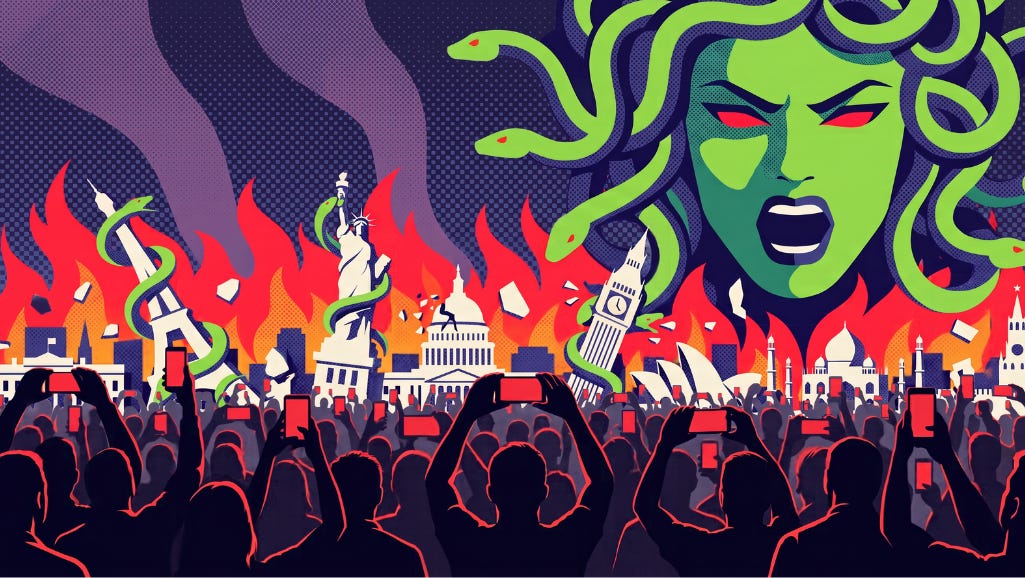
There are weeks when one story stops the world, and then there are weeks like this one, when the stories come so thick and fast that none of them gets the chance. The worst horrors imaginable came streaming out of our phones at us like a fire hose this week, aimed at a world that has no idea how to drink from it.
In Ukraine, a Russian drone hit a public park and killed six people, including a young mother and her baby, after Trump waived the Russia sanctions Congress passed, and the Wall Street Journal reported that Elon Musk had personally ordered Ukraine’s Starlink connection throttled, which left its drones useless for days.
In the wake of it all, Trump’s envoy Steve Witkoff sat down with Putin in St Petersburg and told him he was a humanitarian, and then, within hours, Russia put 21 missiles into Kyiv, some with cluster warheads, hitting the metro, a rail station, a monastery and a clinic.
The Iran war, now in its eighth month, grows hotter by the day, with Iran this week declaring that seven tankers had been hit by mines or strikes in the Strait of Hormuz, the most since the war began, and Brent crude passed $112 a barrel. The US State Department ordered non-emergency staff and their families out of Saudi Arabia after Houthi missiles hit Dammam airport and sent Aramco out of its headquarters.
Meanwhile, Vanity Fair dropped a bombshell about Trump’s envoy to the Middle East - his son-in-law, Jared Kushner - alleging Dutch military intelligence hacked Kushner’s iPhone in 2018, while he was a senior White House adviser, and watched him log into a bank account in Abu Dhabi holding about $750 million, funded by the rulers of the UAE and Saudi Arabia, with Kushner as a signatory. Reportedly, a second account at Israel’s central bank held about $1 billion more, with money routed through Azerbaijan to hide where it came from. Kushner denied it all and demanded the excerpt be taken down, and Trump called it “a totally false story.”
In Jordan, two gunmen opened fire on a funeral at a Greek Orthodox church in Karak and killed seven people. The kingdom declared three days of mourning.
In Canada, months of noise about Alberta breaking away came down to an actual vote, and about 76% of Albertans chose to stay. Meanwhile, next door in British Columbia, a snap election called two years early swept the centre-left NDP from power, as the Conservatives formed their first government there in nearly a century. Their interim leader, Lorne Doerkson, saying his top priority is repealing the province’s law enshrining the rights of Indigenous peoples.
A magnitude 7 earthquake in Tibet killed at least 16 people and flattened 339 homes, and Super Typhoon Champi, the strongest storm of the year, swept past Taiwan and injured more than 500.
Parts of Finland and the Netherlands went offline after an AI found a critical flaw in PHP, the code running up to about 70% of the world’s websites. The NSA issued a warning, and Cloudflare’s chief executive warned of a “vulnerability tsunami.” This, the same week that America’s biggest banks found AI agents operating inside customers’ accounts, some of them acting on their own.
After France had its worst riots in decades - students protesting crumbling schools became a half-million-strong march, and about 3,000 businesses were looted and nearly 2,500 people arrested - curfews were put in place in Paris, Lyon, Lille and Nice, the Louvre closed, and 70,000 police patrolled the streets for this weekend’s protests. The same weekend, cost-of-living marches across Italy turned into looting too, and 500 soldiers were sent into Milan.
Ahead of the US midterms - in which Republicans are now expected to lose the House and with the Senate also in play - the president’s approval rating sank to an all-time low of 31% according to Reuters/Ipsos, as the man himself appeared to be coming apart. At rally after rally this week his speech dropped mid-sentence into sounds that aren’t words; he reached for “Nobel Peace Prize” and instead landed on “Pulitzer,” shrank $22 trillion to $22 billion, cheered a supporter who punched a protester, and asked how Europe would feel about renaming the Pacific the “American Ocean.” In the Oval Office he told a reporter from The Independent, “I don’t know who the hell you are, but you better be careful,” then had him pulled from the Air Force One pool, and he called CNN’s Kaitlan Collins “a low-IQ person, you’re a dummy.”
Amidst it all, the election itself came under new pressure, as the Justice Department sued to block Alaska from certifying its Senate result if the Republican loses, on Trump’s orders, according to him. A federal judge halted the government’s door-to-door hunt for “noncitizen voters” in nine states, and ProPublica reported that political appointees had asked the cyber agency CISA to secretly hack a voting machine. The Justice Department is now 0 for 26 in its voter-roll lawsuits, while early voting broke records in Georgia, Iowa, Texas and North Carolina anyway.
A decade ago, any one of these stories would have stopped the world for weeks, but these days there’s no time for pausing as the stories keep coming, one after another, each one demanding our eyes and attention. We’ve never been more informed, or more overwhelmed, here in the dying days of the old world. In the wreckage and the rubble, something better is quietly being born, but while the green shoots of a new world find their way, we must ride the old one down as it collapses. There’s a way to hold the horror of it all, without being consumed by it, and the wisdom for the way forward has been hanging in the night sky for three thousand years.
If you’re feeling exhausted by the news or like nothing makes sense any more, or you’re worried for the future, then read on, dear friend. As always, the sky is showing us exactly what’s going on - and why - and how to hold what’s coming next.
Receive this Wrap-Up in your inbox every Sunday!
The cosmic insights shared here are mapped to the real movements of the heavens during the past week. If you want to know more about planetary pattern recognition, read about it here

A Terrible Fascination
When the bloodiest single day in United States history unfolded in September 1862 - when Confederate General Robert E. Lee marched his army across the Potomac River into Maryland and 23,000 men were killed, wounded or went missing in the battle at Antietam Creek - most Americans weren’t there to witness it. No images of the event appeared in the paper and no footage was flashed on the nightly news - television was still almost a century away from being a thing - and certainly nobody scrolled past live video of it on their phones, because they hadn’t yet even been dreamt up in science fiction.
Back then, war came home only as words; a list of names in the paper, or a letter from a captain, or a story from a soldier who came back changed. It wasn’t until October 1862 - a month after the bloody day on the battlefield - that Americans saw the first images of the dead at Antietam on display in Mathew Brady’s gallery on Broadway, after Brady’s men had carried their cameras onto the battlefield before the dead were buried, so ordinary people could see the bodies lying where they fell.
Beneath a little placard at the door that simply read “The Dead of Antietam,” crowds climbed the stairs all day, and a New York Times reviewer described what he found at the top - “hushed, reverend groups standing around these weird copies of carnage, bending down to look in the pale faces of the dead, chained by the strange spell that dwells in dead men’s eyes.”
“There is a terrible fascination about it,” he wrote, “that draws one near these pictures, and makes him loth to leave them.” Brady hadn’t brought the bodies and laid them in the door-yards of New York, the reviewer said, but he’d done something very like it.
Nobody who climbed those stairs ever thought about the war the same way again. Until that week the dead had been a column of names. Now they had faces.
164 years later, that terrible fascination now lives in our pocket. We don’t climb the stairs to the gallery anymore - it comes to us, all day and all night, in the glowing rectangle we carry from room to room, and this week the pictures didn’t stop.
A Bombardment of News
The images came in one after another, endlessly, all week.
Limoges town hall in flames and the Louvre with its doors shut.
Tankers burning in the Strait of Hormuz.
A funeral in Jordan turned into a shooting.
A village in Tibet flattened in the night.
Taiwan under a typhoon.
Kyiv’s metro after the missiles.
A president growling at a reporter in the Oval Office.
Each of them stopped the thumb for a second, and then the next one arrived, some with stories underneath that cut right to the core.
The image of a dead child in her stroller filled feeds worldwide, after a Russian drone hit a park in the small town of Nova Vodolaha and killed six people, among them a young mother named Inna and her 14-month-old daughter Anhelina. An 11-year-old girl died too, and seven more children were wounded. Within hours Zelenskyy laid the photographs in front of American senators - “This is how Russia responds to the lifting of sanctions and the easing of pressure” - and the whole world held the horror of it all in its hands, literally.
That image was quickly replaced by one from far outside the war zone, in Ohio, where bombs of a different kind were dropping, as Vivek Ramaswamy, the Republican running for governor, released an ad starring his opponent’s estranged mother calling her a liar. Amy Acton was 12 years old when her stepfather was charged with sexually abusing her - he skipped bail and fled the state to avoid the charges, and her mother went with him. He remained a fugitive until he died, and Acton and her brother have been estranged from their mother ever since. Acton’s brother called it “a despicable low,” and when fellow Republicans winced, JD Vance told them to “stop whining.”
As we came to terms with that, news flooded in from Australia, where Helen Haines, an independent member of the federal parliament who represents a big rural electorate in Victoria, was run down by a four-wheel drive outside her own office, in what the prime minister, Anthony Albanese, called “a deliberate act.” Haines was lifting things out of the boot of her car on the main street of Wangaratta when a LandCruiser did a u-turn into the car park and rammed her against her own vehicle, then reversed and did it again. The man was arrested and charged, while she was flown to Melbourne for emergency surgery, and by midweek she had lost both her legs.
Horror after horror after horror this week, streaming out of the phones in our hands like a never-ending bombardment of bile, drowning us all before breakfast, offering us no chance to catch our breath before the next relentless onslaught.
Want the Wrap-Up sent to your inbox each Sunday?
Stoking Fear and Fury
Back in Brady’s gallery all those years ago, the people who climbed the stairs stood in silence once they got to the top. There was nobody in the room to shout at, nobody to blame, and no “take” on what they were seeing - just the images of the dead, and the living bent over them in a hush, grieving together. The horror came without a comments section.
This week, there was no such silence, and that’s the difference between then and now. Brady hung those pictures so we could have a way to feel the weight of war - the hush that fell in that gallery was the weighing. The pictures today are hung with different intention - most of what reaches us now has been built to fill the silence with fury, because that’s what keeps us looking. Always looking, never weighing.
The algorithm that delivered the image of the dead child in the stroller also delivered the thousands of comments below it; many angry voices, most of them shouting. Inserted into the frame beside Helen Haines, almost as large as her, was the man who caused the harm - his name, his face, his defenders’ excuses.
And in Ohio, $4 million was spent to deliver an ad about Amy Acton whose only job was to make sure we looked. It was cruelty on display, ensuring maximum eyeballs were drawn to a man opening the oldest wound in a woman’s life - a 12-year-old whose mother chose the man who hurt her - and putting that mother’s face on screen to open it again, in public, for the cameras.
That kind of cruelty stops the scroll every time - it’s that same old terrible fascination, now weaponised, to ensure the kind of hush that fell in Brady’s gallery never gets a chance to fall. The silence that rises naturally when we’re asked to hold a horror is now immediately filled with fury, before we’ve had a chance to feel what’s there to be felt, and when we’re handed someone to aim that fury at, we don’t weigh it, we just hurl it, because at least that feels like doing something in the seconds we have before the next horror arrives.
The fury we’re hurling is just fear with an angry face. A world that can run a woman down outside her own office is a terrifying world to live in, and the quickest way to stop feeling that is to find the man and throw something at him.
In the end, what our eyes end up fixed on more often than not is the person we’re furious with - the one we’re afraid of, more than the one who was harmed. Our eyes slide off the stroller, and lock onto Putin, or Musk, or Trump. They slide off Helen, and lock onto the man in the car.
And with our eyes fixed on the source of our fear, the loop quietly closes. Every share, every furious reply, is a signal, and the feed reads it and serves up the next thing built to make us feel exactly that again. So the next picture lands on a nervous system that never settled from the last one. Fury on fury, trauma on trauma, the loop running a little faster every week, and all of it feeding us the very thing that made us look in the first place.
In the midst of all that fear and fury, and all that hurling, the grief the silence was there to make space for never gets any room at all. What came for free to the people in that gallery one and a half centuries ago is something we now have to make for ourselves, but we’re so frozen in fear, gripped by the eyeballs, seemingly unable to look away or end the vicious cycle, that we just stay locked in the noise, being devoured by the monster that feeds on our eyes.
Want the Wrap-Up sent to your inbox each Sunday?
The Monster That Feeds on Eyes
The Greeks knew that monster, and told the story of the one person who managed to gaze upon it and live because he learned the only safe way to look at it.
Perseus was a boy on the island of Seriphos when the king set his sights on Perseus’ mother. With the boy standing in his way, the king gave him an errand he was sure would kill him - “Bring me the head of Medusa.”
Medusa had been a priestess once upon a time, but a curse had turned her into a thing with snakes for hair and a face so terrible that anyone who looked straight at it turned to stone. Medusa killed with her own gaze - the ground around her lair was littered with every man and beast that had ever come that way and met her eye, still standing exactly where they’d stopped. A collector of gazes, she drew her only power from being looked at.
When Perseus set out to face Medusa, Athena, the goddess of wisdom, gave him a shield polished to a mirror with a single instruction never to look at her directly. So he walked in backwards with his eyes on the shield, watching her in the reflection the whole way. In that mirror he saw her completely - every snake, every detail of what she’d become - and with Athena guiding his hand, he struck a blow, and took her head.
Perseus refused to feed Medusa’s demand for his gaze.
He saw everything and gave her nothing.
The Greeks thought this story mattered enough to put the whole thing up in the sky. Perseus is up there with Medusa’s head held down at his hip, reduced to a single star in his hand - Algol, the demon star, which dims and brightens every three days, like an eye blinking open and shut. It’s like a marker in the heavens, reminding us what to do with a thing that thrives on our attention - perhaps it’s what the old mystics were looking at when they borrowed the old Greek word for “wakeful” to describe a thing that grows on a crowd’s gaze as an egregore; a thing that stays awake only as long as we keep watching it, like the eye of Medusa in the sky that never quite closes.
The mystics believed an egregore was born when enough people poured their attention and their feeling into the same shape - a cause, a leader, a terror, an enemy - and it grew stronger the more people looked at it. Like Medusa, it derives its only power from attention.
A nation is an egregore.
So is a political party.
Celebrities.
Politicians.
Movements.
They’re all egregores made entirely of the people watching them, the way Medusa’s field was made entirely of the people who’d looked at her. Every eye that fixes on the egregore adds to it, and the longer the eye stays fixed, the more of that person it has, and therefore the more power it syphons.
An egregore doesn’t care what flavour the attention comes in - devotion feeds it, but so does dread, and hatred. Fear and fury grip the eyes harder than love does and hold them longer, so a thing that lives on attention learns, fast, that frightening us and enraging us is the surest way to keep us looking.
And once it’s big enough, it starts reaching back, steering the crowd that made it to keep feeding it. We’ve all seen this happen on social media. A panic fills every feed for a month. A movement looks enormous right up until somebody counts it - Alberta spent months as the biggest story in Canada, and when the vote finally came, about three in four Albertans chose to stay. One voter in four had been casting the shadow of a whole province, because that’s what a crowd’s attention does to a thing - it makes it the size of the gaze, however small the thing itself turns out to be.
Every strongman who ever lived was an egregore; a man puffing himself up in front of a crowd, saying just about anything to keep them, because he knows he’s nothing without their eyes. These men grow loudest when they feel the ground giving way beneath them - look at how loud they are right now - but the volume is just another desperate bid for our attention. The outrage they provoke is food, and so is the fear. This week, $4 million in Ohio was the price of seeding one, built to grow on every furious share.
The one thing the mystics said could end an egregore is the same thing Athena handed Perseus. Nobody has to defeat it - simply starve it and it dims. The stone figures around Medusa’s lair were her whole strength, and the one person who refused to give her his eyes was the one she couldn’t hold.
Our attention is our light, and our light is our power.
Whatever we give it to grows.
That’s why the shield matters more than the sword. The shield was a mirror - the weapon Athena handed Perseus was reflection, in both senses of the word. The mirror put a still surface between the monster and the boy’s eyes, so everything she was reached him while none of his gaze reached her. And reflecting is what we do when we stop and turn a thing over before we act on it. It’s the hush, and it’s the weighing. Same word, because it’s the same act - a stillness held up between us and the horror, for long enough to see what’s really there.
Looked at in the mirror, the horror is still the horror; we see every snake, and every detail of it - the stroller, the car park in Wangaratta, a mother’s face on a screen. We see who’s been harmed, and we see the face we’ve been handed to hate, and because a mirror shows the one holding it as well as the thing it’s turned on, we see what our own fury is made of too, and most of the time, what’s looking back at us is just fear.
From there, nothing gets fed by accident. The monster can’t turn us to stone, because we never gave it our eyes, and it can’t grow, because the gaze it lives on stopped at the glass. We saw all of it and gave it nothing, and we’re still standing, still moving, with our light still in our hands and a choice about where it goes.
Want the Wrap-Up sent to your inbox each Sunday?
The Sky That Floods Our Gaze
The flood of news and information that keeps forcing that choice on us - picture after picture, outrage after outrage - has a sky behind it, and it’s one we’ve seen before. Uranus, the planet of sudden change and new technology, is moving through Gemini, the sign of words, news and the restless mind, and the last two times it passed through Gemini it handed humanity a new way of seeing far, and each time people were flooded with more than they could bear to look at.
In the 1860s it was the war photographs and the cable under the Atlantic that made global communication at speed possible. Brady’s gallery opened under that sky, and for the first time, a nation could see its own dead. When Uranus moved through Gemini again in the 1940s, it was the newsreel and the television - a word that literally means seeing far - so the world could watch the war, the camps and Hiroshima from its seat, eventually bringing the horror right into our homes. Now, it’s putting it directly in our hands, and it’s pounding on the door to our hearts.
But each time the world was overwhelmed with the sudden flood of information, enough people turned the light of their attention from the horror to the remedy. They gave their power to the thing that would help, not harm, by doing what the myth of Perseus has been telling us all along - that there’s a difference between awareness and attention.
Perseus was completely aware of Medusa - he knew exactly where she was and what she was - but what he withheld was his attention. He gave that to the shield, to the reflection, to the next step, keeping her in view, while giving his light to something else.
These days many voices call on us to speak out and raise awareness about matters of concern, and it’s a delicate dance, because raising awareness can also feed the very thing we’re trying to disempower. Every time we share the latest outrageous thing the likes of Trump or those around him have done, we run the risk of playing right into their hands, handing them the attention they need to hold on to power. And yet turning our eyes away from harm runs the risk of letting the one who caused it slide. The balance to strike is between awareness and attention - aware of the monster, and giving it none of the light it feeds on.
The great American poet Walt Whitman showed us how it’s done, in December 1862, two months after Brady’s exhibition, when he found his brother George’s name on a list of the wounded from Fredericksburg and went south to find him. George’s wound turned out to be minor, but when Walt saw the hospitals of Washington, full to overflowing with broken young men, he stayed, and for the next three years he walked the wards almost every day. By his own count he visited tens of thousands of soldiers, buying oranges and paper and stamps, writing letters home for boys who couldn’t hold a pen, and sitting with the dying through the night. He put it in a poem afterwards, writing:
Returning, resuming, I thread my way through the hospitals,
The hurt and wounded I pacify with soothing hand,
I sit by the restless all the dark night....
Whitman was as aware of that war as anyone alive. He saw more of its horror than almost anyone in the country, he knew exactly who’d sent those boys south, and he must have felt the rage of it. But his attention went to the wards. His poems from those years are full of the harmed and almost empty of the harmers. The generals barely appear. The men who sent those boys to Fredericksburg don’t get a line. He kept the war in view, and gave every ounce of his light to the wounded.
That same winter, a book came out in Geneva written by a Swiss businessman named Henry Dunant who had arrived at Solferino in northern Italy in the hours after a battle that left around 40,000 men dead or wounded, to find most of them lying where they fell with almost nobody to tend them. When he wrote about what he saw, he spent most of the book making his readers see what he’d seen, every bit of it, and then turned all of that horror toward the question that mattered most - what would it take for this never to happen this way again?
His answer, written in the book, was a body of trained volunteers in every country, and a treaty binding nations to protect them and the wounded, and within two years he’d formed the committee that became the International Committee of the Red Cross, the first Geneva Convention was signed in August 1864, and in 1901 he shared the very first Nobel Peace Prize for it.
That’s awareness and attention laid out in two lives.
Both men saw the horror whole.
Whitman did it one bed at a time.
Dunant built a house for it.
Same winter, same light, different scale.
And the next time the sky flooded the world’s eyes, in the 1940s, the same thing happened at the scale of nations. In response to the war, the world shone its light on the United Nations, the Universal Declaration of Human Rights and, in Britain, the National Health Service.
That’s the answer we’re reaching for in these dark days, as Uranus in Gemini puts a phone in every hand, with a feed flooded with rage and a hungry algorithm behind it. As the horrors abound, we give them our awareness but not our attention. Light to the wounded, and none to those doing the wounding.
Most of the time, most of us are asleep at the wheel. We scroll and we react and we hand our light to whatever’s put in front of us, without noticing we’re even holding a light at all. A sleeping crowd is exactly what a monster needs, because it gets fed without anyone ever deciding to feed it. And a world permanently fixed on the horror only grows more of it. Every hour we spend staring at the monster, the monster only gets bigger. Things don’t get better until we give our light to something better.
The monster’s already had plenty. Somewhere out there is the next Red Cross, or the next National Health Service, just waiting for enough of us to look its way. That’s what these days are for - these days filled with more horrors than our minds can hold. The shock of it all awakens us, and once we’re awake, we can focus our own light.
Want the Wrap-Up sent to your inbox each Sunday?
Be part of our community. Join the Inner Circle
Let Your Light So Shine
This week, in Australia, Helen Haines’ husband, Phil, showed us what that looks like. Just days after the tragedy that took Helen’s legs, he stood in front of the gathered media at the hospital, and spoke with grace and compassion, thanking everyone for their support, and expressing gratitude that, above all, Helen was still alive. Then he asked people to send donations to Save the Children instead of flowers - a cause that Helen had always supported - and by the end of the week over a million dollars had been raised. Every one of those dollars was light that could have gone towards the man in the car, and went instead to where it’ll help children across Australia and around the world.
Meanwhile, the man who caused the harm has a name, and a court date, and that’s as it should be, and it needs no more attention from us than that, only our awareness. The man charged over Helen’s attack will face a judge. Senators from both parties have now seen Anhelina’s stroller, and some of them are asking hard questions about the sanctions and about Musk’s switch. Ohio votes in less than two weeks. Accountability has its channels - courts, ballots, a free press doing its job - and it works best cold. Hatred is the thing we keep out of it, because hatred is attention, and attention goes straight back to the one who caused the harm.
The news these days mostly does the opposite. The camera follows the man with the weapon, and the people he hurt become a footnote in his story. But we can turn the camera around.
We can send light to Amy Acton, a woman whose oldest wound was used as a weapon against her, and none to the ad.
We can send light to Inna and Anhelina, and to every family in Nova Vodolaha.
We can send light to Helen, and Phil, and to the surgeons in Melbourne, and to whoever’s sitting by her bed tonight.
We can send light only to what we want more of, because we are the light of the world.
So this week, when the next terrible fascination calls and the next horror lands in our feed, we can take a moment, like the people in Brady’s gallery did, to let the feeling land. We can put the phone face down before the fury has a chance to pick a target, and in the stillness we can weigh three questions.
Who’s been harmed?
What do they need?
Where will I shine my light?
That’s the reflection that the story of Perseus guides us towards, when we each face our own Medusas. May we learn to pause and consider the power of our own gaze.
An age rises the same way a monster does, on what we give our eyes to. Turn them, one picture at a time, from the one who did the harm to the one who was harmed, and the monster starves while something far better grows on the light.
That’s what Whitman was growing in the wards.
And Dunant in Geneva.
And Phil outside Helen’s hospital room in Melbourne this week.
It’s been growing one turned gaze at a time for 164 years since Brady hung those photos in his gallery, and this week the sky has just made it impossible to miss.
These are the days, friends, to focus our light.
And so rises the Age of the Heart.
If you need a place to land after reading this, or if you want some support as we navigate the days ahead, come join me in the Daily Lighthouse. I’ll be there, each day with you, or if you’d rather listen to it, head over to the Resonance Room.
If anything written here has stirred something heavy in you, please reach out to someone who can sit with you in it, whether that's a person you love or a crisis line where you live. The heart can hold a lot, but it was never meant to hold it all by itself.
See you in the stillness, friends.
Onwards!

If this writing resonated with you, please share it with your friends.


I know what my assignment is. Thank you for reminding me. ♥️
Brady, Perseus, Whitman. Your way of bringing history and the patterns in the sky to light for us to understand the stories unfolding upon us in this time of chaos and collapse, it’s simply profound. Your words are the light we need at this moment. Today this piece was a map, a compass, a mirror, guiding us through with our shields held mindfully in the dark. My heart feels softer, stronger. I know the way now. Thanks Wiz, for your words of light.