


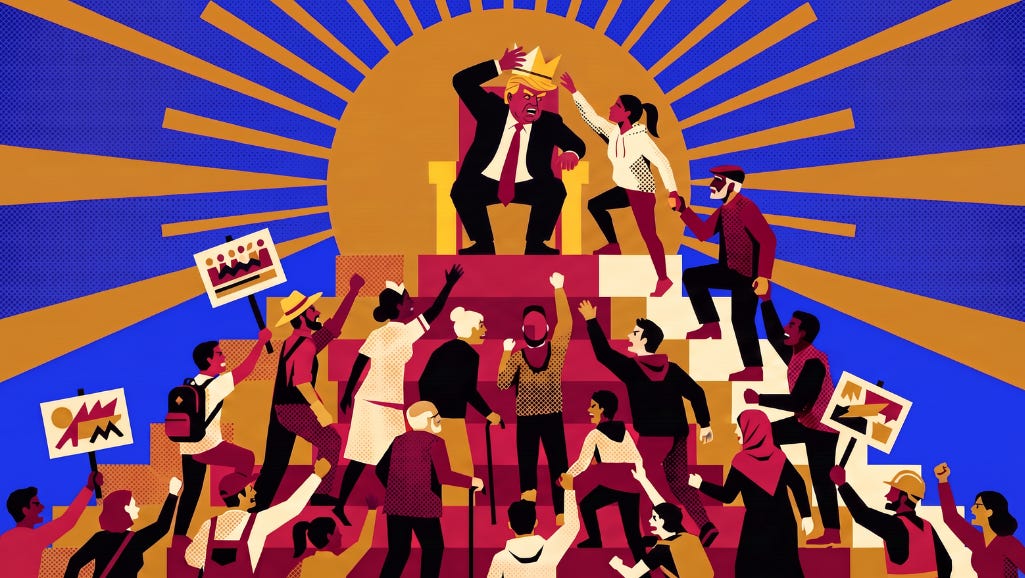
This week, the news came at us like a blizzard - a storm front of votes and counts and crowns crying theft, with a war still burning in the background and prices biting at every checkout. But underneath all the noise, in country after country, the ground beneath the thrones began to give way.
The Iran war, now in its eighth month, had its most violent weeks yet in the Strait of Hormuz, with more than 30 attacks on shipping in October alone - double September’s - and Iran saying at least six tankers hit mines in the last three days of the month, one of them a supertanker carrying more than 2 million barrels of oil. Washington told its Gulf allies to prepare for a “brief but intense” strike after the midterms, and Iran’s new Supreme Leader, Mojtaba Khamenei, ordered his military to answer any attack “without geographical limitations.” Trump, meanwhile, continued to insist that the war would be “wrapped up soon.”
Just days out from the US midterms, Republicans are bracing for what Senator Ted Cruz is predicting will be a “bloodbath,” with Trump’s approval down to 30% and only 1% of Republican ads in October even mentioning his name. With oil hovering around $114 a barrel, gas prices in the US hitting an average of $4.29 a gallon, and Halloween candy costing about 15% more than last year, Trump’s response to it all at a rally in Georgia was to say that he doesn’t “give a damn,” because “we’re making a freaking fortune.”
The same week, Democrats on Congress’s Joint Economic Committee reported that Trump’s oil and gas shares are now worth as much as $81.6 million, nearly double what he held at the end of last year, and that he bought as much as $17.5 million more of them after the war with Iran began. And House Judiciary Democrats released a 50-page report on Trump’s ties to Jeffrey Epstein, citing Justice Department records that show he flew on Epstein’s jet at least eight times between 1993 and 1996. It also includes an allegation by former Miss Switzerland Beatrice Keul that Trump raped her at the Plaza Hotel in 1993, which the White House denies, and a spokeswoman called the report “a desperate attempt by crazed Democrats.”
Meanwhile, Barack Obama told a rally crowd that Trump has “got the White House looking like Saddam Hussein opened a Cheesecake Factory,” and Trump took the bait, spending the week railing against his predecessor calling him “not a smart guy,” at a time when the rest of the nation wants to hear about his plan for making things more affordable. Crickets.
As the Trump administration weighed lifting sanctions on a Russian fund the US Treasury once called Putin’s “slush fund,” in Ukraine, a Russian drone hit a railway platform in Dnipro where a passenger train was waiting, and killed 13 people. Days later, more than 750 people were evacuated from the occupied city of Oleshky under a humanitarian truce, the most significant pause in the fighting since the full-scale invasion began. The White House credits Melania Trump for brokering the truce; Ukrainian sources say it was actually the Pope.
At the G20 foreign ministers’ meeting in Atlanta, the traditional family photo was scrapped after about a third of the countries, Australia and Britain among them, refused to stand beside Russia’s foreign minister, Sergei Lavrov. The talks wrapped up without agreement on most of the big security questions on the table.
Hackers linked to North Korea drained about $6.3 billion from Binance, the world’s biggest crypto exchange, in roughly 20 minutes - the largest crypto heist on record - and the price of bitcoin tumbled with it.
In Spain, a high-speed train ploughed into the back of another that had stalled near Toledo, killing 69 people. Recordings later showed the signalling system had crashed half an hour earlier, and controllers told the second train to carry on anyway. It was the second deadly crash on that line this year.
In Congo, the Ebola outbreak passed 5,000 deaths among more than 10,000 cases, the second-deadliest outbreak on record, with no vaccine for this strain and cases now confirmed in Kenya and Nigeria.
In Britain, Prime Minister Andy Burnham said his government is open to a formal apology for the country’s role in the transatlantic slave trade, but ruled out reparations - as King Charles toured the Bahamas and Guyana and was met by protesters demanding them.
In California, Dolores Huerta died at 96. She co-founded the United Farm Workers in the 1960s and spent some seven decades organising for the farmworkers, women and immigrant families America too often left uncounted, and in 2012 Barack Obama hung the Presidential Medal of Freedom around her neck.
And the starship Enterprise lost two of its crew in one week. Walter Koenig, the original series’ Chekov, died at 90, and two days later Patrick Stewart - Captain Jean-Luc Picard, Professor X, and a Shakespearean actor long before either - died at 86. For seven seasons, Picard would hear out his crew, weigh it all, and then give the order: “Make it so.” For most of our lives, we’ve waited on the captains to give it.
This week, the crew stopped waiting.
Across Europe, around 320,000 people took to the streets of France on Halloween, many of them in costume, in a third straight weekend of protests over the cost of living and crumbling schools, while in Germany, Gen Z marches spread to some 34 cities.
And from Serbia to Brazil to Israel, the crowd turned up at the ballot box and gave the order itself - make it so - and the crowns, perhaps for the first time in a long time, began to realise what - and who - had been holding up their thrones all along.
If you’re feeling battered by the week, or unsure where any of this is heading, read on, dear friend. As always, the sky is showing us exactly what’s going on - and why - and how to hold what’s coming next.
Receive this Wrap-Up in your inbox every Sunday!
The cosmic insights shared here are mapped to the real movements of the heavens during the past week. If you want to know more about planetary pattern recognition, read about it here

Serbian Students Say No
Almost two years ago, when the concrete canopy over the entrance of the newly renovated train station in Novi Sad, Serbia’s second city, came crashing down and killed 16 people, university students blamed it on the corruption and cronyism behind the renovation, and decided a government that let a roof fall on its own people wasn’t one they were willing to hold up any longer. So they walked out of their classrooms and into the streets, and they never really went home.
These students had no leader - no single person or entity was telling them what to do. The movement ran on plenums - open assemblies where anyone could speak and everyone voted - making it hard for the government to stamp it out, without a single face to target. Over the course of the last two years it drew in professors, doctors, farmers and artists, until it was much bigger than the students who started it - a movement ignited by the youth, taken up by the people, for the people, against a government that had forgotten who it served.
That government was headed by Aleksandar Vučić who had ruled Serbia for more than a decade - as prime minister from 2014, then as president from 2017 - with a tight grip on the country’s media, so his side painted the students as foreign agents, in an effort to crush the crowd. But in the streets they stayed.
Facing the end of his second term as president in a system that only allows two, Vučić found a way around it by calling a snap election, then resigning as president and leaving his close ally Ana Brnabić as acting president, so he could then run for prime minister instead - the same trick Vladimir Putin pulled in 2008. His critics called it a ruse to dodge the term limit for months, and analysts said that as prime minister he’d still be the most powerful person in Serbia. All he had to do was beat the students at the ballot box.
The students were ready for him. Through more than a year of assemblies, they’d chosen 250 candidates from right across the country - academics, doctors, farmers, artists, a playwright, even a former basketball star - to put on the ballot as the Student List, under the name “Students Win”. It was a citizens’ group with no party behind it, headed by Ilija Srdanović, a cardiology professor from Novi Sad, while the students cycled and walked from village to village to reach voters.
Meanwhile, Vučić’s machine did what it had done for 12 years, using its near-total control of the media to have pro-government outlets vilify the students as bad actors who couldn’t be trusted, and on election day independent monitors reported dozens of irregularities, including attempted vote-buying.
But this time none of those tricks worked.
The students won the election, with 52.7% of the vote to 39.2% for Vučić’s alliance, and around 139 of parliament’s 250 seats. An hour and a half after the polls closed, Vučić went on air and conceded, saying “it is clear that we have lost the election,” and crowds poured into the streets of Belgrade chanting “Aleksandar is gone,” and the mother of one of the 16 who died in the train station collapse said, “Now I expect that they will all be held accountable.”
By next morning, Brussels was saying “the door to the EU is open,” while Moscow - which had counted Vučić among its closest friends in Europe - said it hoped he’d keep helping Russia while in opposition. It’s the second time this year the Kremlin has lost a friend like this, after Hungary’s voters ended Viktor Orbán’s 16 years in power back in April. Two of the Kremlin’s favourite strongmen in Europe, gone in six months, and both brought down by movements that started in the street.
The most remarkable - and some might say delicious - part of the story is that the victors in Serbia still haven’t said who’ll lead the country; the students never named a candidate for prime minister, so the new lawmakers will now choose one together with the movement, and the person who formally puts the prime minister’s name forward will be Vučić’s stand-in, the acting president Ana Brnabić - though it’ll take the students’ majority to confirm whoever she chooses.
Brnabić holds the pen, but the Student List holds the numbers.
The crown is facing the crowd, and the crowd holds all the power.
Want the Wrap-Up sent to your inbox each Sunday?
Brazil Votes, Flávio Flees
The same day Serbia voted this week, Brazil went back to the polls after current president Lula da Silva had come second in the first round of elections earlier this month to Flávio Bolsonaro, the eldest son of the former president now serving 27 years for plotting a coup, and with neither man winning more than half the vote, the two went head to head in a runoff.
No one had ever come from behind to win a Brazilian runoff since direct elections returned in 1989, so the odds were against Lula, and the stakes were enormous. Flávio had promised to set his father free if he won, and analysts expected an amnesty for Jair Bolsonaro’s supporters who stormed Brazil’s Congress, Supreme Court and presidential palace a week after Lula took office in January 2023. Flávio had also vowed to rewrite the 1988 constitution, the one Brazil wrote to put its military dictatorship behind it.
Lula is a man who’s spent his life working tirelessly for the people of Brazil, first as a union leader who led strikes against the dictatorship in the late 1970s, helping to found the Workers’ Party, then as president from 2003 to 2010, when his Bolsa Família program paid poor families a small monthly sum to keep their kids in school and get them vaccinated, and helped lift tens of millions of Brazilians out of poverty. After he was jailed in 2018 on corruption charges, and spent 580 days in prison before the Supreme Court annulled the convictions, ruling the court that tried him had no jurisdiction and had been biased, he made a comeback in 2022 and beat Jair Bolsonaro, but after just four years, it seemed Brazil was considering a return to Bolsonaro rule.
After the first round of elections yielded no clear winner, Lula’s supporters took to the streets. The day after the vote, students at a university in Niterói held a rally for him that spread into a wider movement, and on the eve of the runoff around a million people filled Copacabana beach.
And what was happening in the streets was mirrored online. A volunteer WhatsApp channel called Lula’s Army grew to around 10 million people in under three weeks, and its instructions were simple: like, comment on and share the posts you believe in - even before you’ve watched them, to tell the algorithm they matter - and when the other side’s videos start spreading, don’t watch them, don’t comment, don’t feed them at all.
Brazilians coined a phrase for the strategy: ruas e redes, the streets and the networks. That was their plan to win….and it worked.
About five million more people turned out for the runoff than for the first round, the lowest abstention rate since 2006. Lula added more than 10 million votes to his first-round total and won 51.8% to 48.2%, by about 4.4 million votes, just days before his 81st birthday.
Flávio called it “foul play” and refused to concede, and then, the day after the vote, Supreme Court Justice Alexandre de Moraes, who’s overseeing a money-laundering investigation into him (he’s accused, among other things, of taking millions from a banker to fund a film about his father), ordered him to hand over his passports and stay in Brazil. Flávio defied the order and fled to the United States, reportedly travelling on an Italian passport with a US visa the Trump administration had granted him in the wake of the election result. Now he’s calling himself “the true leader of Brazil,” while Trump, who said the election “looked like another rigged election”, says of the Bolsonaros, “I think they’re fine people.”
Flávio may have the visa, and a friend in the White House, but Brazil has the votes.
The crowd remembered its own power, and the crown fled.
Want the Wrap-Up sent to your inbox each Sunday?
The Crown and the Crowd
Not every crowd got its way this week, but the tide is turning and the energy is shifting, and the crowns that felt the ground move beneath them all cried theft.
Israel went to the polls for the first time since Hamas’s attack on October 7, which killed around 1,200 people in Israel. In the three years since, Benjamin Netanyahu has led the country through a war in Gaza that has killed more than 74,000 Palestinians, according to Gaza’s health ministry, an occupation of southern Lebanon (the first in more than 25 years), and a war with Iran that’s now in its eighth month.
For a lot of Israelis, the vote was a verdict on all of it. Netanyahu has blocked an independent inquiry into how October 7 was allowed to happen, he’s still on trial for corruption, and his government leans on far-right ministers who back the settler movement. More than 1,000 Israeli soldiers have died, while the ultra-Orthodox community his coalition depends on is still largely exempt from military service.
Netanyahu’s main challenger was Gadi Eisenkot, a former army chief whose son was killed fighting in Gaza in late 2023. His party is called Yashar - Hebrew for “straightforward” - and he promised that his first act as prime minister would be an independent inquiry into October 7.
When Arab citizens turned out to vote in record numbers - overall turnout was the highest since 1999 - Netanyahu pulled the same line Flávio reached for and said Arab voters were “stealing the election.” Once the final count came in, the result was so close that neither Netanyahu nor Eisenkot can form a government yet. The Arab parties hold a record 19 seats, and Netanyahu has declared it “forbidden” to govern with them, so now Israel’s president, Isaac Herzog, has to hand someone the job of stitching together a majority, with up to six weeks to do it - and if nobody can, Israel votes all over again.
Meanwhile, in America, more than 50 million people have already voted ahead of the midterms - more than voted early in the whole of the 2022 midterms - with the election now just days away. At the same time, the Justice Department was in court trying to set aside thousands of ballots in California and Washington state, and suing Alaska to block certification of its Senate race if the Republican loses, at Trump’s direct orders.
All of this played out under the light of a Full Moon in Taurus, the sign of the ground we stand on - the food, the money, the home, the body - as both it and the Sun squared Pluto, the planet of power, in Aquarius, the sign of the people. As the people went to the polls across multiple nations, the sky was really only asking one question this week: who does the ground agree to hold up?
Every throne and every government stands on an agreement the people make, day after day, to keep holding it up. We pay the taxes, accept the money, show up for work, cast the vote. The crown can’t stand a single day without the crowd underneath it, and this week, in country after country, the crowd shifted its weight.
That’s the story the sky is telling right now as Pluto moves through Aquarius for the next two decades. For thousands of years, each time it passes through this sign - every 250 years or so - power tends to slide from the few towards the many. It’s a slow current, but it always runs from the crown towards the crowd.
The last time it was here, in the late 1700s, it gave us “We the People,” as well as a crowd in Paris storming the Bastille that soon started sending its own to the guillotine. That’s one of the two ways a crowd can topple a crown - it can storm it, or it can simply stop holding it up. The first tends to end with a new crown built from the rubble of the old one. The second is the road this week’s crowds took. Serbia’s students sat in their assemblies and walked village to village until a government fell under its own weight, and Brazil filled a beach, then the ballot boxes, and turned a dynasty away.
The crown won’t go quietly, though - we’re seeing that already. Jupiter, the planet that makes everything bigger, is moving through Leo, the sign of the king, so the crowns are going to look and sound enormous for a while yet. That’s the energy behind Flávio crowning himself Brazil’s true leader from Miami, Netanyahu calling his own citizens’ votes theft, and Team Trump suing to stop a count before the votes are even in. That’s what a crown sounds like when it can feel the ground beneath its throne moving.
And it’s going to keep sounding like that for a few more years. According to the sky, we’re in the middle of a decade of disruption, that started around the time of the pandemic in 2020 - these are the years when the old world gets pressed right up against its limits and comes apart, and that pressing won’t ease fully until around 2032 when Saturn and Uranus both move into Cancer, the sign of home and family and the people we care for. That’s when the building of something better begins in earnest, once these days of demolition are done.
The last time Uranus crossed into Cancer in the 1940s, just after the Second World War, it gave us the National Health Service in Britain, public housing right across Europe and the pension systems many of us still rely on.
That was the heart’s first draft of a civilisation, written largely by the crown.
This time, the second draft will be written by the crowd.
Want the Wrap-Up sent to your inbox each Sunday?
The Parts the People Play
A crowd is made up of all kinds of people, and each one has a part to play. Right now the sky is telling us all what our role will be in the crowd that steers us out of this old dying world into the one that’s being born; out of the one the mind built and into the new one the heart is drafting.
Young people are leading the way as we cross from one age into the next, and this week showed it. The crowd that turned the tide in Serbia was made up of students, while in India, young people furious over a leaked university entrance exam forced the education minister out. In Indonesia, students marched twice in a week over the worst forest fires in over a decade, and in France, the movement that’s now filled the streets three weekends running started with teenagers angry about their schools. Young people everywhere are channelling the energy of change, and the sky is telling us why.
Neptune is the planet of the dream - the picture of the world a generation carries deep inside it. Between 1998 and 2012, Neptune was moving through Aquarius, the sign of the people, so everyone born in those years - today’s teenagers and twenty-somethings - came into the world carrying a dream of the crowd. Over the next 18 years, as Pluto, the planet of power, walks through Aquarius, it’ll pass over the Neptune of every one of them, one birth year at a time, handing the generation born dreaming of the crowd the power to actually build it.
But while young people are bringing the spark that ignites the new world, that spark needs a hearth to become a fire that warms the whole house, and that’s where the rest of us come in.
Those of us born between about 1984 and 1997 are the bridge builders. Most of us arrived as Uranus and Neptune met in Capricorn, the sign of structures, carrying a dream of rebuilding them, and the oldest of us are now in the famous midlife awakening of our Uranus opposition, rebuilding our own lives as well. Ours are the hands that lay the planks the young will walk across.
Those of us born between about 1968 and 1983 are the healers, meeting our Chiron return one after another between 2018 and the early 2030s - the moment Chiron, the wounded healer, comes home to where it stood when we were born, and the wound we’ve carried our whole lives starts working as medicine for other people. Ours are the hands that know how to dress a wound.
Those of us born between about 1957 and 1967 are the stewards, born with Pluto in Virgo, the sign of service and healing, so our power has always come through tending, fixing and caring, which makes us exactly the ones to sit with an old world as it ends. Ours are the steady hands at the bedside.
Those of us born between about 1949 and 1956 are the keepers of collective memory, born with Uranus in Cancer while the post-war world was building its health systems, its public housing and its safety nets, and in the 2030s Uranus comes back to Cancer, right where it stood when we were born, just as the second draft begins. Ours are the hands that carry what the first draft got right, and what it got wrong, to the people writing the next one.
And those of us born between about 1942 and 1948 are the wise elders, walking through our own Uranus return, a once-in-a-lifetime awakening at around 84 and one last chance to let go of what was never ours to hold forever. We were born with Pluto in Leo, the sign of the king, a generation raised to believe power lived in the crown, and now, with Pluto standing opposite in Aquarius, ours are the hands being asked to open and pass it to the crowd.
Spark, builder, healer, steward, keeper or elder, we’re all here at this moment to tend the seed planted at the Genesis Reset, when Saturn met Neptune in the very first degree of Aries in February this year - the seed of the new world, and of the Age of the Heart. Saturn, the planet of the elder, is still in Aries, standing guard over it, holding the scaffolding while the new thing grows and leaving the building to the ones who’ll live in the house once it’s built.
And alongside the seed, we all must tend the seedlings who came in with it.
Those born since 2012 are the heart’s natives, and raising them falls to the whole crowd. They arrived with Neptune in Pisces, the ocean of feeling where everything is connected, in the very years the wall between the mind and the heart began dissolving, so they came in already feeling everything, sometimes more than the old world knew how to hold. The oldest of them will be reaching their 40s as the first great crossing from the old world into the new completes in the 2050s, so they’re the ones the new world is really being built for, and the ones the rest of us are carrying it across to.
And then there are the babies born this year, and the ones who’ll keep arriving over the next decade - the first children born since the Genesis Reset brought down the wall between the mind and the heart. The ones born this year carry the seed of the new age itself in their charts, and every one of them arrives with Neptune, the planet of the dream, in Aries, the sign of beginnings, so the dream they carry deep inside is the dream of a world made new. They’ll grow up through the building years that begin around 2032, watching the new world go up around them, and they’ll be coming of age just as the crossing completes in the 2050s. They’ll know the old world only as a story we tell them. The only world they’ll remember is the one we’re building, and they’ll be the first to call it home.
So the youth are the spark.
The rest of us are the hearth.
And the little ones are the reason we keep the fire burning.
Want the Wrap-Up sent to your inbox each Sunday?
Be part of our community. Join the Inner Circle
Letting the Old World Fall
Weeks like this show us the direction of travel as we make our way from one age into the next, and the road only runs forward. The crowd is calling for change, for something different and something new, and a better world beckons.
But the crowd isn’t all moving in the same direction yet. Close to half the voters in Brazil this week backed Flávio. Israel’s count came down to a handful of seats. Polls still show Trump enjoys the support of around 30% of the American electorate, which is roughly 70 million people. In every country that’s voting right now, millions of people are still choosing the crown, and they’re the crowd too. Most of them are voting for the shape of the world they know, because the old shape feels safer than whatever comes next, and every one of us knows that feeling from the inside.
Most of us built our whole lives inside that old world. Our jobs, our savings, our sense of how things work and what’s safe - all of it was made there, and watching it come apart can feel like watching our own house burn, and the instinct is to grab hold of the walls.
That instinct belongs to the mind - our human capacity to think, plan and predict, reading tomorrow from the patterns of yesterday. The old shape is the only one it knows how to predict, so it holds it up with everything it’s got, clinging on in fear that we’ll be harmed if the old shape goes. And that’s how we can find ourselves holding up the very things that most need to fall. Every crown still standing is standing partly because some of us are still too frightened to stop holding it up.
The heart - the part of us connected to something far bigger than ourselves - can do what the mind can’t and let go, because the heart knows how to grieve. And right now, as we allow old things to fall, there’s an awful lot to grieve.
Once we stop holding the old world up, we’re left to measure the distance between what we hoped would be and what actually is, and most days it feels like an unfathomable chasm. That’s the grief, and the only way across it is through it, as all that feeling asks to be felt. Our work is to grieve what’s falling properly, all the way through, so we can open our hands and let it go, as we accept that this is the journey.
We’re the ones who remember the old world fondly, and we’re here to shepherd the young ones coming up behind us, who only ever knew it once it broke: to remind them of the best of what we had, feed their dreams of how their world could be better, and make sure the worst of what came before is taken down for good. That starts with holding the old things loosely enough that they can come down.
And as they go, we get to choose what we carry across. The young will build the new house, but we know which coals from the old hearth are still worth keeping warm: the hard-won lessons, the stories, the things we fought for that worked. We get to put them into young hands, and trust those hands to build something we couldn’t have imagined. We get to hold the door open, too - to stand at the threshold and say to the ones coming through, go on, we’ve got you, and mean it.
Dolores Huerta spent her whole life doing just that, standing at the door for the farmworkers nobody else was counting. She co-founded the United Farm Workers and gave them three words that are still being chanted in the streets today - Sí, se puede - yes, we can. Some coals keep burning long after the hands that carried them have let go.
She also knew how much power sits in an ordinary pair of hands. When the grape growers refused to budge in the late 1960s, she helped lead a boycott that saw millions of Americans simply stop buying grapes, a crowd shifting its weight one fruit bowl at a time, until the growers came to the table. Every person who left the grapes on the shelf was answering the same question the Full Moon asked of every nation this week, and the one it asks each of us now: what are we still holding up?
Maybe it’s a job that stopped making sense years ago, or a certainty about how the world works. Maybe it’s the country as it was when we were young, or a version of ourselves built for a world that’s already gone. That’s why the old plans feel so heavy, and why the news feels like a house on fire, and why some mornings we find ourselves gripping the walls.
Whatever it is, we can set it down gently, the way this week’s crowds did. We can stop, and seek the stillness, and breathe, and drop out of the noise and into the deepest part of us, and let ourselves feel what it costs to let it go.
And then, we can open our hands.
The young need our hands free, because we’re here to midwife what comes next. A midwife leaves the labour to the mother. She knows what’s normal, keeps everyone calm when it gets frightening, and stays ready for the moment the baby’s head first appears - the moment midwives call crowning. And in a world of collapsing crowns, that’s the only crowning worth waiting for.
Every crown that ever stood has told the crowd that nothing can change. Dolores Huerta answered it in three words, and they’re ours to carry now.
Hands at the ready, friends.
A new world is crowning.
Sí, se puede.
Yes, we can.
Make it so.
And so rises the Age of the Heart.
If anything written here has stirred something heavy in you, please reach out to someone who can sit with you in it, whether that’s a person you love or a crisis line where you live. The heart can hold a lot, but it was never meant to hold it all by itself.
If you need a place to land after reading this, or if you want some support as we navigate the days ahead, come join me in the Daily Lighthouse. I’ll be there, each day with you, or if you’d rather listen to it, head over to the Resonance Room.
I also post daily mantras on my social media accounts each day, so you can follow along on all the platforms - Facebook, Threads, Instagram, Bluesky, TikTok and Youtube.
And just a reminder, if you’re wanting to order an astro-chart reading as a Christmas gift for a loved one, the cut-off to place orders so I can get them done in time is November 15. Order yours here!
See you in the stillness, friends.
Onwards!

If this writing resonated with you, please share it with your friends.


Had to take a recess half way through today’s Wrap Up!!! Breathing deeply, looking out the window at the colored leaves almost all down, Sandy Creek minding its way north to Lake Ontario, I considered the depth of our mission here, at this juncture. I’m in the healing profession, recently moved to this house overlooking the creek and park where I played with polywogs as a child.
You cleared the air as I’m sitting in the ashes of these times. I may be just the seed but I will birth the Phoenix for my son and the generations after him. There’s work to be done and my sleeves rolled up, will plant garlic today and welcome November and everything falling down like the leaves. Spring always comes.🪴
Thanks Wiz for fertilizing my imagination and heart ♥️ . You are a guide for the ages.