


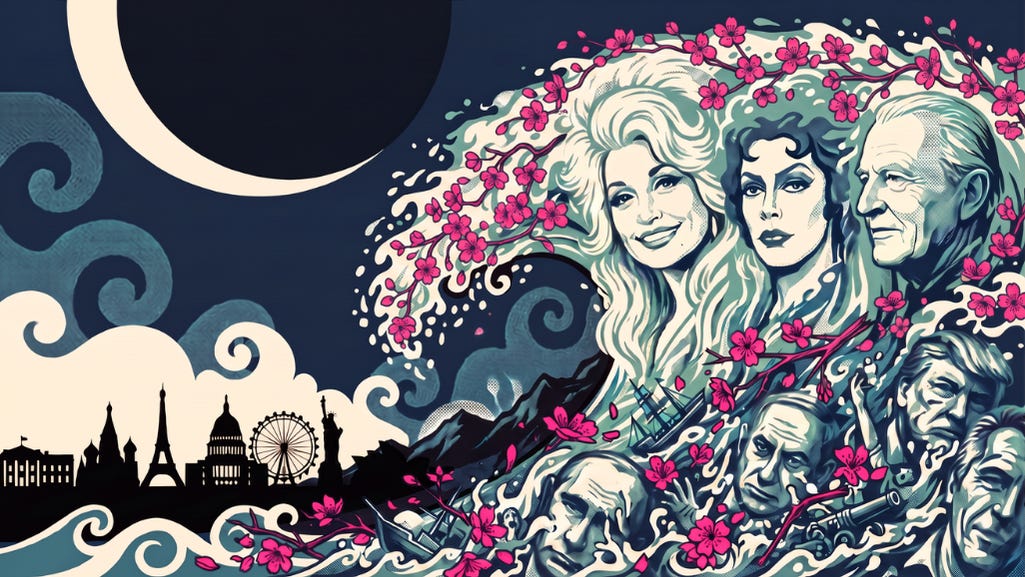
This week, the world cracked, as walls that held for our whole lives gave way - between allies, between nations, between the truth and the story we’re told about it - one after another, and what’s pouring through the gaps is a flood of feeling that none of us were taught how to hold.
After Trump invoked a tariff law nobody’s touched since the Great Depression to put 50 percent duties on Canadian goods and launched what the Wall Street Journal called “the dumbest trade war in history,” Canada vowed to hit back dollar for dollar as a wall of friendship that’s stood along the longest undefended border on earth for over a century crumbled. Trump declared that America doesn’t need Canada, and signed an executive order renaming Lake Ontario as Lake America; it’s been Lake Ontario since before Canada was Canada or America was America, so the only thing renaming it achieves is turning America's next-door neighbours into enemies, which Trump was already doing a pretty good job of anyway.
In the Gulf, six months into Trump’s war that was supposed to be over in weeks, Iran now decides who sails through the Strait of Hormuz and who doesn’t, and the US has likely lost its 15 bases in the region for good. The US Navy is now moving money out of payroll to keep the operation going; one contractor summed up the state of the mightiest military in human history this week by saying, “they shot all their weapons, they trashed all their ships, they ran out of their money.” Trump’s response was to post an AI-generated image of himself under a banner reading Mission Accomplished 2026. The wall between the story and the facts is down, and everyone can see through the gap.
Meanwhile, measles is back in America. For more than half a century, a wall of immunity built by everyone getting vaccinated kept it out, but now the disease that was eliminated over two decades ago is spreading out of control, with more than 2,800 cases so far this year across 45 states, mostly in people who are unvaccinated. The epicentre is in Pennsylvania, where this week the state recorded its first measles deaths in 35 years - one of them a newborn who caught the virus in the womb and died within hours of being born. The response from RFK Jr - the man in charge of the nation's health, at war with vaccines - was to suggest the death had been fabricated for political gain.
Ten weeks out from the midterms, the Supreme Court cleared the way for Trump’s restrictions on mail-in voting, with Justice Jackson writing in dissent that the ruling “needlessly injects chaos and uncertainty” into the election, while Republican candidates in three states were caught on tape promising to send ICE agents and off-duty police to polling places.
Meanwhile, Homeland Security announced the end of protection for 350,000 Haitians with a video of Black men and women in chains, being walked through the rain to a waiting plane. The same week, DHS was found to have been bulldozing through the oldest wall there is between a citizen and the state - a judge's warrant - secretly pulling the private phone and banking records of journalists, unions and nonprofits, and YouTube account data from the likes of Don Lemon, Democracy Now, the Milwaukee Journal Sentinel, and, remarkably, Megyn Kelly - one of the president's loudest cheerleaders. They even arrested and deported Milo Yiannopoulos this week - the British provocateur who once demanded ICE checkpoints at every supermarket and petrol station - proving that the wall he thought he was standing behind doesn't exist, and the net doesn't care whose side you're on.
Meta agreed to pay 17 billion dollars to 47 US states to settle claims that it deliberately designed its platforms to addict our children. There used to be a wall between us and the world's horrors - a door we could close, a screen we could switch off - and this week the company that owns the apps on the machine in our hands confessed in writing that it tore that wall down on purpose, and built the thing so it could never be put down.
In Reno, 42,000 people fled their homes as fire tore through the hills in what’s already the worst fire year America has ever recorded - nearly 8 million acres burned - while the specialist crews who respond to disasters in the national parks had been reportedly reassigned to Trump’s beautification projects in Washington, where 200 manhole covers were welded shut so IndyCars could race past the Capitol at 150 miles an hour, and the beloved century-old cherry trees in East Potomac Park were felled to clear the ground for the championship golf course Trump wants built there.
And while there was fire in the west, the story that swallowed this week whole was water, as a wall of it came down a Himalayan valley in Nepal with almost no warning, and by the weekend more than 500 people were confirmed dead and nearly 2,000 were still missing. And in a week already so heavy with death and grief, the world lost some of its most beloved icons - Dolly Parton, Tim Curry, and King Harald of Norway, who died in the shadow of this week’s eclipse, as if the sky was determined to make sure we really felt it.
If you’re feeling exhausted by the news or like nothing makes sense any more, or you’re worried for the future and want to know what comes next, then read on, dear friend. As always, the sky is showing us exactly where we are, and why this feels the way it does, and what’s on the road up ahead.
Receive this Wrap-Up in your inbox every Sunday!
The cosmic insights shared here are mapped to the real movements of the heavens during the past week. If you want to know more about planetary pattern recognition, read about it here


The World Beneath the Waves
Most weeks, the headlines can be better understood by holding current events up against past ones that they echo. They say that history rhymes but never repeats, but whoever said that maybe didn’t look far back enough in history before they spoke; our world seems to operate in repeating cycles, with patterns playing out over and over again on a loop, though most of us don’t notice because the loop is longer than our lifetimes.
So to understand the events of this week, we need to look back, as always, but further than usual. Back decades, back centuries, back millennia, to a time roughly 12,000 years ago when a cataclysmic flood changed the shape of our world.
For thousands of years, vast sheets of mile-thick ice had locked up most of the northern world, making sea levels much lower than they are today, which meant the English Channel didn’t exist, and Britain was connected to Europe across a broad fertile plain. In Southeast Asia, a great landmass called Sundaland stretched across what is now the South China Sea and the Java Sea, connecting islands we now sail between. The Persian Gulf was dry land and the Black Sea was a freshwater lake; the whole coastal geography of our world was completely different.
And then, everything suddenly changed as the ice destabilized, and began to rapidly melt. Experts are still arguing over what caused it - the dominant though contested theory is that a comet entered the atmosphere over the North American ice sheet and either struck or exploded above it with such force that it unleashed wildfires that burned ten percent of the biomass on the surface of the earth, leaving a layer of nanodiamonds - the kind of debris only a cosmic event produces - in sediment layers from that exact period 12,000 years ago on every inhabited continent. The debate about it is still fierce, but what’s undeniable is that something enormous happened that rewrote the world entirely.
The ice sheets began to collapse, as rivers of meltwater poured into the oceans. Sea levels rose rapidly, sometimes catastrophically fast, and the coastal world that had been home to our species for a hundred thousand years went under water. Plains became shallow seas, and whole landmasses vanished. Sundaland sank. The Black Sea basin filled as the Mediterranean broke its banks and the waters rushed in. Britain became an island. The Persian Gulf filled. There's no real debate among scientists over this part of the story - across the years that followed the melt, our world was undeniably swallowed by water, incrementally and then suddenly, over and over, until the world we know today emerged from beneath the waves.
Our history books hold no detailed record of this time, which mainstream historians believe is because this all happened in a time before civilisation; before written language had been invented, before humans had organised themselves into cities with libraries holding records that could be destroyed by a flood in the first place. Most historians believe nothing complex was lost from this time because nothing complex yet existed; the flood was primarily a geological event rather than a civilisational catastrophe.
But while it may not be written in history books, every single culture on earth - in every language, on every continent - carries a memory of a great flood and the devastation that it wrought. Noah’s Ark in the Levant is the most famous, but then there’s also Gilgamesh in Mesopotamia - a story carved in clay that’s thousands of years older than Genesis and describes the same deluge, the same surviving family, the same dove sent out to find dry land. Deucalion in Greece, who anchors his chest on the peak of Mount Parnassus. Gun-Yu in ancient China, fighting the flood for thirteen years. The Dreamtime flood stories of the First Peoples of Australia, some of which geologists now believe preserve accurate accounts of real coastline changes that occurred 10,000 years ago, passed down in oral tradition across 300 generations. And Manu - the great figure of Hindu myth - who was warned of the coming flood and was told to build a great boat and load it with the seeds of every living thing, and who was towed to safety by anchoring to the highest peaks of the Himalayas.
Everywhere we look in the ancient history of every continent, the same story shows up about our world being devoured by a flood. Even the great Greek philosopher Plato wrote of such a cataclysm in 360 BC, describing, in extraordinary detail, a civilisation called Atlantis that had existed roughly 9,000 years before his own time that was wiped out by a great flood. An island empire beyond the Pillars of Hercules - what we now call the Strait of Gibraltar - greater in extent than Libya and Asia combined. Advanced, powerful, maritime, wealthy, proud, and eventually, in Plato’s telling, morally corrupted by its own grandeur, and then destroyed in a single day and a single night, swallowed by the ocean that now bears its name - the Atlantic - leaving nothing above the waterline.
Many historians shrug at this and call Plato’s account allegory, but Plato wasn’t in the habit of making things up and calling them historical. He went to unusual lengths to document the provenance of the Atlantis account, as if he were passing on something the Egyptian priests had held in their records from before the melt, from a world our history books have no other record of, because any record of it was drowned with it.
Just because a written record never survived the cataclysm doesn’t mean it isn’t etched into the collective memory - tales like that, told around the fire, passed down from generation to generation, live on in our bones. History may have forgotten but humanity, deep down, remembers.
And we keep proving it, whenever our great modern storytellers in Hollywood imagine the end of the world and the full weight of the civilisational terror that comes with it. In 2012, with its literal arks carrying the survivors of a drowned world, or in Waterworld, where Kevin Costner sails the ruins of everything we built. The Day After Tomorrow, with New York going under in a single sequence, or Deep Impact, where Elijah Wood scrambles to higher ground to outrun the wave.
We keep returning to this theme, not because movie-makers have run out of ideas but because we’re still wrestling with an ancient collective memory, still trying to hold a watery wound we can make no sense of. History may have forgotten, but the dreaming mind hasn't - it keeps pulling us back to the water, over and over, as if trying to remember something important that lives just out of reach. Something that happened to us - to all of us - that we lived through together, and it was so unimaginable, and so enormous, and so cataclysmic, that we can hardly face it, and so we forget.
Until weeks like this week, when that ancient memory comes flooding back, into our social media feeds, across our television screens, and - for some less fortunate than us - into our homes, and streets, wreaking the kind of devastation we’ve been trying to outrun for lifetimes, but we can’t outrun it anymore.
The water has returned for all of us, beseeching us to remember.
Want the Wrap-Up sent to your inbox each Sunday?
A Wall of Water
At 8:40 on Wednesday morning this week, as people in the villages along Nepal’s Trishuli River were preparing to start their day, and the market stalls were opening, and offices were just flickering to life, and people were moving through the ordinary motions of an ordinary morning in the mountains, out of nowhere came the water.
High above them in the high glacial terrain along the Nepal-Tibet border, a section of ancient glacier had broken away and fallen into the gorge below, and what it became as it fell wasn’t ice anymore, but an unstoppable wall of water, tearing down the mountain at an average speed of 193 kilometres an hour, travelling 14 miles in under seven minutes toward the Trishuli River and everyone living along it.
There was almost no warning when the water hit - a churning black-brown torrent of ice, rock and debris, the mountain itself liquefied and moving, consuming everything in its path with a sound survivors described as a roar that arrived before the water did, which was the only warning anyone got. The market stalls that had opened for business minutes earlier were simply gone. Buildings that had stood for generations collapsed into the current and were carried away as rubble. More than 30 bridges vanished beneath the rush of water as if they’d never existed. As people scrambled to higher ground, the river rose nine metres in half an hour, and all they could do was watch helplessly from above as the town below was swallowed whole.
And the water didn’t stop at the valley. It kept going - down through Rasuwa, through Nuwakot, through Dhading and Gorkha, losing speed but never stopping, until bodies were being recovered from riverbanks 60 miles away in Chitwan, on the open plains, far from any mountain. The devastation ran for miles, with distraught residents fossicking through the murky waters searching for loved ones who’d been swept away. In one village, a man described what sounded like a thunderclap before a wave of muddy water crashed into his home, carrying away his wife and two daughters. “They all died and I lived,” he said, though he hoped he was wrong. Families of the missing gathered at an army barracks in Trishuli to wait for news, and some of them are waiting still.
In the days since the disaster, more than 500 people have been confirmed dead and nearly 2,000 are still missing. The flood didn’t distinguish between locals and travellers, between those who’d lived in that valley their whole lives and those who’d come from the other side of the world to stand on sacred ground - it just wiped them all away in an instant.
Among the missing were pilgrims. A husband and wife from Texas had travelled to Tibet on a religious pilgrimage to Mount Kailash, one of the most sacred sites in the Hindu world, a journey undertaken to mark his 60th birthday. Their children told CNN their parents had just completed the pilgrimage and were on their way home, feeling proud of themselves for finishing it. They were among the 90 Americans still unaccounted for, alongside 35 Australians, 33 British nationals, and hundreds of others - trekkers and travellers from all over the world who had gone to those mountains for their beauty and their sacred charge, and found themselves in the path of something ancient and unstoppable.
This is what our ancestors’ bones remember. Not slowly rising tides, but exactly this - the mountain releasing without warning, the wall of water arriving before the mind can make any sense of it, and the long silence afterward where the names of the missing sit unanswered.
Want the Wrap-Up sent to your inbox each Sunday?
A Flood of Feeling
We’re not good at holding that kind of grief. Grief is more than just the sadness that comes when something heart-wrenching happens - grief is the distance between what we hoped would be and what actually is. By that definition, we encounter grief every day, usually only in small ways, as things don’t play out the way we expected, and most days we can manage the distance.
But when something like this happens - when humanity’s oldest wound and its most traumatic memory is triggered watching hundreds perish in a flash of water - the distance between what we hoped and what we got becomes a chasm we have no idea how to cross. The mind can’t make the leap - it can’t make any sense of it. The facts are impossible to file because they come with a flood of feeling that we long ago forgot how to hold.
That’s why, as footage of the horrific events in Nepal flooded our social media feeds this week, many online urged others not to watch - to look away, for the grief was too great and might devour us whole. Initially, it wasn’t clear exactly what the videos depicted - a wall of water enveloping a river town as villagers scrambled for higher ground - but then it became clearer that not everyone made it out of the water’s path, and what we were watching was not just a geological event but a human one. A mass death event flooding our screens.
Suddenly we were watching the very thing humanity has been trying to forget for millennia - the thing we built a whole civilisation to try and outrun. Not the water itself, but what the water made us feel - the grief of a whole world lost at once, a feeling so far beyond what anyone could hold that the only way to survive it was to stop feeling altogether, and build a life that never asked us to start again. That was the bargain the survivors made on the mountain, and if the oldest account we have is to be believed, it was the very same bargain that drowned the world in the first place.
By Plato’s account, Atlantis wasn’t just a civilisation that drowned - it was a civilisation that had forgotten how to feel. In the beginning, Plato tells us, the Atlanteans were guided by their divine nature, living in harmony with the earth, led by the purity of their hearts, their wisdom rooted in something deeper than cleverness. But over generations, the divine in them thinned as they allowed something more human to take over - pride, and the hunger for power, and the belief that the mind’s brilliance was enough, and that they could dominate what they’d once moved in harmony with. And so the balance broke, and the water came.
There’s no record of this in our history books - any record of it would lie either deep beneath the waves or in the ashes of the great ancient libraries that held the world's oldest knowledge before the flames took them too. What we know of this comes from Plato’s detailed account, and the later writings of the theosophist Helena Blavatsky, the philosopher Rudolf Steiner, and the American mystic Edgar Cayce - each of whom, working independently across different decades and traditions, arrived at the same conclusion that what drowned twelve millennia ago was a heart-based world, and what rose in its place was the mind.
And if that’s true, then what the survivors carried up the mountain all those years ago wasn’t just grief, but a decision never to feel like that again. Instead of returning to the deep feeling they’d abandoned, they leaned into the very thing that had wrought cataclysmic imbalance in the first place, and started building. We know this because Göbekli Tepe, the oldest known structure on earth, appears in the archaeological record right at the moment the flood waters were receding - 11,500 years old, built by people who according to conventional history shouldn't yet have known how to build anything. Someone survived, and someone built. But alongside the physical structures, they built inner structures too - an inner wall between the heart and the mind.
Determined to avoid the feeling of the flood, humanity retreated into the mind and barricaded itself in, so the heart’s feelings couldn’t find a way in. The decision to think our way forward rather than feel was written into the blueprint of the civilisation that followed, and in the 12,000 years since, we’ve built the most astonishing mind-based civilisation the earth has ever seen. We split the atom and mapped the genome and sent machines to the edge of the solar system. We filed every fact and every variable in the great ledger of human knowledge, and we called it progress - and in many ways it was - but underneath all of it, quietly, the unfelt grief of the flood sat waiting. The feeling that was too enormous to feel at the time, deferred across a hundred centuries, passed down not as a memory but as a wound - the wound that made us build the wall in the first place.
We’ve been running on mind alone, almost to prove a point. We don’t need to feel - we can think our way to safety. The heart is the thing that broke last time, so we simply won’t use it.
But deferred feeling doesn’t dissolve. It doesn’t file itself tidily away and stop asking to be felt. It waits - with the patience of twelve millennia - and when the conditions are right, when the age that was built to contain it begins to crack at its foundations, it rises. Not as a thought, or as an argument.
As a flood.
The Age of the Mind is crashing out, friends. We can feel it in everything - in the way the old certainties no longer hold, in the way the institutions built to manage reality are losing their grip on it, in the way the answers the mind once provided with such confidence are meeting questions too large for the old tools. And as it goes, what it was built to keep at bay is rising to meet us. Thousands of years of unfelt feeling, asking now - at last, at the end of the age - to finally be felt.
Nepal is part of that rising, but so is the grief that moved through the whole world this week, and so is everything that the footage triggered in us that we cannot give a name - that ancient resonance, older than memory, that stood up in the bones this week and said: I know this water.
The flood didn’t just return to Nepal this week.
It returned to all of us.
Want the Wrap-Up sent to your inbox each Sunday?
Be part of our community. Join the Inner Circle
All the Feeling, Finally Felt
In many ways, our world is once again being swallowed whole by a flood - in some places that’s showing up as a very literal watery deluge, but in all places it’s a flood made of feeling. More than at any other time in recorded human history, we are being asked - or perhaps the better word is forced - into feeling. It’s gushing in through every crack and every crevice.
We’ve lived through horrors before, that’s undeniable, but never before have these horrors been delivered to us each individually, through a device we hold in our hands. When Hitler was doing his worst in Nazi Germany - committing the most unfathomable atrocities in modern history - the news moved slowly, filtered through governments and newspapers and newsreels, and even once the full truth broke through, most of the world received it late, secondhand, softened by distance. The footage played in cinemas, in a closed room you could choose to enter, or choose to avoid. We could look away, if we wished. But not now.
Now, every unfathomable thing shows up in our feed before we’ve had the chance to scroll away - it’s there waiting for us every time we reach for our phone, which is constantly at the zenith of the Age of the Mind. The devastation in Gaza. Ukraine’s buildings reduced to rubble. Russia burning. Europe on fire. America being dismantled, piece by piece, by the man it elected to power, starting wars he cannot win with foes and friends alike.
And then there’s the kind of thing that used to live behind doors nobody could get into. Epstein, and the revelations still coming, thick and fast, about what powerful men and women did for decades to less powerful men and women and children, always behind those same locked doors that used to hold, but not anymore. The water doesn’t recognise a lock - it finds the seam and rises through it regardless, and what’s surfacing isn’t only water, it’s what the water’s long been hiding.
Every other travesty on the news is running the same current, and even our streaming services are full of tales of terror and tumult, called true-crime documentaries, packaged as entertainment because we haven’t yet found another way to hold them. Everywhere we look, we’re being asked to feel instead of flee - to stop trying to outrun the flood or reach for higher ground, and just let what’s rising wash over us, because at last there’s nowhere left to run, and nothing left hidden.
Even if we tried to turn away from the flood of feeling in Nepal this week, the waters leaked in from other directions, as we watched crews of men in Washington take a chainsaw to cherry trees in East Potomac Park to clear the ground for the championship golf course Trump wants built there. Those trees - planted from Japan’s 1912 gift to the American people - are a symbol of the oldest lesson in feeling there is: they bloom for a week and then fall, and for a thousand years people have sat beneath them to practise loving something they can't keep. For over a century they've stood beside the Potomac - beseeching a capital city to feel, one spring at a time - and when they were felled this week for a monument to a man, the grief that rose in people watching them come down was the exact feeling the trees were planted to teach.
The flood of feeling intensified as those we collectively loved departed, the flood coming for those we’d crowned, both literally and in our hearts.
King Harald V of Norway died at 89 this week, after 35 years on the throne. He'd famously refused a string of brides from the European nobility so he could marry Sonja Haraldsen, a commoner, and when his father refused to give her hand, Harald told him he'd give up the throne entirely rather than marry without love. He died the day before what would have been their 58th wedding anniversary.
Beloved actor Tim Curry died too, at 80 - the man who gave a generation of outsiders the crown. His famous line from Rocky Horror - “don’t dream it, be it” - became a life philosophy for everyone who’d been told that what they felt inside was too much, too strange, too far outside the lines, and showed a generation not how to think their way to belonging, but how to feel their way there.
And Dolly Parton died, also aged 80, after a brief battle with cancer. She was the last public figure in America that the whole country agreed on - red state and blue, everyone claimed Dolly and no one argued about her. When she died, the flags went to half-staff by order of the White House, as a divided nation, for once, felt the same thing at the same time. A woman who lived her entire life from the heart - who gave 300 million books to children she’d never meet, who once said she’d never choose a side because she loved everybody - left by showing the whole world, one final time, what it looks like when you do.
These deaths were not controversial - not the kind of departure that can be easily filed as “oh well, they deserved it” or “the world is better off without them.” These passings left the world staring into the chasm between what was hoped for and what is - an unfathomable grief while we reckon with a world without these lights in it. The mind can’t cross this gap - no bridge it could build can reach the other side - so the only way across is to feel.
And that’s what this is, friends - a flood of feeling, rushing in from every direction, and it’s not going to stop until all the feelings are finally felt.
And the sky, as ever, is pointing the way.
Want the Wrap-Up sent to your inbox each Sunday?
The Sky That Reaches for the Crown
This week played out under a sky that was building towards a lunar eclipse in Pisces, which perfected on Friday. Pisces is the sign of the deep water stirring - of feeling, and everything that lies beneath the surface - and a lunar eclipse in that sign draws all of that deep water up, both revealing what the water had been hiding and bringing it crashing down on us like a flood. This week, the sky could not have been more literal.
An eclipse in any sign always comes for the crown - it’s the light going out on a king, or a Queen, or the roof of the world, as was the case this week. Nepal - the earth’s own crown, the highest point the planet rises to - was struck two days before the eclipse. Dolly, the Queen of country music and of America’s heart, and Tim Curry, the prince of the strange and wonderful who gave the crown to the ones who'd been told they didn't deserve one, both went together, just days before King Harald breathed his last on the very day of the eclipse.
This week’s eclipse came for all the crowns at once - not the jewelled thing itself, but what it represents. In the ancient traditions, the crown sits at the top of the head - at the seat of the mind, the place where the king or queen of the inner room holds court. For thousands of years, the crown has been the symbol of the mind’s authority - the highest point of human achievement, the place from which we govern, the apex we aspire to. The Age of the Mind is a civilisation of crowns: the crowned king, the crowned intellectual, the crowned expert, the mind itself on its throne above the feeling body. And that’s what the Pisces eclipse, the water eclipse, came for this week - the flood rising to the highest point, to the mind’s throne, to the place we’ve been governing from for millennia, and forcing us to feel.
And the feeling isn’t over - it’s really only just begun. With Chiron, the wound, moving through Taurus, the body and the earth, over the next eight years we can expect to see more geological distress. What happened in Nepal this week arrived in Chiron's very first weeks in that sign. The wounded healer stepped one foot into Taurus, and the earth's crown was immediately struck - there can be no clearer preview of what the years ahead intend to ask of us.
Chiron is the wounded healer, and the wound it’s working on in Taurus is our relationship to the earth itself - to the living body of the planet we’ve been treating as a warehouse for 12,000 years, ever since we retreated into the mind and decided that nature was a resource to be managed rather than a home to be felt. We can only heal what we’re willing to feel - that’s always been Chiron’s medicine - which means the years ahead are going to keep asking us to feel the earth in our own body.
Nepal is not an isolated event - it’s a beginning. The glaciers are releasing what they held. El Niño is building. The years between now and 2032 will bring more weeks like this one, more footage we can’t look away from, more walls of water and fire and wind delivering the earth’s feeling body directly into ours. Chiron in Taurus is showing us the wound, but it can’t begin to heal until we feel it.
For many of us who were raised to flee our feelings, reading that makes us feel like those poor souls scrambling up the mountainside this week trying to escape the rushing water. But the sky isn’t asking us to outrun what’s coming - it’s asking us to allow it, finally, to arrive.
Chiron’s years in Taurus run right up to 2032, when Uranus and Saturn move into Cancer and the building years of the Age of the Heart finally begin. The feeling years come first - Chiron will make sure of it - because we can only build from the heart when we know what we love, and we can only know what we love when we’ve felt what it means to lose it. These coming years are the apprenticeship. The grief is the training. The people who let themselves feel through this decade are the ones whose hands will be on the levers when the heart starts building, and what they build will be shaped by what they let themselves feel now.
As we reach the end of the age, the flood comes for the crown that was never meant to rule alone. The heart has been waiting, patient as water, for thousands of years, for the mind to step down from its throne and govern in partnership. This week’s eclipse didn’t come to destroy the crown, but to remind it that it doesn’t have to carry everything alone.
That’s the question the sky asks of us now - as the eclipse axis shifts from Pisces to Aquarius, the question of who rules, and by whose consent, will be asked at every scale; on the world stage, in the halls of power, in the chart of every leader whose crown the eclipses will continue to press on, and in each of us, at the place where the mind meets the heart, at the wall that was built in the aftermath of the flood and has been standing ever since.
The flood we now face - a torrent of feeling - is relentless and unstoppable, washing over everything in its path. But this time, friends, for once, we don’t have to run.
Want the Wrap-Up sent to your inbox each Sunday?
Wading Into The Water
Twelve thousand years ago, the water came, and we fled it - up the mountains, behind the walls, into the granaries and the ledgers and the plans, all the way into the inner room, where we’ve lived for a hundred centuries, safe and dry and further and further from our feeling selves. The Age of the Mind was born in that flood. It was our shelter, and it served us, and it grew into our prison.
And now, at the far end of the age, the water is returning - in a Himalayan valley, in the rising seas, in the grief of a world losing its Dollys, in every feeling that arrives too big for the room to hold. And this time, the invitation is the opposite of the first one. Where the first flood taught us to wall ourselves in, this one asks us to open the door. The water rising in the world and the water rising in each of us is the same water, and it comes bearing the same question the flood stories have carried for thousands of years. Every one of those stories, in every culture, ends the same way - with what gets carried across.
The ark.
The seed.
The pair of every living thing.
The flood only ever asks one thing of us: what do you love enough to carry through?
Friends, may what crosses the water this time be a mind that feels through the heart, feeling all the way to the far shore where we can hold what is. That’s the crossing, and it’s the work of the age, and it begins in each of us, whenever the next wave of feeling arrives and we choose to stay. Because the alternative is to keep running. And there’s nowhere left to run.
The mind has spent eons getting very good at the sprint. Whenever the feeling got too big, it built something - a belief system, an ideology, a new certainty, a war, a wall - anything that converted the unbearable feeling into a manageable argument. And it worked, for a long time, because there was always somewhere new to retreat to. A higher ground. A new room inside the room.
But Uranus is now moving through Gemini - the sign of the mind itself - flooding the information systems past the point of saturation, making the inner room too loud and too crowded and too full of noise to stay in. The walls are thinning, and the door is showing, and the sky in the coming years is not going to let up. Eclipse by eclipse, flood by flood, grief by grief, it will keep pressing until the feeling finds a way in. To flee is not just futile - it’s finished as a strategy. The world that was built to protect us from having to feel - the Age of the Mind, with all its brilliant walls - is done. It’s what the water is finally washing away.
The water rises now not as punishment, but in the same spirit that every great flood in every culture’s memory came - not to destroy, but to reveal. To carry away what was never built to last and return us to what remains when everything false has been washed clean.
Plato tells us the Atlanteans, in their beginning, before the pride and the hunger for power - before the mind convinced them it could do this alone - lived guided by their divine nature, in harmony with one another and the earth, led by the purity of their hearts, with wisdom rooted in something deeper than the mind. We are descended from them, and we carry the memory of that in our bones, along with the memory of the flood and the fall; the felt sense of a world in which the mind was in service to the heart rather than sitting on its throne above it is etched into the fibre of our beings. We carry a deep knowing that there’s a way to be human that’s wiser and warmer and more alive than the way we’ve been living, because we’ve done it before, we just chose to forget.
But now, we are being called to remember.
When we dream of a world where medicine is organised around the healing of human beings rather than the management of billing cycles, and where politics asks what people actually need rather than what will win the next news cycle, we’re not just imagining - we’re remembering.
When we envisage an economy that measures flourishing alongside profit, that treats the earth as a home to be tended rather than a resource to be extracted, that’s remembering too.
When we think of an education system that teaches our children to know what they feel alongside how to think, and that makes emotional fluency as central as literacy, because it is, we’re looking forward at the same time as we’re looking backwards - back further than our mind dares remember, to the place the heart recalls, and names as home. To a world where harming another registers as harming ourselves, because the walls between us have come down far enough that we can feel each other again. That’s not a dream - it’s what becomes possible when the mind steps off the throne and governs in partnership with the heart.
The mind in service of the heart is the most formidable instrument available to a human being. And to a civilisation. We lived it once, in an age long forgotten, whose time is coming once again. We’ve had the mind without the heart for 12,000 years and we know what that builds, and what it costs, and we know what it eventually floods. Now it’s time to remember what the other half of us can do.
Our ancestors fled the water in fear of feeling, and built walls that might be strong enough to keep it out. Those walls are now failing, and what we are being asked to do is what those who came before us couldn’t or wouldn’t, and muster the strength to finally turn around and face it. That day has finally come, friends. The flood is here and there’s nowhere left to flee.
The age that began in water is ending in water.
It’s time to wade in once again.
The mind has taught us that we should be afraid.
But the heart knows there’s nothing to fear.
Because the water - the flood of feeling - isn’t here to destroy us.
It’s here to return us - to carry us on its back to the seat of our own divinity.
The water is the way.
The feeling is the forge.
The reckoning is a remembering.
And so dawns - and so returns - the Age of the Heart.
If you need a place to land after reading this, or if you want some support as we navigate the days ahead, come join me in the Daily Lighthouse. I’ll be there, each day with you, or if you prefer it in an audio listening format, head over to the Resonance Room.
And before we close this week, I want to send love to the people of Nepal, trying to reckon with life after the deluge, and to all those whose loved ones were taken by the wave. May we all hold them up to the light in our hearts, and send love to them down the golden threads of light that bind us all. They’ll need it in the days to come.
If anything written here has stirred something heavy in you, please reach out to someone who can sit with you in it, whether that's a person you love or a crisis line where you live. The heart can hold a lot, but it was never meant to hold it all by itself.
See you in the stillness, friends.
Onwards!

If this writing resonated with you, please share it with your friends.

If you’re interested in exploring your own natal chart, I was part of the team that built Ask Arion - an app that helps you read what the sky has to say for you personally. It’s free to sign up, and a great way to start your journey with the stars.


Prophetic writing. Having avoided every apocalyptic film that's ever been produced, Wednesdsy's newsreels of the catastrophe in Nepal - this I could not unsee. Emotional and physical tectonic plates are on the move, big time.
Beautiful and terrifying at the same time. I have hope for this world though. In spite of the horrors inflicted on people by would-be leaders, kindness is being practiced person to person throughout the days. Reading and seeing these kindnesses keeps me going. Love will be the only way forward.