


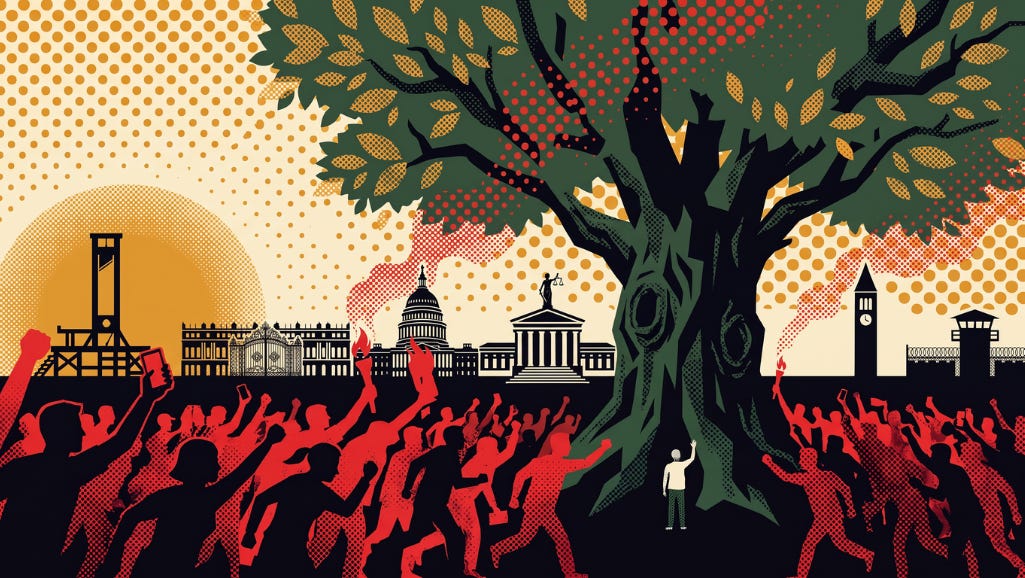
This week, everybody had a score to settle. The scales came out in courtrooms and committee rooms, on the campaign trail and in the war room, and wherever something had gone wrong, somebody went looking for a head to load onto the other side, until there was so much piled up that nobody could tell which way the thing was meant to tip.
The first score was an old one. Jack Smith, the prosecutor who brought two criminal cases against Trump, sat before a Republican-run Senate committee, where Senator Eric Schmitt waved a poster of text messages he said put Smith at an Atlanta Hawks game, and accused him of perjury. Smith had been at a college game in Maryland, where the Iowa Hawkeyes were playing. “You had the teams wrong, sir,” Amy Klobuchar chastised him. The gotcha got them instead.
Then the scores got older still. Trump’s Justice Department is now reviewing the prosecutors who brought down Richard Nixon more than 50 years ago, after a former Nixon aide turned up with a 78-page presentation called “Watergate As Lawfare.” Earlier this year, one Trump official said of two of the men who exposed Nixon, “May they suffer in eternity.”
Some scores were settled on the spot. When Senator Tom Cotton wouldn't back permanent daylight saving time, Trump posted what appeared to be his mobile number on social media and urged the people of Arkansas to give him a call. "Arkansans don't want their kids going to school in the pitch dark," Cotton replied.
In Texas, the Republican nominee for the state's Railroad Commission turned out to have spent six years online calling for his political opponents to be put to death. "I want more than perp walks," Bo French wrote. "I want public executions." The governor has kept his endorsement in place.
On a flight from Dubai to Tel Aviv, one pilot stabbed the other and the plane dropped around 17,000 feet before passengers and crew forced their way into the cockpit and two off-duty pilots landed it safely in Saudi Arabia. Trump suggested Iran might be behind it and promised it would be “hit, very hard” if so, before anyone had offered any evidence. This in the same week the last American troops left Iraq more than 20 years after the invasion, which Trump called “the end of a very expensive excursion into Hell” as he sent a third aircraft carrier to the Middle East and said Iran’s leaders would either sign a deal “or they won’t exist any longer”.
In the West Bank, a Palestinian family won a court order to get their homes back from settlers and returned under military escort, where more than 100 settlers overwhelmed the escort, forced them onto a roof and burned the homes down.
In France, high school protests over teacher shortages spread from the suburbs of Paris to the whole country in ten days. More than 400 were detained, and the Paris police chief called it “out of control”.
In Madrid, thousands camped in the main square after an 87-year-old woman was carried on a stretcher from her home of more than 70 years, her rent having jumped from 500 euros to as much as 2,650. A preliminary deal now lets her go home at the old rent.
Back in America, the price of bread kept climbing. With diesel up 70% since the war with Iran began, a food bank in Ohio watched its fuel bill triple, and with beef priced out of reach it’s now handing out canned chicken and beans, while a new hunger report found families cutting their children’s meals or skipping their own.
And as the food banks ran short, it emerged that Trump had personally ordered $20 million of public money be spent on ads praising himself, among them one titled “God Made Trump” and another called “King of the Jungle”. According to reports, the money was taken from border protection funds and routed through a budget line meant for memorials to officers who died in the line of duty.
With families going hungry, a ruler admiring his own reflection and a rising appetite for heads to roll, this was a week we’ve lived through before. It all came to a point in the two stories the whole world was talking about - a botched execution in Tennessee, and a crowd calling for seven heads at Cornell - and to understand what they’re showing us, we have to go back to a wet October morning in Paris over 200 years ago, when the crowd went to the crown looking for justice, and came up short.
If you’re feeling exhausted by the news or like nothing makes sense any more, or you’re worried for the future, then read on, dear friend. As always, the sky is showing us exactly what’s going on - and why - and exactly what’s coming next.
Receive this Wrap-Up in your inbox every Sunday!
The cosmic insights shared here are mapped to the real movements of the heavens during the past week. If you want to know more about planetary pattern recognition, read about it here


A gentle word before we dig in. This week's story travels through some heavy country - an execution, a murder, sexual violence and the harm done to a child - so take it at whatever pace feels right, and put it down for a while if it gets to be too much. The road leads somewhere better, and the last stretch is the reason for the whole walk, so stay to the end if you can….there's light waiting there.
When the People Lost Their Heads
They say history doesn’t repeats but it rhymes, and this week the rhyme was so loud it rang like poetry, echoing events from 237 years ago, almost to the day, when the crowd in pain reached for the crown in search of justice and all it got was more pain.
On the morning of 5 October 1789, thousands of Parisian market women began marching through the rain towards Versailles, armed with kitchen knives and dragging a couple of cannon, demanding answers from King Louis XVI as to why their children were hungry while his court dined under chandeliers. A brutal winter had diminished the wheat crop so a loaf of bread cost a working man most of his day’s wage, so when word reached the city that the king was holding lavish banquets out at the royal palace while Paris queued at empty bakeries, the fishwives and stallholders of the city’s great food markets snapped; they walked for six hours to Versailles and arrived soaked and furious.
King Louis initially promised them grain, but the crowd wasn’t assuaged - what they wanted, more than bread, was justice. They surged inside the palace and went looking for the queen, killing two of the royal guards on the way, and Marie Antoinette ended up fleeing barefoot down a hidden passage to the king’s rooms. By morning, both king and queen were dragged from the remote palace and walked back to the city flanked by the crowd, where they were installed in an old, half-empty palace in the middle of Paris; for the first time in a century, a French king lived where his people could see him, and couldn’t leave without their say. This was the crown finally meeting the crowd in what became one of history’s great turning points.
Until that summer, a French king answered to God and nobody else; the women’s march finally ended the King’s unfettered power in a day, as he found himself living essentially under lock and key in the middle of Paris with the people’s guards at his doors. It was as though the crown had been lifted off his head and handed to the crowd. He’d keep the title for another three years, but from that day on the crowd had the final say, and for a moment it looked as though justice had been done.
But rule of the crowd turned out to be no less cruel than the rule of the crown. The people had suffered for centuries, and now they had the power to hand that suffering back, so crowds eventually stormed the palace and threw the royal family into a prison tower, then broke into the jails and killed more than a thousand prisoners in a matter of days, convinced they were traitors waiting to rise. They moved from jail to jail, holding makeshift trials in the courtyards and cutting down whoever they found guilty on the spot, and by the end, around half the prisoners in Paris were dead, most of them common thieves, priests and beggars - people with no power to plot against anyone.
Perhaps realising that mob rule was kind of chaotic - just a bit - the people elected a government and declared France a republic, bringing an end to the monarchy. Louis was put on trial for treason, and when he was found guilty, he was dragged to the guillotine and beheaded in the public square in front of an enormous crowd. They took Marie Antoinette’s head months later.
And then they took almost anyone’s.
The guillotine took pride of place in the grandest square in Paris and heads rolled daily - people came early for a good view, sellers moved through the crowd with lists of that day’s condemned, and a group of women became famous for sitting at the front with their knitting while the heads fell. Watching people lose their heads became something of a national pastime, as the new government’s rule became known as The Terror, which is what Robespierre - one of the men running it all - said justice actually was. "Terror," he said, "is nothing other than justice - prompt, severe, inflexible."
17,000 French citizens lost their heads in the 18 months after they took Louis’s. And it wasn’t just nobles that got the chop - shopkeepers, servants, farmers, priests, soldiers and bakers all lost their tops, along with the chemist who gave oxygen its name, a playwright who’d dared to write that women had rights too, and in the end the very men the crowd had elected to govern. At its height the guillotine was working so hard that the neighbours complained about the smell of blood hanging in the air, and it had to be moved. It was as if the people lost their minds, and so the people lost their heads.
We call it capital punishment, and the word itself comes from ancient Rome. “Capital” is from the Latin “caput”, meaning the head. For the Romans, a capital crime was one you paid for with your head, and it’s the same root that gives us “decapitate”. For thousands of years, our word for the ultimate punishment has been the word for taking someone’s head off, and for most of those years it was a public event - hanging days drew enormous crowds, and people brought their children. What France added was scale; a new kind of state, armed with a machine and a list, killed its own citizens faster than any before it, to the point that a new word had to be invented for the men in charge - they were called “terrorists”.
These days we’ve mostly given capital punishment away, at least in the western world. Only one country in Europe still carries out executions, and Canada, Australia and New Zealand have done away with them too. France itself kept the guillotine until 1977, and retired it for good four years later. America is the exception - 27 states still have the death penalty, and 29 people have been executed there so far this year. There’s no guillotine - America’s preferred method of state-sanctioned killing used to be hanging, until the late 1800s when something more humane was sought after too many hangings had gone horribly wrong. The electric chair was invented in response, and for a century that’s the main way the United States killed its convicted citizens, but even that often proved gruesome, so in the 1970s lethal injections were proposed as a much nicer way to kill people.
But even a lethal injection can go wrong, as we saw this week when the state of Tennessee tried to execute a woman, and couldn't.
Want the Wrap-Up sent to your inbox each Sunday?
A Botched Execution
Christa Pike has been on death row for the better part of 30 years, sentenced to die for the murder of 19-year-old Colleen Slemmer back in 1995, when Pike herself was still a teenager. The two were classmates at a job training program in Knoxville, when Pike became convinced Colleen was trying to steal her boyfriend. One night in January, she, the boyfriend and a third classmate lured Colleen to a patch of woods, where Pike cut her with a box cutter and beat her to death with a chunk of asphalt. A pentagram was carved into Colleen’s body, and Pike bragged afterwards that she’d kept a piece of her skull as a souvenir.
At the time, America was in the grip of a panic about Satanism, and the pentagram made the case a sensation. The classmate who kept lookout cooperated with prosecutors and got probation, while the boyfriend, who has since admitted he was the one who carved the pentagram, was 17 and too young to be executed, so he got life with the chance of parole, while Pike, who was 18, was sentenced to death.
It ended up taking 30 years to get Pike to the gurney, partly because America gives the condemned decades of appeals. Pike’s appeals ran out in 2020, and so her execution date was set for this year. Colleen’s mother, May Martinez, travelled from Florida to watch, and planned to sit in the witness room holding her daughter’s photograph. “Every time I think about it,” she said last week, “I think about Colleen feeling that pain and trying to get up and run.”
Pike has a blood disorder, and drawing blood from her has always been difficult, so back in January her lawyers had warned the courts that finding a vein would be a problem. “I am not afraid to die,” Pike wrote in a letter days before. “I’m only nervous about the process.” Her lawyers asked for her to be killed another way instead, or for medical help to be standing by in case the needle failed, but Tennessee said no to both.
The execution was set for 10am on Wednesday, but with an hour to go an appeals court ordered a pause which the Supreme Court lifted that afternoon, so Tennessee pressed on that night. Pike was strapped to a gurney, with a Buddhist teacher at her side, and the team set about finding a vein, which took them about an hour. Her lawyer, watching, counted at least seven needles going into her left arm, one of which came out bent. Through all of it Pike tried to help. “Please try up on my shoulder, higher,” she kept saying. “Please try here. I think it will be okay.”
When they finally believed they had two lines in, Pike thanked them and then gave her last words. "I'm going to leave this world the way I spent most of my life," she said, "and that is with love." She told the room she loved the people who were angry with her just as much as the people on her side. "I'm at peace, and I'm ready to go."
Then they gave her the drug, but eight minutes later she spoke again. "My arm feels like it's about to burst open." Pike looked over at the prison officials and asked if it was supposed to feel that way, but nobody stopped, and her mouth eventually fell open and she began to snore. Twenty minutes after the first dose, officials closed the curtain across the witness room window, and that’s how an execution usually ends, but three minutes later the curtain opened again, and Pike was still on the gurney, still snoring. So they gave her the backup dose. Her lawyer could see her right arm turning purple. A few minutes after that the curtain closed a second time, her spiritual adviser was sent out of the room, and it never opened again.
What happened behind that curtain, nobody outside knows. Those in the viewing room could hear doors opening and closing, and Pike snoring. Her lawyer had to pass through six locked doors to reach a telephone - his colleagues rang the governor’s office and the emergency number for the Tennessee Supreme Court, which went to voicemail. One hour after Pike’s first dose they told a federal court that both syringes had been used and their client was “still alive and snoring”.
It was almost half an hour later before anyone told them an ambulance was coming, and somebody cut the microphone and led the people in the viewing room out, with Pike still audible behind the curtain. “I’ve witnessed five executions in Tennessee,” one of them said. “Nothing about today was normal.”
The Department of Correction said its staff had “followed every step of the state’s lawful, established execution protocol,” but now days later, Christa Pike is unconscious and on a ventilator. The drug appears to have missed her bloodstream and poured into the flesh of her arm, where it blistered and burned. “Essentially,” one anaesthetist said, “they’ve injected bleach into the tissue of her arm.” Doctors say she may have lasting brain damage. Her lawyer said her biggest fear was not dying, but a prolonged, painful, traumatic death, “and that’s what happened, minus the death.”
Want the Wrap-Up sent to your inbox each Sunday?
In Pursuit of Justice
Nobody got justice this week. May Martinez has been waiting 30 years for it. After sitting through a trial where her daughter’s skull was passed around the courtroom as evidence, she’s waited for the person who did this to face her punishment, scraping together the money to drive to Nashville this week to see it finished, only to find it still ongoing. “I didn’t get justice for my daughter,” she said afterwards. One Tennessee politician was blunter: “All we’ve done is pick the scab off of their wound and pour salt in it.”
Colleen got no justice either. Her life was cut short 30 years ago, and this week, and in all the weeks since, her name has been little more than a detail in someone else’s story. “Nobody,” her mother says, “remembers Colleen.”
And whatever we think Christa Pike deserves, it’s hard to call what happened to her justice. Her sentence was death, and it was meant to be quick and humane, but what she got was 30 years alone in a cell, an hour of needles, and a drug that burned through her arm, and now, God only knows what.
For thousands of years, we’ve been killing those who kill and harming those who harm as a way of ending the cycle of pain, but this week we were shown clearly how that endeavour often causes more of it. In all the years of beheadings and hangings and electrocutions and lethal injections, not one of them has ever taken the pain of what was done away. If the needle had found the vein and Pike had died quietly as intended, May Martinez would still have driven home to Florida with the same grief she arrived with, and Colleen would still be gone. The one thing her mother has wanted for 30 years is the one thing no execution can give her.
Tennessee’s answer has been to accept the resignation of the head of the Department of Correction and argue about the equipment. The governor wants to find out what went wrong so the state can “do what the people of this state want done”. The woman likely to replace him says the answer is simple: bring back the electric chair. But nobody seems to be asking whether the machine could ever have produced what we built it for.
In every picture we’ve ever made of it, justice is a woman holding a pair of scales. Something was taken, so something must be given back, until the two sides hang level again. It’s a tidy idea, and it works beautifully for a stolen horse; you took my horse, you give me a horse, and we’re square. But a life isn’t a horse. When we put a second death on the scales, the first one is still sitting there - nothing’s been given back, there are simply two of them now.
None of the machines we’ve ever built for more efficient or humane killing has managed to restore the balance. They’ve just given us somewhere to put the feeling, and made more of it in the meantime.
When something terrible is done, it leaves a weight in everyone it touches, and that weight is almost unbearable to carry, so instead of sitting with it, we hurl it back at the one who caused it, as if making them hurt could absolve us of having to feel it ourselves. That was the guillotine, and the firing squad, and the hangman’s noose, and the electric chair, and the gurney with the poison needle - each one a way of making someone else feel the pain so we wouldn’t have to. That’s what punishment is: pain, given on purpose, in answer to pain. The word itself comes from the Latin for pain - its purpose is written into its name.
Justice is a different word, from a different root. It comes from the Latin for what’s right, and it means putting right what was made wrong. Somewhere along the way we folded the two together, until “bringing someone to justice” came to mean little more than making them suffer. We’ve been using the first to chase the second for thousands of years and it’s never once caught it. Pain answered with pain puts nothing right, it just makes a new wound somewhere else.
“I don’t think that someone should kill me to teach me that killing someone is wrong,” Pike said last month.
The gallows and the guillotine may have gone to the museums, but we’ve never given up the reflex underneath them: the urge to take the unbearable feeling and throw it at somebody.
That reflex has simply found itself a new square.
Want the Wrap-Up sent to your inbox each Sunday?
The Court of the Crowd
We may have lost our stomach for blood, but we’ve kept our appetite for heads. The public square is still with us - it’s now online, where several billion of us can fit in it at once - and it has its own way of carrying out a sentence. A name goes up, then a face, an employer, a home town, a family, and within hours the crowd has gathered, the lists of the condemned are being passed from hand to hand, and people are settling in at the front with their knitting. There’s no trial and no appeal, and the sentence is carried out the same day.
We saw it this week when the internet lit up with the names and faces of “the Cornell 7,” a group of Cornell University students named in a lawsuit filed by another student who says she was sexually assaulted two years ago, when she was 20, after she went to a fraternity house to meet someone she thought was a friend.
In a 101-page civil complaint, the student - identified as Jane Doe - alleges she was visiting a friend at the house and was intoxicated and unable to consent when two male students pressured her into snorting a substance they claimed was ketamine. After an initial sexual assault, one of them posted in the fraternity’s group chat for active members, offering her to anyone who wanted her, and more men came. Jane Doe was subjected to an hours-long assault by seven of them, according to the complaint. The filing details graphic abuse - men snorting lines of ketamine off her body, moving her between rooms, continuing to sexually assault her while she was incapacitated, before she finally lost consciousness. As far as the suit tells it, nobody came to help.
Though Jane Doe reported the incident to campus police, no charges were laid - the local district attorney read her statement and declined to charge anyone because, by his account, she’d described what happened that night as voluntary and consensual. The university ran its own inquiry, conducting 50 interviews and more than a dozen hearings, and at the end of it expelled two of the seven men. The others were given suspensions and workshops, and some were allowed to reduce their penalty by writing an essay.
After Jane Doe dropped out of Cornell and filed her lawsuit, her story exploded, and within days, the names in the suit were matched to photographs, LinkedIn profiles and employers, and posts naming where the men now work were spreading across social media - a website went up listing all seven and raising money for billboards to keep them in public view. Though lawyers for several of the men say their clients did nothing wrong, people all over the world have been calling for their heads, and amid all the online fury the district attorney reopened the case, but then the governor of New York took it off him, saying she'd lost faith in him, and handed it to the state's attorney general for further investigation.
The fury and the outrage have been palpable, and entirely understandable. A young woman says seven men raped her, and for two years very little came of it. When a truth like that has nowhere to go, the crowd picks it up, and most of us felt that fire this week, like we’ve felt it far too many times before. In 2018, we watched a woman testify and the man she accused get a seat on the Supreme Court for life. Then we watched a man a jury found liable for sexual abuse become president, for the second time. Enough is enough is enough.
And the fire this week did some good. The case was only reopened once the fury arrived, after two years of proper channels had gone nowhere, the same way the march on Versailles brought a king back to where his people could see him two centuries ago. That's the crowd demanding to be heard, and it worked.
But taking heads before any court has spoken is another thing altogether. That's the crowd passing sentence, and it's the point where the march of 1789 became the massacre. The messages from that fraternity group chat are out there for anyone to read, and they're vile, but the accounts of what went on in that house vary, and working out the truth between them is exactly what a court is for. Jane Doe deserves one that takes her seriously, which is more than she’s had so far. The seven men deserve one too, before the crowd gets to them, and if that court finds they did what she says, they should be held to account for all of it.
This week, in our pursuit of justice, what landed was punishment - pain in answer to pain. Jane Doe has been carrying hers for two years. When she reported what she says happened and wanted to go home and recover, her lawyer says the university refused to refund her tuition, so she spent another semester on a campus where she kept seeing the men she'd accused. This week the court of the crowd handed pain to seven men, and hers is still no lighter for it.
The pain hasn’t gone away, it’s just been distributed.
Want the Wrap-Up sent to your inbox each Sunday?
Be part of our community. Join the Inner Circle
The Pain that Asks to be Held
Punishment is pain passed on deliberately, but most of the pain passed on in this world moves faster than that. It’s a reflex. Something hurts us, we don’t know what to do with it, and before we’ve had time to think it’s landed on whoever’s nearest - the sharp word at the dinner table, the slammed door, the bad day at work brought home to the kids. Most of us have done it this week.
Usually the damage is small, but it’s the same urge at every size - push away the pain so we don’t have to feel it. When the pain is enormous and we don’t know how to hold it, the same urge can end somewhere terrible. That's the part of Christa Pike's story the jury never heard.
According to her case files, which the state of Tennessee hasn’t disputed, she was molested and raped from the time she was in kindergarten, first by men she knew and then by a stranger. Her parents came and went, and she was passed between relatives in different states. When she was 17, she told police in North Carolina that a man had thrown her to the ground and raped her as she walked to the store, and nobody was ever arrested. A year later, she killed Colleen.
The jury that sentenced her heard every detail of what she did to Colleen, and nothing of what had been done to Christa; that’s what briefly stalled the execution on Wednesday morning, while a court examined whether any of it was taken into account when she was tried three decades ago. It makes her no less guilty of murder - most children who are hurt the way she was grow up and never harm a soul, and Colleen’s mother has every right to refuse Christa's history a moment's thought, but it shows us what can happen to pain that’s given nowhere to go. It doesn’t sit quietly, and it doesn’t aim. Colleen had nothing to do with the men who hurt Christa. She was just standing closest when 18 years of it finally went off.
The psychologist who assessed Pike years later wrote that the adults in her life had failed her. “Nobody,” she said, “was trying to get her help.” So the pain moved. A child was harmed and nobody came, and she grew up and handed it to Colleen. Colleen’s mother was harmed, and we told her an execution would settle it, so she waited 30 years to hand it back. Then this week we did deliberately, with 30 years of that pain, what Christa did with 18 years of hers - we went looking for somebody to put it in. We call one of those murder and the other justice, but the pain moves the same way through both, and when the needle missed the vein there was more of it in that room than there was before anyone walked in.
It’s the road the pain took in Paris, too. The market women carried theirs to a king, and when it found no answer there it spilled into the prisons and the public square until 17,000 heads had rolled, and the bakers and servants were standing closest. Jane Doe carried hers to the police and then to her university, and both handed it straight back to her, so two years later she took it to a court, and the crowd snatched it up on the way and hurled it at the seven men she named.
Every one of these is pain passed on as the answer to pain, and every time there’s more of it afterwards. The one who throws it keeps it, and now somebody else has it too. Pain keeps travelling until it reaches somebody who’ll hold it. Every punishment we’ve ever built, from the guillotine to the gurney to the pile-on, has been a way of keeping it moving - it’s that same reflex with a verdict attached - and this week showed us where that road ends.
We can’t keep passing it on. Nothing gets lighter until we learn to hold it.
Want the Wrap-Up sent to your inbox each Sunday?
The Scales in the Sky
The sky has been offering this lesson on a loop for centuries, reaching a crescendo roughly every quarter of a millennium, when the planet of power comes face to face with the planet of action in a very specific part of the sky.
The planet of power is Pluto, and it takes around 250 years to complete its journey, digging up whatever’s been buried in each part of the sky as it goes. When the market women set out for Versailles in October 1789, Pluto was moving through Aquarius, the sign of the people, so what came up was the buried pain of the crowd. Pluto’s back in that same sign now for the first time since the French Revolution, and that pain is rising for reckoning once again.
That same week, Mars, the planet of anger and action, had just marched into Leo, the sign of kings, directly across the sky from Pluto. Anger in the sign of the crown, staring down upheaval in the sign of the people. The crown met the crowd, and the crowd won. This week, as the days ticked over to the anniversary of the march, Mars walked into Leo again and took up the same position, and by Saturday the two were standing exactly face to face. It’s the sky those women marched under, come back around after 237 years.
So we’ve been here before, and we know how it went last time. The pain that rose up in the people of France was real, and so was their claim to justice. Things were out of balance, and the crowd was right to want balance restored - they were right to want their pain to be held. But instead of holding it, they threw it. They hurled it at a king and a queen, then at the prisons, then at their neighbours, and finally at each other, and 17,000 heads later France was no closer to balance than the morning the women set out.
That’s the lesson this sky left behind. It brings the pain of the crowd to the surface and hands the crowd the power to do something with it, and in 1789 we answered pain with more pain, and more, and more.
This week it handed us the same pain and the same power. A state tried to settle a killing with a killing. A crowd tried to settle an alleged assault by taking seven heads in the town square. And at the end of it, just as in Paris, none of that took away the pain. It just made it louder in its demands to be held.
All of this has unfolded with the Sun in Libra, the sign of the scales, just as it was when the women marched. Those scales belong to Venus, the planet of love, and weighing is love's work: what something’s worth, what’s fair, what we owe each other and what we’re owed. And this week Venus has been travelling through Scorpio, the sign of debts, and of the wounds that go deepest. Venus in Scorpio is the part of us that keeps the ledger, and wants every debt paid in full.
It was in Scorpio when the women marched, too, but in 1789 Venus was in a hurry. It swept through the sign in under four weeks and moved on, and the crowd moved with it, straight from the march to the prisons to the guillotine. The debt was tallied and collected in the same breath, and nobody stopped to ask what the scales were actually weighing.
This time Venus has stopped and turned back, and over the coming weeks Venus will reverse all the way out of the sign of debts and into Libra, the sign of the scales itself, before turning forward again in the middle of November. The sky that sent the crowd rushing in 1789 has built a pause into the same moment in 2026, and for the next six weeks the planet of love goes back over the ledger, asking us to take a second look at how we settle our debts.
The last time we stood under this sky, our pain taught us how to rise.
This time, it's giving us a moment to finally learn how to hold it.
Want the Wrap-Up sent to your inbox each Sunday?
The Wisdom of a Tree
Those scales in the sky are the same ones Lady Justice holds in every picture we’ve ever made of her. When harm is done, one of those pans drops. It’s heavy with pain, and everything in us wants the scales level again, so we do the only thing we’ve ever known how to do, and load the other side. We heap pain into the second pan until the two hang even, and we call that justice. Balance restored.
And the scales do balance, but their sum total is pain, on both sides. We make more of the thing than there was in the first place and call it even, but then wonder why the world’s choking on all the pain.
We’ve been doing this for thousands of years, making pain in response to pain, and none of that pain has gone anywhere. It hangs in the air like carbon, the way the smell of blood hung over that square in Paris. Every head that rolled put more of it up there, and so did every hanging and every execution since, and every name thrown to the crowd this week. We’re all breathing it, and the more of it there is, the faster we reach for somebody to throw it at, like that’s the only way to balance the scales.
For thousands of years, our response to pain rising has been to look for who caused it and figure out what to do with them, as if doing something to them is what puts the harm right.
But what if the harm is a flood? Or a fire, or an accident, or an illness? The loss is every bit as real and the pain is every bit as heavy, and there’s nobody to go after. We can’t punch the sky. We can’t put the river in prison, or make the fire pay. The only way to account for that pain is to hold it, because there’s nobody to hurl it at. It simply demands to be held - that’s the only way that pain is healed.
Pain that’s healed takes weight off the scales. Rather than heaping more pain on the other side, we can take the pain that already exists and hold it, and let it do what it came to do. Most of us spend our whole lives avoiding the pain that finds its way to us, but what if feeling that pain all the way down is the only way to take it off the scales? What if that’s what restores the balance?
Pain that’s thrown stays pain - it lands on somebody new and the whole thing starts again. Pain that’s held and honoured does something else entirely. It moves through us, and it changes as it goes, and it changes us too.
A tree knows how it's done.
A tree stays. It can’t run from what’s in the air and it can’t throw it at the tree next door. Whatever arrives, it meets standing where it is. Then it takes it in, opens itself to the very thing that would choke us and draws it right inside. Then it brings it into the light - in the dark, the carbon slips back out, but in the light, the carbon becomes the tree. Most of a tree’s body came out of the air. Every ring in the trunk is a year of taking in what was there and building with it. Even its wounds stay. A tree keeps every scar it’s ever had, and grows new wood around each one until it’s bigger than the wound. What it gives back is air the rest of us can breathe. The poison becomes the wood.
For us, the light is the truth, seen and heard. Pain kept in the dark slips straight back out - a report sat on for two years, a child nobody was trying to get help for. Holding pain means bringing it to where it can be seen, the way the women of Paris brought a king to where his people could see him, and staying with it there. Silence is just more dark.
The heart, the deepest part of us, was made for this work. The mind can only move pain around, from one pan to the other, from one person to the next. The heart can take it in and feel the whole truth of it - that what’s underneath all the pain is love. May Martinez's grief is the size of her love for Colleen. Fury, underneath all its heat, is somebody we wanted kept safe - a hungry child in Paris, a young woman in a fraternity house. Thrown, it’s a weapon. Held, it turns back into what it started as.
Pain held all the way through transmutes into love - the kind that only comes through suffering, the kind we know as compassion. The word itself comes from the Latin for "to suffer with", and it's the deepest kind of love there is. The kind that allows us to stay with pain the next time it rises, or to sit with somebody else’s, as well as our own. That’s why the people who’ve sat with their own grief are so often the ones most able to sit with ours, because they’ve learned what to do with their own.
Love Made From Pain
When a person causes harm, there are two people holding the pain - the one who was harmed and the one who did the harming. The one who was harmed heals by holding the pain all the way through, and the one who caused the harm should be held to account, not because that’s how we heal but because that’s how they do.
Our healing comes from feeling our own pain, and theirs comes from them feeling theirs: the pain of what they did, and the older pain underneath it that was never held, and until both are felt, it will keep passing on. That’s what holding someone to account is actually meant to be - it’s holding them to the truth of the harm, so the pain can be felt all the way down. That's justice in the oldest sense of the word - putting right what was made wrong. The balance is the truth, held fully. For most of history, we’ve just piled on more pain in answer to the pain they caused, but that resolves nothing - it only makes more pain.
We can lock people away, and even take their life, but nobody can force another to sit with their pain - some people will never do that work no matter how much we try to force them, and that’s the hardest part of all. If our healing waits on them holding the pain, then we’ll always be in their hands. Whatever they do or don’t do, the pain that reached us is ours to hold, because pain we refuse to hold just becomes more pain.
How a mother carries 30 years is hers alone to decide, and the same goes for Jane Doe. The work here belongs to the rest of us, the crowd, whose pain this week arrived second-hand.
In the world we were born in, we took our pain to the mind where it did the only thing it knows how to do - find who’s to blame, weigh up what they owe, and hurl the pain back at them. The mind sorts and measures and settles accounts, and it’s brilliant at it, but it can’t feel, or transmute pain into anything. All it can do is move it around, and every time it moves, there’s more of it.
A whole age was built on moving pain around, and the air's thick with what it left behind. The heart is the only part of us that can take pain in and make something else of it. It’s where pain becomes compassion, the way carbon becomes wood. That’s how a better world emerges, when we learn where to put our pain. That’s how the Age of the Heart rises, each time one of us feels the fire go up and carries it past the judge and the scales, down into the deepest part of us, and stays with it there until it turns. That’s one breath of carbon taken out of the air. And then another. And another.
The mind still has its work to do. Once the heart has held the pain, the mind can do what it’s best at.....find the truth, keep people safe, hold someone to account.....with nothing left to throw. That’s what a new age could look like - more holding and less hurling, more healing and less harm.
No single tree ever cleaned the sky. It takes a forest, and a forest takes a long time to grow. But a forest is only ever a lot of trees, each doing its own work on its own patch of ground, and each making the air a little easier for the rest of us to breathe.
This week it can start with Colleen. She was 19, she volunteered at the Special Olympics, and she loved bowling and roller skating and computers. Her mother says nobody remembers her. We can.
More than two centuries ago, the market women of Paris walked six hours through the rain to hand their pain to a king, but ours has a much shorter road to travel. A better world won’t be handed down to us - no leader can legislate us into love, and no better system is coming to do the holding for us. It starts with each of us, in every ordinary moment, in the headline that makes our blood boil, or the comment that stings, or the old hurt that still flares up at the dinner table.
That’s our work this week.
When the fire goes up, we stay.
We take it in.
We carry it down into the deepest part of us.
And we hold it in the light until it turns.
That’s the wisdom of the trees.
Taking in whatever the wind brings.
Standing tall where they are.
And turning it into something the rest of us can breathe.
And so rises the Age of the Heart.
If you need a place to land after reading this, or if you want some support as we navigate the days ahead, come join me in the Daily Lighthouse. I’ll be there, each day with you, or if you prefer it in an audio listening format, head over to the Resonance Room.
If anything written here has stirred something heavy in you, please reach out to someone who can sit with you in it, whether that's a person you love or a crisis line where you live. The heart can hold a lot, but it was never meant to hold it all by itself.
See you in the stillness, friends.
Onwards!

If this writing resonated with you, please share it with your friends.


Pain, hurling it, the tree metaphor, stirred a deep understanding of the world we are living in. With the history of the planets coinciding with what happened in Versailles, the landscape certainly looks familiar. After a week of all that has been in the headlines and my heart, this piece brought comfort. Yes, things are a mess, it’s a bit frightening to think how current events might escalate into something horrific. Yet, the planets have a template of the heart and a history of failure with only the mind in charge. Astrology is helping me manage the chaos in the world during this time. Sunday morning coffee and your Wrap up are truly a compass and a comfort. Onward… as you always say:-)
I left church at age 13 , but reading this today has taken me to church in a real way. This week as I followed the Cornell story, it evoked a flood of memories of my years as a woman in our culture.. too many to recount. And because I realize with more clarity that I realized I had, I have done a lot of sitting with my pain. My 40 years working as a therapist gave me much of that, as I sat with the pain of countless victims of sexual and physical abuse, I had to sit with my own. Much of my own pain has healed. Through the years the men I loved who hurt me the most have died. The most recent , I attended his memorial, remembering mostly the good in him, and not the pain of his alcoholism and mental disorder he inflicted on me at age 17. When they each died from their own pain, medical issues, I felt no revenge or joy. Just that nature took its course.
I am 76, and have more gratitude for the good enough men I have had in my life, my dad, uncles, husband, and friends. The others no longer matter. So when I found myself sharing the named names and photos of the Cornell 7, it did not feel right, or satisfying. I now see that I THOUGHT I should feel better. My heart was trying to tell me otherwise. Now, thanks to your writing, I UNDERSTAND why. And see a much better direction for my feelings in order to help us all evolve. Thank you.