


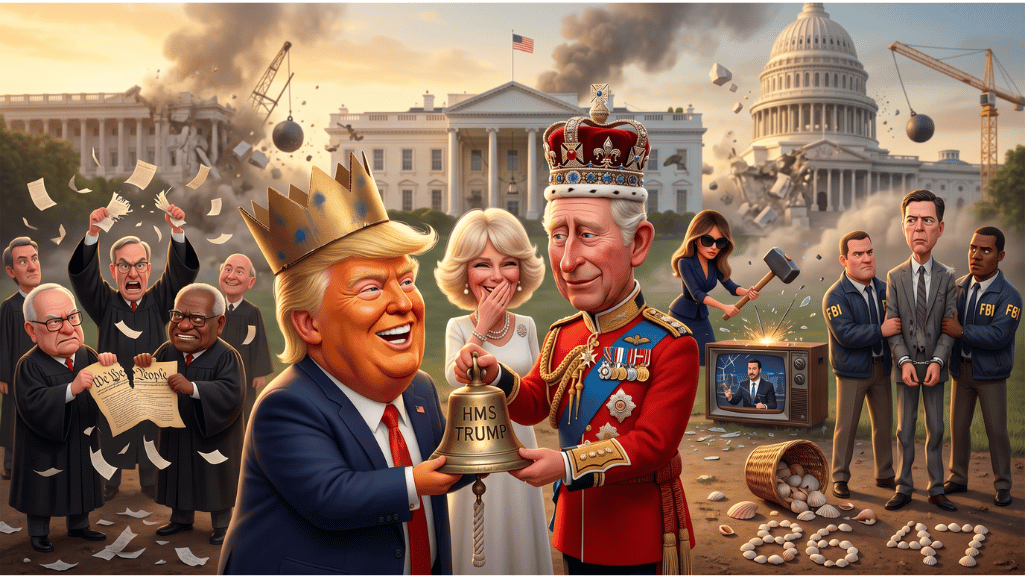
This week the old world's losses came in faster than its performers could spin them, as the empire kept insisting on its dominance while the ground gave way beneath it; the alliances cracked, the allies walked, the institutions bent, and beneath all the noise, the sky began drawing a map that does not lead back to the house we were born in.
This week revealed the shape of a presidency losing on every external front all at once, as Trump’s war on Iran hit its sixty-day War Powers deadline - the date by which a president who has launched military action without congressional approval must either end the hostilities or get Congress to authorise them. Trump did neither, instead sending letters to the House and the Senate claiming the war “terminated” on April 7 - the day he ordered a ceasefire that has since been broken multiple times. The letter conveniently ignored the ongoing US blockade of Iranian ports - which in itself is an act of war - the April 19 US strike on an Iranian tanker, the fact that Trump himself told an audience the same day that “we’re in a war,” and that he’s still requesting a $1.5 trillion defence budget to keep prosecuting the war he says has ended.
Defence Secretary Pete Hegseth tried to argue in front of the Senate that the sixty-day clock pauses during a ceasefire; Senator Tim Kaine noted the law says no such thing. Speaker Mike Johnson declared that Congress doesn’t need to act because the United States is “currently not at war,” and Senate Majority Leader John Thune said he won’t challenge Trump’s reading of the War Powers Act because his caucus isn’t asking him to. So everything’s going just swimmingly over on Capitol Hill.
With 13 American service members dead and more than 400 wounded, dozens of aircraft lost and US missile inventories alarmingly depleted, the Pentagon confirmed the war has cost American taxpayers $25 billion so far, but CNN reported the figure climbs to $40–50 billion when the damage to US bases and infrastructure across the Gulf - far worse than the administration disclosed - is included.
When German Chancellor Friedrich Merz declared this week that the United States has no strategic plan, and “the entire nation is being humiliated by the Iranian leadership,” the Pentagon responded by confirming the US would withdraw 5,000 troops from Germany - a move that primarily benefits Vladimir Putin, whose war on Ukraine just entered its fifth year, and visibly cracks the post-war alliance system that has held the world together since 1945.
At the same time, the United Arab Emirates formally left OPEC after 59 years of membership, after spending weeks absorbing Iranian missile strikes while supporting the US war effort, and watching the Strait of Hormuz closure cripple their oil exports. The UAE was the cartel's third-largest producer, and no major top-tier OPEC member has ever voluntarily walked out before - the petrodollar architecture that’s anchored US economic dominance since 1974 is fracturing because America's most loyal ally in the region got tired of bearing the costs of the war Trump started on a whim.
Economist Paul Krugman noted this week that the acronym “TACO” for “Trump Always Chickens Out” has been replaced by “NACHO” for “Not A Chance Hormuz Opens” - Iran has no incentive to strike a deal with Trump because the oil pinch hurts him more than it hurts them, and because Trump cannot be trusted to honour any deal he makes anyway. Meanwhile, the real cost of Trump’s war is starting to be felt not only at gas pumps worldwide, but in the business sector, as Spirit Airlines - America’s eighth-largest carrier, with 17,000 employees - ceased operations suddenly this week, citing rising fuel costs due to the closure of the Strait as a contributing factor. As gas prices keep going up and farmers keep declaring bankruptcy due to rising cost of fertilizer - also a casualty of the Strait closure - it’s getting harder to hide the fallout from Trump’s reckless war, and the worst of it is still yet to come.
Perhaps as a convenient distraction, the administration spent the week trying to weaponise last weekend’s gunshots at the White House Correspondents’ Dinner in service of the ballroom Trump wants built. Acting Attorney General Todd Blanche filed a seven-page motion to dissolve the court injunction blocking construction that read as if it had been written by a madman. It opened by declaring that the National Trust for Historic Preservation’s name is “FAKE,” and then went on to argue that if a man can sprint through a magnetometer at the Washington Hilton with a shotgun and three knives, the only acceptable solution is for the President to never have to leave the White House grounds ever again. Senator Lindsey Graham and other loyalists then introduced a bill to appropriate $400 million of taxpayer money to build the ballroom outright, on the site of the East Wing the President demolished without permission, despite the fact Trump has repeatedly promised the Ballroom would be funded through private donations he claims have already been collected.
Trump took to 60 Minutes, ostensibly to address the shooting and his urgent need for a ballroom, only to be confronted by CBS correspondent Norah O’Donnell reading aloud from the alleged shooter’s manifesto, including the line where he stated his motive as a refusal to “permit a pedophile, rapist, and traitor to coat my hands with his crimes.” Though never mentioned by name, Trump assumed the reference was to him and declared, “I’m not a rapist… I’m not a pedophile,” to which O’Donnell responded “Oh, do you think he was referring to you?” And for just a brief moment, she silenced the man who never stops talking.
Mid-week, King Charles and Queen Camilla arrived for their British state visit to commemorate the 250th birthday of the United States. In Trump's welcome speech to the visiting royals, he rewrote the founding of the United States as a story of “blood and noble spirit” and “Anglo-Saxon courage” and explicitly rejected the idea that America was founded on “the revolutionary idea of life, liberty, and the pursuit of happiness” in favour of the idea that America is a bloodline.
King Charles, only the second British monarch ever to address a joint session of Congress after his mother in 1991, used what was supposed to be a courtesy to deliver a Magna Carta rebuke of his host. He centred the 800-year-old document that established that kings must answer to the law, noted the Supreme Court has cited it in at least 160 cases, praised the Founders for “balancing contending forces and drawing strength in diversity,” and urged the United States to “ignore the clarion calls to become ever more inward-looking.” He also invoked NATO’s collective defence commitment as a sacred trust, reminding Congress that the only time it has ever been triggered was after 9/11, in defence of America.
The most-watched speech of King Charles’s reign turned out to be a goodbye to Trump’s revisionist alliance, disguised as a warm state-visit greeting, to which the official White House social media account responded by posting a photo of the two men together captioned “TWO KINGS,” which went down a treat. Then, at a state dinner, King Charles presented Trump with the original brass bell from the HMS Trump, a British submarine that served during World War II. Trump looked pleased as punch, not realising the entire population of Britain was sniggering at the bell’s implication - very Benny Hill - made even sweeter when the King quipped, “Should you ever need to get hold of us, just give us a ring.” Soft diplomacy with a very British finish.
Inside Trump’s own administration, the cabinet kept fraying, with Vice President JD Vance reportedly now distancing himself from the Iran debacle by quietly questioning whether Hegseth is providing Trump accurate information about the war, and Republican senators losing confidence in Hegseth as he hollows out the senior officer ranks of the US military. Though new polls revealed Trump’s approval is tanking even amongst Republicans, that didn’t stop the State Department from finalising plans to put Trump’s face on US passports, or the Pentagon from asking Congress to formally rename the Defense Department the “Department of War” at a cost of $52 million.
As the week went on, the FCC, chaired by Trump loyalist Brendan Carr, opened a review of ABC’s broadcast licences after Jimmy Kimmel told yet another joke that the Trumps didn’t like, and a federal grand jury in North Carolina indicted former FBI director James Comey for posting a photo of seashells on Instagram arranged in the pattern “86 47” - alleged by the indictment to be a death threat against the 47th president of the United States. All very, very normal stuff.
As the world watches on in horror, it’s not just Trump’s presidency that’s unravelling - it’s the architecture of an entire world order coming apart on America's watch, by America’s own hand, in front of a global audience whose lives are shaped by decisions made by people they did not vote for and cannot remove.
The sky has been pointing at this moment for years, mapping the same configuration that produced America itself two and a half centuries ago, asking the same question it asks every time an old order has stopped serving the people inside it. But this time, under this sky, the answer being pointed to looks nothing like the one given in 1776.
If you’re feeling flooded by the news and like nothing’s making sense right now, or if you feel worried for the future and want to know what comes next, then read on, dear friend. As always, the sky is showing us exactly where we are and where we are headed. Let’s look up and find the way through, together.
**The cosmic insights shared here are mapped to the real movements of the heavens during the past week. If you want to know more about planetary pattern recognition, read about it here**

The World Made in America
For most of our lifetimes, the President of the United States has been widely considered the leader of the free world - the most powerful person on the planet - but this was not always so. Prior to the mid 1900s, the question of who governed in Washington was a matter of distant interest to most of the world’s population. Britain ran the international financial system, France and Germany contested Europe, the Ottoman world held its own sphere, and China was an empire of itself. The United States, until well into the twentieth century, was politically peripheral to the way the rest of the world organized itself.
That changed in 1945, when the Second World War ended with the European powers exhausted - their empires bankrupt, their cities in rubble, their treasuries empty. The United States, by contrast, emerged with its territory untouched, its industrial capacity doubled, its treasury full, and its scientists in possession of the atomic bomb. Roughly half of all manufacturing on Earth was happening within American borders, so when the rest of the world needed reconstruction, only one country had the capital and the capacity to fund it.
What followed, across the second half of the twentieth century, was the construction of an international architecture with the United States at its center. American money rebuilt Europe under the NATO security umbrella, the dollar became the world's reserve currency, American military bases ringed the planet, American consumer culture became global culture, and American technology became the platforms through which most humans communicated.
For three quarters of a century, this was the world we lived in, in which the basic rules of international finance, trade, communication, and security were all set by a single power with a relatively predictable internal politics. The rest of the world had no say in who steered the ship; only Americans got to vote for the person who sat at the center. Roughly 5% of the world’s population chose the leader who shaped the lives of the other 95% - that was the deal the rest of the world agreed to in return for America saving the day. The rest of the planet placed its faith in the American people to always choose leaders wisely who would honor international treaties, keep the global currency stable, limit wars, promote peace and ensure the center held.
For three quarters of a century, that faith mostly paid off - it wasn’t perfect, but it staved off global conflict and produced prosperity across the Western world for decades. But that trust has now been irrevocably broken, after the American electorate chose twice to elect a convicted criminal and serial fraudster whose first administration ended with an attempted coup and whose second administration has taken a wrecking ball to the entire post-war architecture.
Under America’s mad king, NATO allies are unsure whether their security guarantees are real. The dollar’s reserve status is being questioned for the first time in eighty years. Tariffs no court has authorized are reordering global trade. And the war on Iran - the war this administration started in defiance of its own intelligence services, in violation of international law, and against the advice of nearly every regional ally - has now closed the Strait of Hormuz, choked off roughly 20% of global oil supply, and pushed the international energy system to the edge of a crisis with no historical precedent.
As a result, energy and food prices have already doubled in much of the world, and now famine warnings are being issued across parts of Africa, South Asia, and Latin America. Countries who had no vote in the American election are now bearing the cost of its outcome in a way that no country outside America’s own population should ever have been asked to bear.
The world has watched on in horror these last fifteen months as Donald Trump has run roughshod over American democracy and the world order, and the systems designed to rein him in have failed one by one. Congress, the Senate, and the Supreme Court have all failed, and it seems that now the only hope of ending Trump’s reign of madness might be a return to the very ballot box that began it, with the entire planet asked to place faith once again in an American electorate that is as unreliable as its institutions.
The world’s weary eyes are squarely fixed on the November midterms in a way they have never been during any election in living memory, eager to see whether the country that built the post-war world can still correct itself through the mechanism it built itself around - the vote - or whether that mechanism has now been damaged past the point where correction is possible from inside it.
The outcome of these midterm elections won’t just affect Americans - this is a hinge point for the whole world, and right now 8 billion people are leaning in with some trepidation to see what America does next.
Dirty Deeds Done in Daylight
Trump is going into these midterms as one of the most unpopular presidents in American history. His approval rating has cratered to the low 30s across all the major polls, converging on numbers that match the floor he hit in January 2021, in the days after his supporters stormed the Capitol. What makes this historically remarkable isn't just the depth but the persistence: Trump has been underwater for nearly his entire time in the Oval Office.
As each day passes in Trump’s second term, so do the chances that Republicans hold on to power beyond the midterms. By every standard measure of the modern political cycle, the Republican Party is heading into November carrying the heaviest weight of any incumbent administration in living memory.
The midterms are always a referendum on the party that holds the White House, and what the American public is being asked to ratify in these elections is unprecedented. A war with Iran. The kidnapping of Maduro. ICE agents shooting civilians on American streets. Boats blown up in the Caribbean. Concentration camps in the Florida swamps. Tariffs no court has authorized. The Epstein files mishandled at the highest level of the executive branch. A cabinet stocked with conflict and apparently designed for impunity. The list runs longer every week.
As it stands right now, Democrats are positioned to take back the House and very possibly the Senate, and what waits on the other side of that flip is the thing this White House fears most - hearings with subpoena power, committee investigations, and likely articles of impeachment for the president and even the Vice President; a constitutional reckoning the administration has spent the entire first half of its term thumbing its nose at.
In the face of such a likely thrashing at the polls, Republicans haven’t been regrouping, or backing down, or changing their policies to improve their popularity - they’ve been doing everything they can to put their thumb on the scales, redrawing electoral maps to rig the game in their favour. Texas redrew its map last year under direct White House pressure, and this week Florida approved a redrawn map designed to pick up four Republican seats in the House, despite the fact that more than ten years ago, voters passed a constitutional amendment that bans partisan redrawing. New York’s GOP-favoring seat was protected by the courts in March, and Missouri, Indiana, and Ohio have all signalled that redrawn maps of their own are incoming. There’s no pretence that any of this is being done in response to demographic change or census revision - it’s all being done to protect Republican-controlled legislatures from facing electoral collapse in November.
This gerrymandering of electoral maps is not new. The word itself was minted in 1812 after Massachusetts Governor Elbridge Gerry - a Founding Father - signed a redistricting bill that twisted one of the state’s senate districts into a shape that resembled a salamander. The Boston Gazette ran a cartoon of the district drawn as a winged reptile, captioned “The Gerry-mander,” and the word entered the language.
What’s new is the scale and the science. After the 2010 census, the Republican State Leadership Committee ran an operation called REDMAP - Redistricting Majority Project - that targeted state legislative chambers in census years specifically so that Republicans would control the drawing of congressional maps for the entire decade. The strategy worked, and by 2012, in the first election under the new maps, even though Democrats won 1.4 million more votes than Republicans in House races nationwide, Republicans won the chamber by 33 seats. The maps had done what no campaign could have undone.
Gerrymandering is not unique to America - democracies all over the world have seen ruling parties attempt to redraw electoral maps to favour themselves, but most have put a stop to this blatantly corrupt behaviour, appointing independent bodies to oversee such redrawing to avoid following the American system down the rabbit hole, where it’s now spiralling out of control.
In America, far from stopping the corruption, the Courts have been chipping away at the laws designed to prevent it. In 2013, the Supreme Court gutted Section 5 of the Voting Rights Act of 1965 - the pre-clearance regime that for decades had forced states with histories of disenfranchisement to get federal approval before changing voting laws.
Then in 2019, the Court crossed another rubicon when it ruled that federal courts have no authority to police partisan gerrymandering claims, essentially giving a green-light to the redrawing of electoral maps for political purposes. That devastating decision left only one federal framework standing - Section 2 of the Voting Rights Act, which prohibited the drawing of maps that diluted the voting power of racial minorities. Where the courts could no longer touch a map drawn for partisan advantage, they could still strike down a map drawn to weaken Black, Latino, or Indigenous voting power, by either packing those communities into a single district or splintering them across many.
But this week, the Supreme Court came for Section 2, in the final act of a long running saga that has piece by piece sought to dismantle the scaffolding that holds up American democracy, and signals peril for the upcoming November midterms.
The Democracy Dilemma
The case the Supreme Court ruled on this week was brought by “non-African American voters” who believed Louisiana’s congressional map was an unconstitutional racial gerrymander, after it was redrawn following a court ruling that deemed the one the Republican-controlled legislature had drawn diluted Black voting power. This week the six Republican-appointed justices on the Supreme Court agreed, and within hours of the ruling, Louisiana’s Republican governor, Jeff Landry, declared a state of emergency, suspending the primary elections in the state in order to gerrymander the state to grab one or two more Republican seats, even though overseas ballots have already been mailed and early voting was about to begin.
The Supreme Court’s ruling this week has all but neutered Section 2 of the Voting Rights Act - Justice Kagan said as much in her dissent, noting it rendered Section 2 “all but a dead letter.” The Supreme Court has now established a constitutional architecture in which states are now free to redraw district lines to undercut the power of minority voters, a demographic that tends to vote for Democrats.
That is not a system of fair elections under federal law - it’s a system of map control under partisan command that the Republicans have been preparing for for decades, and now faced with this new tainted architecture, Democrats find themselves with few options that don't require them to compromise the basic principles of democracy itself.
This week’s ruling all but forces Democrats to walk through the door Republicans have already walked through - match them gerrymander for gerrymander in every state where Democrats hold the pen. If Democrats redrew everywhere they hold power to the maximum the law allows, the math roughly cancels the Republican advantage, but the cost of taking this path is that the country ends up with a Congress in which essentially no general election seat is competitive anywhere - every district is drawn to be safe for one party. The legitimacy of representation as a concept quietly collapses, with both parties’ fingerprints on the weapon.
Alternatively, Democrats can refuse the arms race entirely and run on the rule of law - maintain independent redistricting commissions, honor the existing maps, and campaign as the pro-democracy party against a Republican Party that has openly abandoned democratic norms. The argument for that course of action is principled, and some Democratic strategists continue to make it, but it also, on the present numbers, loses the House. Possibly badly.
And so, Democrats now face a crossroads - a fork in the road Republicans came to long ago and chose their path straight off the cliff. One path leads Democrats to becoming the very thing they say they oppose, by dismantling the legal infrastructure they built to protect minority voters and the basic tenets of democracy itself. The other path leads to an almost certain loss in November, where they remain the minority party, unable to launch investigations or place a check on Donald Trump’s power. There are no other paths available inside the electoral system as currently constituted.
America’s institutional architecture has been systematically rigged over decades to produce exactly this dilemma. The Supreme Court has not handed Democrats a defeat - it has handed them an invitation to corrupt themselves in the name of resistance. This is what corruption at scale actually looks like - not a wad of cash in a brown paper bag, but a system in which the only way to win is to cheat. The system is no longer functioning despite the cheating - the cheating is the system functioning as intended.
Republicans have spent decades building a machine designed to make Democratic resistance impossible without Democratic complicity, and that machine is now operational. The Democrats can refuse to use it and lose, or they can use it and win and discover, somewhere on the other side, that they have become the thing they were elected to defeat. Neither of these options preserves what the party claims to stand for. The trap is the trap because the system itself is the problem.
The binary we have been told defines our politics - left vs right, blue vs red - is becoming little more than a costume as both parties try to operate the same rotten machine. The map is no longer the map, and the party is no longer the party, as the system that was supposed to translate the will of the people into the shape of the government is being dismantled in plain sight, by both hands working together.
Since Trump returned to office at the start of 2025, the prevailing wisdom has been that if we can just make it to the 2026 midterms, then we can vote our way out of the mess that’s been created, and while a win for the Democrats in November may certainly put checks and balances on one of the most reckless presidencies in history, it will do little to address the rotting system that the Democrats themselves have long been part of and are now being forced to fully buy into in order to have a chance at that November win.
Voting in November is a temporary solution to a terminal problem. The last time America faced a broken system - exactly 250 years ago - voting was the answer that rid the system of the rot, but this time around, simply propping up the system with votes is not the answer the sky is pointing to. The answer to America’s problem lies right back where its original solution was forged, under the same sky we’re looking at now, almost two and a half centuries later.
The Sky of Collapse and Revolution
If you look up in the sky right now, you’ll see Pluto moving through Aquarius, and Uranus starting its journey through Gemini. These two powerful outer planets have not held these positions together since the late 1700s, and the last time they did, the world changed completely.
The last time Pluto was in Aquarius from 1778 to 1798, it worked with Uranus in Gemini to oversee the most radical political experiment of its kind in centuries - building the architecture of modern democracy. The Declaration of Independence, the Articles of Confederation, the Constitution, the first Congress, the Supreme Court, the Bill of Rights, the establishing of the presidency itself - every foundational structure of American governance was assembled during Pluto’s last journey through Aquarius, triggered by Uranus electrifying the world in Gemini.
Now, two and a half centuries later, both these outer planets are back in the signs where they last revolutionized the world to work their magic once again.
Pluto’s not a builder - it’s the mechanism that churns old systems into mulch, clearing the ground for the planting of something new. It’s Uranus that sparks new life in the world’s garden, and in the sign of Gemini, what it sparks is always electric. Uranus is revolution and Gemini is communication, so while Pluto does the composting, Uranus in Gemini rewires the way we communicate - that’s what’s happening now, just as it did back in the 1700s.
What was forged in the 1780s came about as the result of a similar period of collapse to the one we are currently living through. Contrary to the sanitised historical picture that’s been painted, the twenty years from 1778 to 1798 were not a calm constitutional drafting exercise carried out by wise men in powdered wigs. They were two decades of more or less continuous crisis, war, near-collapse, and improvisation, in which the eventual architecture got built because the existing arrangements kept failing. The founders who established the constitution, the federal courts, the presidency and the Bill of Rights were responding to a British imperial system that no longer served them. They weren’t planning to build the United States - they were acknowledging something was broken, and attempting to build something better from the rubble, not despite the chaos, but inside it.
When Pluto left Aquarius in 1798, it didn’t return until 2024, just two weeks after America voted to put Donald Trump back in the White House for a second term. Trump was essentially Pluto’s messenger, and he came in like a wrecking ball - his entire second term has been like the composting of the old world, grinding the old system to dust and clearing the ground for something new.
We’ve been living inside that process of demolition for over a year now, watching everything we have come to rely on being dismantled, without anything solid being planted in its place, and that collapse is going to continue - Pluto’s going to be in Aquarius until the 2040s and the deconstruction of the old world will carry on right through those years - but just last week, Uranus returned to the sign of Gemini, and once again the ground Pluto’s wrecking ball has cleared is being electrified with the energy of something new.
A New Answer to the Sky's Old Question
The last time Uranus in Gemini electrified the world during a Pluto in Aquarius demolition, democracy was what bloomed out of the rubble. At a time when the world was almost entirely organised under monarchies, empires, and aristocratic oligarchies at the time, a representative democracy at continental scale was truly revolutionary. It literally changed the world.
But the system built under Uranus’ last pass through Gemini was made for a world wired for slower communication - a world without phones, or computers, or satellites, or cars, or planes. Now, two and a half centuries later, that world no longer exists, and the revolutionary system that translated 3 million colonists’ will into the United States Constitution is being asked to translate the will of 330 million people into coherent policy, while simultaneously maintaining the international order it built after 1945 for 8 billion people who had no vote in it. No wonder it’s collapsing under its own weight.
The whole machine that was electrified to life by Uranus in Gemini in the 1700s has now hardened into something that no longer responds to the people it was built to serve. The system is failing because it was never designed for the scale it’s now being asked to operate at.
What Pluto is composting on its way through Aquarius this time is not democracy as a principle, but the 18th century implementation of democracy at continental scale via centralised representative institutions. And what Uranus is electrifying on its journey through Gemini this time is exactly what was electrified last time, but at a scale and saturation the colonists could never have imagined.
By the time Uranus leaves Gemini in 2033, the infrastructure of top-down decision-making will not be what it is now. The newspapers, the broadcast networks, and the few-to-many information architecture that has dominated since the postwar era are already in collapse, and the next seven years will finish them. What replaces them will be the substrate on which the new political forms get built, exactly as the pamphlets and printing presses and committees of correspondence were the substrate the founders built on top of.
The committees of correspondence of 1772 were a few dozen letters travelling between a handful of colonies on horseback, taking weeks to reach their destination. The committees of correspondence of 2026 are billions of people, networked instantly, across every continent, in every language, through channels that route around centralised media and centralised governments and centralised currencies.
Substack, social media, podcasts, encrypted messengers, mesh networks, peer-to-peer financial systems, federated social platforms, open-source software running civilisational infrastructure outside corporate control - Uranus is about to electrify the structural role these networks play by pulling them from the margins of how people get their information and into the centre of how people coordinate, organise, and govern themselves.
And running alongside Pluto doing the composting and Uranus doing the electrifying is a third outer planet that’s playing a different role this time around than it did in the 1700s, and it’s that planet that tells us that what comes next will not look like what came before.
Same, Same, But Different
Neptune was in Libra in the 1780s - the last time Pluto was composting and Uranus was electrifying - and Neptune in Libra is the planetary signature of the balanced contract. Neptune in Libra dreams the perfect agreement - between citizens and state, between branches of government, between rival factions, between former enemies. What the founders built under that signature was the most ambitious set of Libra documents in modern political history.
The Constitution, the Bill of Rights, the Federalist Papers and even the Treaty of Paris are all Libra coded. The dream of the founders - the dream of Neptune in Libra - was that a sufficiently well-designed system could produce justice and freedom across vast scale, and that dream produced the most successful version of representative democracy in modern history. It’s the very dream now being composted by the architecture it built, as Pluto moves once again through Aquarius and Uranus moves through Gemini, alongside Neptune now in Aries, the complete opposite signature to Neptune in Libra.
Aries is not balance - it’s the singular flame. Where Libra dreams the perfect agreement and builds institutions to balance opposing interests, Aries returns power to the individual - the person, the household, the small community. Neptune in Aries does not need an institution to legitimise its sovereignty - it dissolves the idea that authority comes from outside the self, and that contracts and balances of power are what make us free, and it returns us to the more ancient understanding that sovereignty is a quality of the person, not a property of the state. It champions the notion that legitimate collective action begins from the gathering of sovereign individuals - not from their delegation upward to representatives who will act on their behalf from a distant capital.
This is the new element amidst this familiar sky of collapse and revolution, and it changes everything about what this cycle is asking of us. Where the founders built outward from the contract - working from the top down - this cycle is building outward from the person. The household, the neighbourhood, the watershed, the bioregion. Networks of sovereign small units coordinating directly with each other across distance, without needing a continental institution to mediate them.
Whatever gets built in this cycle will not look like what came before. The United States Constitution was the Libra answer to the Pluto-in-Aquarius opportunity. The Aries answer will be something we don’t yet have a name for, but its structural signature will be small-scale sovereignty and networked across distance, rather than large-scale institutions delegated from above.
A Big Shift Toward Something Small
The founders did not invent their dream out of nothing - they inherited it from a century of European thought that had already dreamed the balanced contract into being - Montesquieu, Rousseau, Locke, Hume. The intellectual scaffolding for what they built was laid down across the Enlightenment. We don’t yet have the names of the philosophers whose work will be remembered in 2270 the way Rousseau’s is remembered today, but they are alive right now, and their work is accumulating in places the centralised media is not looking.
The philosophy of bioregionalism, the mutual aid tradition, the commons movement, the peer-to-peer political theory, the food sovereignty movement - all of this has been quietly building the philosophical scaffolding for what comes next, exactly as the Enlightenment philosophers built the scaffolding for what came last time.
With Pluto unmaking the systemic structures, and Uranus rewiring the information substrate, and Neptune returning sovereignty to the small unit, we are not being asked to vote harder to prop up the old system - we are being asked to build something smaller. That’s the cosmological instruction of the moment. The smaller scale is the new foundation, and the failure of the big system is what is making the room for it.
The chart of what comes next is being drawn right now, in basements and gardens and group chats and neighbourhood meetings and small congregations and reclaimed lots and watershed councils and tool libraries and open-source projects. It is being drawn at scales small enough that the people inside the structure actually know each other’s names. The committees of correspondence of our era already exist - some of them have existed for decades, quietly building, waiting for the moment the larger system would crack open enough for them to take on structural roles. And that moment is now.
The system we were raised in always told us that the solution to our problems was to cast a vote, and put someone else at the top of the pyramid, but that was the answer to a question the sky was asking in the 1780s, during the last collapse and rewiring. Now, the sky is asking a different question entirely, and it requires a different answer.
A better president will not save us from a broken system, and neither will a better Congress. We can vote in better people, and the better people will still preside over an architecture that delivers rotten outputs, because the architecture itself is rotten at the core. The system of large-scale electoral representation as the primary mechanism of collective decision-making is the thing this cycle is unwinding. It’s what the sky is moving us away from, in favour of something smaller and more personal.
Grow our own food.
Buy from our neighbours.
Generate energy on the roof.
Bank locally.
Educate cooperatively.
Organise the block.
Show up at the town meeting.
Know the watershed.
Know the soil.
Know the names.
Tell the truth in our own language.
Refuse the algorithms when they’re not serving us.
Let the wild voice within us speak.
That’s the new ground - the thing Pluto in Aquarius is making space for this time around, the thing that Uranus in Gemini is electrifying and Neptune in Aries is igniting like a fire in all of us.
Of course, the November midterm elections still matter; we must continue to participate where participation prevents the worst, and we must vote where we live, for the people who will hold the line on the immediate harms - the deportations, the wars, the assaults on minority communities, the dismantling of what protections still remain. A Democratic House may slow some of what’s coming, and that’s not nothing, but it’s not everything either.
Voting was the revolutionary answer in the 1780s to a question that has changed entirely in the 2020s. Now, in this cycle under this sky, we are being guided towards a better answer.
The House, the Garden, and Hope’s New Address
Under this changing sky, hope no longer lives where we have been told to look for it.
Hope is no longer on the ballot. It’s not in the next president, or the next Congress, or the next Supreme Court appointment. Hope has changed its address, and it now lives in the soil, in the neighbourhood, in the network, in the work we do with our own hands at the scales we can actually touch.
The house we all grew up in has rotten floorboards and rotten walls and a collapsing roof, and no amount of nostalgia for what it was will make it other than what it is. We loved that house - many of us were born in it, and many of us still live in it - but it is being demolished, and the cosmic instruction of this moment is to let it come down, while we tend to what is already blooming beneath our feet.
This is the hardest spiritual work this cycle is asking of us - to stop trying to repair what cannot be repaired. To stop pouring our life-force into resuscitating a body that is being composted by forces older and larger than the political season we are living through. To stop mistaking our love for the house for an obligation to keep its rotting walls standing. The walls are coming down - Pluto will make sure of that. We did not start this demolition and we cannot stop it. What we can do is decide where to stand.
We can stand in the rubble, weeping for what was, watching the walls fall, paralysed by grief, or we can step outside, into the garden where the new ground has been cleared, and start planting.
The founders did exactly this work, in their own moment, under the same sky we are looking at now. They did not stand in the rubble of the British imperial system weeping for its restoration. They walked out into the cleared ground and started building. They had no template and no certainty, and no idea their improvisations would last two and a half centuries. What they had was each other, and a refusal to mistake the collapse of the old for the end of the world.
Thomas Paine wrote Common Sense in a borrowed room with no fame to lose. Abigail Adams ran a farm and raised a family while writing letters that shaped the philosophical foundation of a nation. Benjamin Franklin was 70 years old and could have retired to his books and his inventions, and instead crossed an ocean in a leaking ship to negotiate the alliance that won the war. Phillis Wheatley, born in Senegal and sold into slavery in Boston, became the first published African American poet and corresponded with Washington himself, naming the contradictions of the founding even as the founding was happening. Thomas Jefferson drafted the Declaration of Independence with his hands shaking, knowing that if the experiment failed they would all hang.
None of them knew they would be remembered. None of them felt like founders. They felt like exhausted, frightened people doing the next right thing inside a collapse that gave them no choice. They are our ancestors, and their courage is in our blood. Whatever cosmic field carried them through the last Pluto in Aquarius is carrying us through this one, and the strength they summoned then is available to us now, because this sky is the same sky.
We are not walking toward our doom, but toward a moment when the question of how humans live together at scale gets answered again, for the first time in two and a half centuries, by the people alive at the threshold. That’s us. That’s this generation. That’s here. That’s now.
What saves us this time will not be a system. What saves us will be us - together, sovereign, building outward from the person and the household and the neighbourhood and the watershed, networked across distances the founders could not have imagined, holding each other through the demolition and through the bloom that is already beginning underneath it.
The old house is falling, and our task is to let it fall, while we walk into the garden, and reach for the seeds already in our pockets, and have the courage to simply start planting them.
If you need some support with that planting as we step boldly toward a new world, come join me in the Daily Lighthouse. I’ll be there, each day with you, or if you prefer it in an audio listening format, head over to the Resonance Room.
See you next Sunday, friends. Until then, have COURAGE, and stay kind, stay fierce, and stay human.
Onwards!



I think we've already glimpsed the new systems being built ...I'm thinking of the Twin Cities during Metro Surge in particular. People taking kids to school, shopping for neighbors afraid to leave their houses, raising money to pay rent...so many examples of helping each other. (Teri Leigh documents the movement on Substack.) I'm also privileged to know of a small town organization started by a small group of neighbors that now is an umbrella organization in a county of half a million people...it helps thousands of residents with food, clothing, legal advice, and much more. The majority of their work is done by volunteers, including a weekly supper open to anyone in the community, rich or poor....meals are provided primarily by community business and church groups. Since starting as a small group of neighbors 19 years ago, Sunshine Place in Sun Prairie is a community resource hub. (They have a website.) I see a future for everyone.
I so appreciate your weekly wisdom and it does give me hope. The constant barrage of chaos is overwhelming my anxiety which is exactly as they intended. I am not in the center of the evil like LA, Chicago, and Minnesota and basically living my life as I have been except for the financial impact yet at 70, I fear I won’t last the decades required to see the new world but I am embracing grounding myself in new thought and heart. Thank you for showing us the light in the darkness.