


There’s a sense of exhaustion permeating everything at the moment, as the world struggles with the sheer relentless quantity of news we’re being asked to hold, arriving faster than anyone can properly process. Facts pouring in, and a flood of feeling arriving with them, into minds already sitting at their absolute limit.
This week, in the Gulf, the MOU that Trump signed with Iran a few months ago expired with nothing to replace it, and though Trump says the US has complete control, the Strait of Hormuz is still very much closed. He threatened to bomb Oman - an ally - and then scaled back military exercises with South Korea - also an ally - as a courtesy to Kim Jong Un, a murderous dictator who is currently sending 50,000 troops to help Russia in its war against Ukraine.
Meanwhile, sailors aboard the USS Abraham Lincoln - stuck in the Middle East many months past the end of a deployment with no end in sight - have been eating mouldy food, and living in unsanitary conditions, that the Trump administration continues to deny are real, despite messages sent to loved ones from those aboard the ship confirming they very much are. When a reporter put their families’ concerns to the Commander in Chief, he interrupted her to say they weren’t concerned, and when asked whether the deployment had run too long, he said not nearly long enough.
Back in America, more than 9,000 people have fallen ill from contaminated lettuce - the largest outbreak of its kind in the country’s history - after the systems that detect these things were cut by Team Trump, making way for contaminated blueberries, and jalapeños, and eggs, and, according to the FDA’s own records, the occasional piece of metal. This as 15 million people are at risk of losing their healthcare over a paperwork requirement, while Trump’s Treasury Secretary scrapped the rule requiring shell companies to name their owners, on the grounds that the paperwork was a burden on business.
The US national debt sailed past 40 trillion dollars this week, which means the country now spends more to service what it owes than to defend itself. Trump’s crypto venture was quietly granted a preliminary banking charter by a regulator he appointed, making him the first president in history to approve, operate and supervise his own bank. He’s also selling early access to his own social media posts for $100,000 a month, a fact that reached Joe Rogan this week, who asked on air how on earth any of that could possibly be legal.
US trade talks with Canada collapsed, triggering 50 percent tariffs on close to 500 categories of goods, while in the same breath, tariffs came off imported beef in an effort to bring down the price of a hamburger, enraging American ranchers, who make up a large portion of Trump’s support base, which doesn’t bode well for him in the midterms, now just months away.
The Republican party went into meltdown after Senator Jon Ossoff declared at a campaign event that Trump would rather build his ballroom and travel with his aide Natalie Harp than do the job he was elected to do - hearing it as an accusation of an affair, they began loudly demanding an apology on Harp’s behalf. Newt Gingrich - the former House Speaker who drove the impeachment of a president over an affair with an intern, while carrying on an affair with a congressional staffer himself - weighed in, asking the country to imagine the outcry if a Republican had spoken about a Democrat woman that way. Mr Gingrich, Monica Lewinsky might like a word….
After days of denials, and the White House even pulling Melania out of moth balls to give a speech, two personal letters Harp is alleged to have written to Trump were leaked to the press, as stories emerged of her seeming infatuation with the president, running along behind his golf cart to keep up with him, and even climbing into the boot of a car just to be near him. According to reports, Harp has become Trump’s closest aide, controlling all the information he sees, and carrying a portable printer with her at all times so she can provide good press for Trump to read, with her own declarations of devotion slipped in among the pages. Shockingly, Harp held this position for over a year without any security clearance, raising eyebrows for the fact that she has more access to sensitive material than nearly every other official in the White House.
But far from the madness of Trump’s America, the story that’s the real centre of this week - and perhaps this whole era - was unfolding in the United Kingdom, as the nation, and the world, responded to the news of the death of a Cambridge professor. The chaos in America is hard enough to make sense of, but this man's passing, and the details of the days that led up to it, are harder still to hold - and they change depending on who you ask. His story, in all its various versions, is fast becoming a symbol of our times: a cautionary tale about what happens when you can’t tell what’s real and what isn’t. It’s a story worth unpacking, because beneath it lies something the sky has been trying to tell us for more than a decade now, and understanding it is the key to knowing where we’re headed next.
If you’re feeling exhausted by the news or like nothing makes sense any more, or you’re worried for the future and want to know what comes next, then read on, dear friend. As always, the sky is showing us exactly where we are, and why this feels the way it does, and what we’re supposed to do about it.
Receive this Wrap-Up in your inbox every Sunday!
The cosmic insights shared here are mapped to the real movements of the heavens during the past week. If you want to know more about planetary pattern recognition, read about it here


This piece finds it’s way to hope by the end, but we have to walk through some heavy ground along the way to reach it. Go gently, friend. If you’re feeling at your limit, take a pause and return to this when you’re ready.
A Gathering of Grief and Grievance
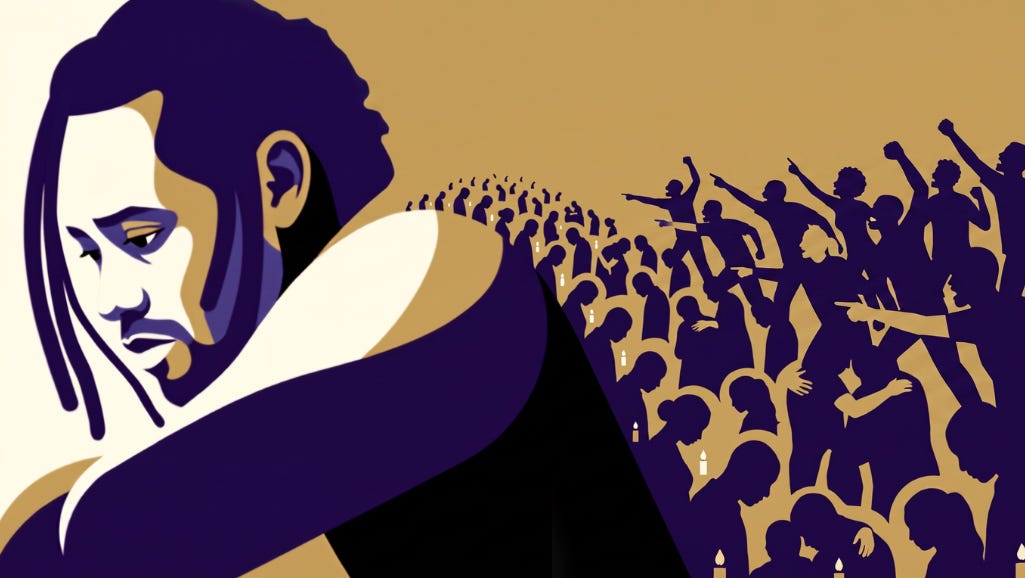
On Monday evening, as the light faded over central London, tens of thousands of people dressed in black filled Trafalgar Square - the great stone heart of the city, where the country has massed for protests and celebrations for two centuries - for an academic named Jason Arday; the youngest Black professor in Cambridge University’s 800-year history, found dead at his home in south London last week.
Crowds of such a size usually only assemble for wars, or for royalty, or for national wounds - not to mark the passing of a sociology professor that most people hadn't heard of a month ago. They bowed their heads to honor the fallen academic with a moment of silence, which is more than he was afforded in the final weeks of his life, as he became the focus of relentless accusations of plagiarism and attacks on almost every aspect of his personal life in the media.
“This time last week, I was with Jason,” said Lord Simon Woolley, the Principal of Homerton College, Cambridge, to the gathered crowd, “because we knew Jason was suffering. We knew that he felt hounded by those rabid wolves. Jason wouldn’t dare leave the house. We held him in our arms, we told him he was loved….and he said, ‘They’re hounding me to death, and I cannot see a way out.’”
Many openly wept as Labour MP Dawn Butler apologised on everyone's behalf for the collective failure to protect Arday, and fellow Labour MP Diane Abbott - the first Black woman elected to the Commons - told the crowd of the hostility Arday had endured during his tenure. “He was first appointed as a professor in Cambridge three years ago,” she said, “and for those three years he has had a vicious campaign, a bitter campaign, by anonymous people, by other professors, who just didn’t believe that a Black man should be a Cambridge professor.” One man in the London crowd coined the phrase that summed up the whole evening - a gathering of grief and of grievance.
The grief was over a life lost too soon, and the grievance, according to the mourners, was that Arday’s death had been entirely avoidable, the result of a race-based witch hunt and a reckless media pile-on. As those mourners gathered, a petition demanding a public inquiry into “relentless press harassment” passed 96,000 signatures, after an analysis by the media monitor NewsCord counted some 249 articles were written about Arday in the British media in the 22 days before his death, many after he’d released a statement saying he’d “reached the limits of what any person should reasonably be expected to endure.”
And it wasn't just the crowd pointing the finger; Cambridge’s Chancellor, Chris Smith, called it a racist feeding frenzy, while Ibram X. Kendi - perhaps the most famous antiracism scholar in the world - declared that the media had lynched him. The leader of the Green Party and a clutch of Labour MPs signed a letter declaring that press self-regulation had failed and demanding official oversight of journalists, and the novelist Will Self wrote to the Prime Minister urging police to start impounding reporters' computers.
The media, meanwhile, initially responded a little like the dog that caught the car, briefly pausing in stunned silence, before talking heads emerged to point out that, as tragic as Arday’s death was, the core of what they'd reported was true.
And that was the confounding thing about this whole sorry saga that galvanised a nation - and much of the world - this week. The media feeding frenzy in the days leading up to Arday’s death was horrific in its scale - beyond anything that the many thousands of other professors at Cambridge have ever endured, or perhaps any British academic in living memory. Much of the coverage was nasty, vicious, and in many cases, completely and utterly irresponsible - there was a human being with kids and a family behind every one of those headlines - but the uncomfortable truth that felt impossible to hold this week was that the stories and accusations the frenzy was built on were themselves, by and large, uncomfortably true.
Want the Wrap-Up sent to your inbox each Sunday?
Crowning the Rising Star
The sequence of events that led to Arday’s tragic death last week began back in 2023, when Cambridge University found itself under pressure and scrutiny over the fact that - of the thousands of scholars working across its ancient colleges - hardly any of its professors were Black. With students and faculty asking increasingly pointed questions about diversity, the institution set itself targets to attract more applicants of colour, and advertised one of the most coveted jobs in the world of academia - a permanently funded professorship at one of the oldest and most prestigious universities on Earth.
A panel of nine experts was convened, and an international search produced four finalists who were invited to Cambridge for two days of interviews and asked to submit a single piece of research each. Three of the four were senior scholars, and two of those were women of colour with strong records.
Cambridge, however, chose the fourth - Jason Arday. Arday’s publication record was modest for a chair of that standing, and his career had moved briskly between institutions - Roehampton, Durham, Glasgow - never pausing long enough in any one place to see a doctoral student through from start to finish. By the cold arithmetic of a Cambridge appointment, he was an early-career scholar reaching several rungs beyond his station.
But what he carried into those interviews was a life story that was, by any measure, extraordinary. The son of Ghanaian immigrants, raised in public housing in South London, Arday said he was diagnosed autistic at the age of three, that he didn’t speak until he was nearly 12 years old, and couldn’t read or write until he was 18, and from that silent childhood he had somehow made his way to a degree, then a doctorate, then a professorship at Glasgow by his mid-30s, where he was celebrated as the UK’s youngest Black professor. He told of running 30 marathons in 35 days to raise millions for charity - a feat that had seen him carry the Olympic torch in 2012. What he lacked on paper he could certainly make up for in good PR.
Cambridge built the announcement of Arday’s tenure around his remarkable life story, introducing the young, charismatic, and eloquent Arday to the world as a symbol of hope for all those facing adversity. The press on both sides of the Atlantic embraced him with open arms; he appeared on morning television and on podcasts, and in due course his speaking invitations multiplied, the honorary degrees accumulated, and a major publisher signed his memoir. Arday was an inspiration - teachers shared his story with struggling students, and parents of autistic children held onto it like a lifeline, as living proof, it seemed, that the doors of the oldest institutions could finally open to anyone.
Cambridge was breathless in its praise of its new appointment. Department chair Hilary Cremin told Arday during a BBC interview that he was the best in the world at his research, and The Times reported her saying his hiring was proof of the university's commitment to tackling inequality. Cambridge hadn't just hired Jason Arday - it had certified him, fusing the university’s credibility to the man’s and ensuring that, from that moment on, every question about him would also be a question about Cambridge.
And those questions started coming thick and fast within months of Arday’s appointment.
Want the Wrap-Up sent to your inbox each Sunday?
The Questions Nobody Wanted Answered
The first question arrived in May 2023, barely three months into Arday’s tenure. David Harris was an emeritus professor from Plymouth Marjon University who’d been posting critical evaluations of articles in the critical race theory tradition on his website for some time, and when the Cambridge appointment made Arday internationally famous, Arday’s back catalogue came under Harris's lens.
In reading a paper Arday published in 2018 in a journal called Social Sciences, he noted that passages of the text appeared to have been lifted from a BMJ Open study by the epidemiologist Anjum Memon on mental health services in Black and minority communities, so Harris emailed Arday, raising his concerns and giving him the chance to explain.
Initially, Arday ignored the email, but when Harris followed up several days later, Arday responded, "Instead of spending your time trying to dismantle racism and ableism, you have spent what I assume is hours combing through my work looking for mistakes." Any further contact, he warned, would be considered bullying and harassment. He would later report Harris to the police, but they declined to pursue it.
It’s not hard to see how it looked from Arday’s side of the desk. Harris was a critic of the scholarly tradition Arday belonged to - a man whose own university would later strip his emeritus title after he published a critique of critical race theory, though the decision was eventually reversed as improper after a free-speech campaign took up his case - and here he was, weeks into the biggest appointment of Arday's life, combing the archive for flaws. Racist scrutiny of Black scholars' credentials is a real and documented thing, and Arday named the scrutiny as exactly that, but in pointing out the motive, he neglected to address the very real similarities between his work and that of another scholar. No matter how dubious the motive for asking the question may have been, the question itself still begged an answer.
So Harris took his concerns to Martyn Hammersley, an emeritus professor at the Open University and one of Britain’s most respected authorities on research methodology. Hammersley reviewed the material, agreed there was a case to answer, and together in May 2023 they wrote to Cambridge itself - to Hilary Cremin, the department head who’d declared Arday the best in the world, and to Rhys Morgan, the university’s head of policy, governance and integrity - informing the university that its newly crowned star may have passed off another researcher’s work as his own.
Morgan replied that since the paper had been published before Arday arrived at Cambridge, the university didn’t consider it within its remit to investigate, while Cremin’s reply indicated that Arday had the university’s full support, mentioning his experiences of racism, and the health issues that had purportedly affected the work, and that Arday had agreed to quietly take the paper down and revise it. Harris wrote back suggesting that, given what they’d found, Cambridge might want to look at Arday’s other papers, and his thesis, adding that Arday badly needed critical friends rather than sycophants. He never received a reply.
Subsequently, the Social Sciences journal appended a correction stating that the article had been amended to increase the clarity of citation sources, but in the revised version, 18 of the 31 quotes at the heart of the paper vanished, without a word of explanation. The following year, a second paper, co-written by Arday in 2020, received the same treatment; apparently borrowed material, resolved with another generously worded correction.
The questions were being answered, in a sense - in deletions, and quiet revisions, and in language engineered to say something without really saying anything at all.
Want the Wrap-Up sent to your inbox each Sunday?
Be part of our community. Join the Inner Circle
The Wolves at the Door
By 2025, the questions that fellow scholars had been asking found their way to a journalist. Jack Grove of Times Higher Education - the trade paper of British academia - began investigating, enlisting independent experts to review Arday’s doctoral thesis, among them David Sanders of Purdue University, a veteran research-integrity sleuth who went in knowing nothing about Jason Arday at all, and came out the other side with the blunt verdict that the thesis was extensively plagiarised.
By September, Grove had assembled a dossier running to more than 60 pages of side-by-side textual comparisons - passages from Arday's thesis laid directly alongside the earlier works they appeared to have been drawn from - which he submitted to Cambridge and to Liverpool John Moores University, which had awarded the doctorate. Then Grove sent Arday three emails over two months, politely laying out what he'd found and inviting a response.
Grove questioned not only the thesis but also irregularities in Arday’s CV, which listed a visiting professorship that an American university said it had no record of, and an association with a South African university that had in fact lapsed. He also queried if there was evidence Arday had actually run 30 marathons in 35 days, or 600 miles in six days, as he’d once claimed; a feat that, if true, would have ranked Arday among the greatest ultramarathon runners on Earth. He also raised questions about the millions supposedly raised for charity, of which no verifiable record could be found.
The response eventually came not from Arday but from Carter-Ruck - one of the most feared defamation firms in Britain. The allegations were false and gravely damaging, the letter said, so Times Higher Education, staring down the barrel of ruinous litigation, killed months of careful reporting, and the story died without a single reader ever seeing it. Liverpool John Moores, for its part, ran a confidential procedure and announced that Arday's PhD still stood - the thesis stayed online, contested passages and all, but what the procedure had actually found, the university wouldn't say, then or since. The only account of its reasoning came from Arday himself, who said it had cleared him, acknowledging errors that fell short of plagiarism.
Arday then made a complaint to the Metropolitan Police about Grove, alleging harassment, which Scotland Yard investigated for four months before closing the case in February of this year, after telling Grove not to reach out to Arday again, because his enquiries were affecting the professor’s mental health. Around the same time, a scholar at another university who’d raised questions also found himself on the receiving end of a formal racism complaint.
And so the dossier sat in institutional drawers, the journalists were lawyered into silence, and warned off by police, and Arday, for his part, carried on delivering keynote addresses and preparing for his memoir to be released, with a major publisher standing proudly behind it.
But buried things seldom stay buried forever.
Want the Wrap-Up sent to your inbox each Sunday?
The Breaking of the Dam
In June this year, an anonymous tipster from within Cambridge reached out to a man named Nathan Cofnas - a philosopher and self-described “race realist” who’d been a research associate at Cambridge’s Emmanuel College until 2024, when the college cut ties with him after he published a blog post arguing that in a pure meritocracy, the number of Black professors at Harvard would approach zero. He sued for viewpoint discrimination, and lost.
Cofnas ran Arday’s thesis through plagiarism-detection software, laid out dozens of passages side by side with the 2009 doctoral thesis of Paula Zwozdiak-Myers, a Brunel University researcher, and in July, he published the lot on Substack; the textual comparisons, the questions about the marathons and the millions, and the allegation that Cambridge had known for years and covered it up.
The cover-up allegation fanned the flames of a media fire, and within days, Retraction Watch published its own investigation, revealing the whole buried history and by end of July, the Times of London commissioned its own analysis of the thesis, and The Telegraph went further, commissioning a statistical review that found 188 sentences in Arday’s thesis identical or near-identical to another scholar’s earlier work, with the odds of that overlap occurring by chance calculated at one in a hundred billion.
Cambridge’s first public response was to stand by its man - the university declared Arday the victim of a vile campaign to undermine his credibility, insisted the allegations had been “thoroughly investigated by the relevant institution and the journals in question,” without mentioning that the relevant institution had never included itself.
But once the scholarly questions had blown open, the press began dissecting almost every element of Arday’s life as he’d told it, discovering that most of it simply dissolved on contact. Arday’s claim that he’d appeared in the famous Seven Up! documentary series was deemed impossible, since the series began decades before he was born. And then there were his claims of menace due to his fame - that a severed pig's head had been delivered to his parents' door, and that a masked intruder had twice visited his Cambridge office, once wielding a knife. When the Guardian examined the knife claim, it found no security footage, no police report, and colleagues who'd never been told a knifeman had entered their building. Nothing was ever proven invented, but the corroboration simply wasn't there, which is perhaps the cruellest knot in this whole affair, because some of the racially motivated menace was surely real.
Institutions began quietly editing themselves - honorary-degree universities, the TEDx programme, his own publisher’s speakers bureau, all discreetly revising or deleting claims they’d once trumpeted. And in the reporting that followed, the miracle at the centre of it all came apart too, when a former schoolmate remembered the boy who supposedly couldn’t speak cracking jokes and doing playful accents on the minibus to church activities, a speech professional who’d worked with him recalled a child with a language delay who nonetheless spoke, and clinical experts said the trajectory - silent at 11, illiterate at 18, doctorate by 30 - had no precedent anywhere in the medical literature.
Arday eventually acknowledged errors in early work, attributing them to his autism - his way of processing information, he said, relied heavily on mimicry - and to inadequate supervision. He said he’d been cleared by the confidential Liverpool John Moores review, and described a long-running “dark arts” campaign to oust him from Cambridge, and told the New York Times he was the victim of a well-documented playbook used to discredit Black academics.
As with everything in this story, the defence held a genuine piece of the truth - that playbook is real, and it has been used - but while the reply answered the motive, it left 188 sentences sitting there, unanswered, at odds of one in a hundred billion.
Want the Wrap-Up sent to your inbox each Sunday?
A Great and Unfortunate Thing
On August 5, after days of relentless pressure from the media, Cambridge announced an investigation - the one it had deflected and outsourced for three years commenced at last - and Arday resigned within hours. In his statement, he admitted no wrongdoing, and wrote that he no longer wished to live under a constant spotlight where every aspect of his life was subject to public examination and judgment. The scrutiny, he said, had gone far beyond scholarly disagreement and taken a profound toll on him and those he loved. “This is not the end of my work,” he wrote. “It is simply the end of this chapter.”
In any normal accountability story, the surrender is the ending - the man had given up the chair, withdrawn from public life, and stated in writing that he’d reached the limit of what he could endure. For all intents and purposes, the accountability function was complete, but the media continued pumping out stories about Arday even after his resignation; 188 articles in the nine days after he resigned alone - the same number, by grim coincidence, as the disputed sentences The Telegraph had counted in his thesis.
His memoir - titled Great and Unfortunate Things, published in the days following his resignation - became an ammunition dump that outlets mined for fresh embellishments, while leaked proofs revealed his publisher had quietly edited out problematic claims. His original book proposal found its way to a magazine. Every institution caught scrubbing his honours from its website became another story. Reporters tracked down his childhood schoolmates and speech therapists. Commentators ran victory laps on podcasts. The coverage reached his divorce, his health, his family - and all the while, the man at the centre of it, by the account of the friends who held him in those days, no longer dared leave his house.
In the middle of it all, Simon Baron-Cohen - the director of Cambridge’s own Autism Research Centre, one of the most respected autism scientists alive - issued a public warning on social media, citing his own research showing one in four autistic people have planned or attempted suicide, and saying that what was happening to Arday amounted to the relentless bullying of a vulnerable autistic man. The warning was published, but the pace didn’t change.
Days later, on August 14, Arday was found dead at his home in Battersea. He was just 41 years old. The police called the death unexpected, with no one else suspected. His family said the campaign of sustained abuse had been too much for a gentle man who always wanted to see the best in everyone.
Whatever was true in the reporting, the frenzy of those final days had been feeding on a man already, by his own written account, at the limit of what he could endure. The verification was complete - what remained was consumption.
And that’s how tens of thousands of people came to find themselves gathered in a darkened square this week, while a nation looked down at its hands, everyone certain the blood belonged to someone else.
Want the Wrap-Up sent to your inbox each Sunday?
The Filing of Facts and Feelings
Every way we look in this tragic story, we find someone credibly accused of having blood on their hands, including even Arday himself. If he hadn’t fabulated and fabricated, we’ve heard many voices say, none of this would have happened. But if Cambridge hadn’t thrust him into a position he was never qualified for, and set him up for intense scrutiny and ultimately failure, none of this would have happened either. Or if they’d investigated and acted when they were first asked to. Or if the detractors hadn’t asked their questions, or if the media hadn’t asked theirs, and then piled on when the questions begot more questions…..and on, and on, and on.
The counterfactual chain has a link for everyone who touched this story, so every camp can seize the one link that implicates somebody else, hold it aloft, and declare the chain solved.
The racists did it.
The media did it.
Cambridge did it.
He did it.
Every verdict is true enough to hold up, and every one of them is doing the same quiet job of making an unbearable feeling manageable by giving it a face. This is what the mind tends to do when confronted with feelings, especially heavy ones; it’s a filing system built for sorting facts - tangible, provable, solid things that can be weighed and stored and retrieved. It’s not really equipped for weighing feelings - they’re the heart’s domain, the signals it sends that the mind long ago built a wall to keep out, so its facts would never be blurred by something it had no means to measure.
But increasingly, that wall between the heart and mind has been failing - feelings slipping through and finding their way on to the mind’s scales, mistaken as facts, weighed as heavy, filed as true and funnelled into a verdict. And it’s not that the feelings aren’t very real, and valid, and fair - but how a thing feels and the facts of the matter can sometimes be worlds apart, and the mind is not equipped to measure the distance by itself. When it tries to, we end up with a society full of people pointing and screaming and raging and accusing, desperately trying to lay blame so they can file away the uncomfortable feeling, rather than sit with it, and see where it’s leading them, and what truth may be buried beneath it.
That’s what we’ve been living through this week, and this year, and this decade, and for the last fourteen years to be exact, since Neptune started moving through Pisces back in 2011, doing what Neptune always does and dissolving what it touches, and in Pisces what it dissolved was the wall between the heart and mind - the line between what we feel and what we know, thinning until it barely held.
Neptune in Pisces made that wall permeable, allowing feeling to come pouring into a room that had no practice for handling it, so the mind did what it always does with new information and filed it in the same drawer where the facts go. The filing system was corrupted, because in the thick of the Piscean fog, a feeling was easily mistaken for a fact, and over time, the mind lost the ability to tell one from the other at all.
And that explains so much about the last fourteen years - the era that pulled the world into the extremes of MAGA on the right and “woke ideology” on the left, and everything in between. Almost every convulsion of that era ran on the same mechanism - a real feeling, correctly sensed, weighed on the wrong scales, filed as settled, and then acted on as though it had been checked. The world dissolved into arguing over facts it could not agree on, because the facts were really feelings that had been misfiled.
And that’s how Jason Arday happened too. There were always two versions of this man’s story available - the one the record supported, and the one that made people feel something - and every institution that encountered him weighed only the feeling, filed it as true, and built on top of it. It was a true and valid feeling being weighed by an instrument not used to dealing with it, filing a feeling as a fact, often without even realising it.
But in the early days of this year, the sky changed management as Neptune crossed into Aries, moving from water into fire, clearing the fog and allowing us to see what was done in the mist. Every uncomfortable truth that detonated across the world’s front pages in the last few weeks had been quietly available for years - the fog of Neptune in Pisces had just obscured the misfiling, and once the fire came we could finally see the state of the drawers.
The Fiery Purge
When the Piscean fog lifted, suddenly we could see the sorry state of the contaminated filing system, and the gaping hole - where once there was a wall - through which so many feelings had flooded in. The mind started doing its thing again, weighing the facts for filing - the wall is down, the files are a mess, if we can assign the blame to someone else then this can be neatly filed away.
The newspapers who’d been printing Arday’s story without checking a word of it were suddenly calling for his head. The publishers who’d signed off on his memoir on the strength of how it made them feel were now leaking its proofs. The committees that had handed him honorary degrees on a feeling were scrubbing his name from their websites. The university that had certified him at the highest volume an academic institution can speak announced an investigation into the qualifications it had never once examined.
Every single one of them suddenly arrived at rigour as a way of demonstrating they'd never abandoned it, which is what the mind does when it's shown its own corruption; it reaches for the rule it broke and shouts it louder than it's ever shouted anything, as it goes looking for somewhere outside itself to locate the failure. And there he was; the contamination in human form, the misfiled feeling that had walked into the temple of facts and been crowned. Every borrowed sentence they published was a demonstration that the mind’s standards still held after all, performed by the people who’d suspended those standards to build him in the first place.
The louder the standards were asserted over Arday, the further away the corruption seemed to sit from the people asserting them, and the more thoroughly the last fourteen years could be understood as something one man had done to us, rather than something we’d all been doing together in the mist.
The accusations levelled against Arday were real, and the reporting that established them was, in the main, careful and accurate work, and there was a genuine reckoning buried in all of it that was owed, but the sheer volume of it went far beyond anything a legitimate accountability process required. And the volume itself was the tell. This was the mind’s effort - through shouting and pointing and accusation - to kick up enough dust in the hope it might rebuild the downed wall. As if asserting its standards loudly enough might purge the contamination and return the room to the way it once was - a room of facts, kept safe from feeling. That’s what the rage towards Arday was really about; an attempt to rebuild a wall, using a man as the mortar.
So the mind shouted, and pointed, but the wall still stayed down. And it shouted louder and pointed harder, and went through his memoir and his marriage and his childhood and his family, and the wall did not reassemble. It kept going, and now the man is dead, and the wall is still down, and the shouting and pointing continues, and it will still not go back up. A mechanism running on fear has no off switch that a death can reach.
The feelings are in the building now - permanently - and every person and every structure raised on the assumption that they could be kept outside is standing in a room that’s no longer recognisable, holding a rulebook that no longer describes the situation.
How does a university work when the thing on the scales might be a feeling? How does a newspaper? How does racism - the oldest filing system of the lot, the mind sorting people into categories and filing a whole category beneath its own - survive in a room where the sorting no longer holds, and where you can actually feel the human being you’re trying to minimise by filing them according to the colour of their skin?
The mind has no answer, because it only knows how to weigh one thing. Feelings can’t be facts to it - outside of the fog - and they don’t belong on its scales, and no amount of noise is going to change that now.
That’s why this feels so much bigger than one professor and one university. What we’re watching is the mind crashing out, and every monument it ever built crashing out alongside it, because an age is rising that the mind was never designed to lead. The feelings were never the problem, we were just using the wrong mechanism to weigh them. Now they’re here, we’re going to need a better set of scales.
The Turning of the Age
Because Neptune leaving Pisces wasn’t just the lifting of the fog. When Neptune crossed into Aries in the early days of this year, it met Saturn at zero degrees of the zodiac’s first sign - the very first degree of the whole wheel, the place where everything begins again, the Genesis Reset. Saturn is structure and form and Neptune is the collective dreaming, and the two of them meeting at the starting line of the zodiac was a seed going into the ground, like the close of one long age and the first raw breath of the next.
What’s closing is the Age of the Mind, what was planted was the Age of the Heart, and this horrendous mess we’re living through is what its arrival actually looks like from the inside. It shows up as institutions that no longer work the way they used to, and a set of standards that no longer describe the situation, and a room full of people shouting a rule at a wall that simply isn’t there any more.
Neptune in Pisces downed the mind’s wall and let the heart’s signal in, dissolving the mind’s institutions from the inside, hollowing them out while their facades stayed perfectly intact. Pluto moving through Aquarius for the next two decades will complete the demolition, while Uranus moving through Gemini - the sign of the mind itself - is rewiring the way we all think; quite literally reforming the mind so it has the capacity to hold the feelings it fumbled these last fourteen years.
The wall between the heart and the mind is gone, and the heart’s signal is now flowing freely - and perhaps a little haphazardly - through the space where that wall used to stand, and Uranus in Gemini is the long slow work of rebuilding the mind so it can actually receive it; so it won’t try to file feelings as facts, but rather recognise the heart-signal for what it is, and know it’s not the one who should be weighing it alone.
This is not a smooth process - it’s like we’re renovating our house, gutting it completely, and trying to still live in it while we do the demolition. The structure is coming down while the building is being rewired, and that’s why this period feels the way it feels. Humanity has not been through this before - at least not in our lifetime. Not in many lifetimes. We are standing at the end of one world, and crossing the bridge into another, being made ready for that world as we go, one painful step at a time.
In the old world, the mind ruled alone, but in the world we’re stepping into it must work in tandem with the heart - facts in one hand, feelings in the other, neither of them dominating and neither of them suppressed, both being weighed on the scales in the deepest part of us; the part that knows no separation, that knows there’s no real line between me and you, or us and them, and that remembers we’re all the same thing wearing different faces. That’s the only place both hands can be held at once without either being converted into the other.
That’s the dissolving work Neptune is doing now in Aries - the sign of the self, the I am, the first person singular, the edge where I stop and everything else begins. Fourteen years dissolving the line between what we feel and what we know, and now fourteen years dissolving the line around the separate self.
The wall between the heart and the mind came down first.
The wall between me and you is next.
The Wall Between Me and You
The wall between me and you - the veil of separation - is what made the Age of the Mind possible. Every category we ever sorted people into, every hierarchy we ever built, every atrocity anyone ever managed to carry out - all of it required that wall to be standing. It required there to be a me over here and a them over there, and a boundary firm enough that what happened on your side of it never arrived on mine. That was the condition of that old world, but take the wall away and the whole apparatus has nowhere to stand.
Because you can’t harm a person you can feel. The moment another being’s fear or grief registers as our own - once we can feel what they’re feeling - doing them damage becomes indistinguishable from doing it to ourselves, and the impulse simply has nowhere to go.
And that’s the shift we’re living through now. The world that’s rising won’t be built by winning an argument - by blue vanquishing red, or right dominating left, or light over dark, or black above white, or anybody above anyone - but by the wall coming down, one person at a time, until there’s nobody left who can look at another human being and see something other than themself.
Of course, this world is not arriving quickly. It won’t be delivered by the US midterms, or waiting for us under the tree at Christmas. Neptune has fourteen years of work ahead of it in Aries, and even once it’s done there will still be more work to do - it’s going to take time for our species to get the hang of what Uranus in Gemini is rewiring our minds to be able to do. But that rewiring is very much happening, so if we want to welcome in the Age of the Heart, then our task is simply to start trying to get the hang of it.
In the days ahead, we must practice catching ourselves every time we feel the urge to rebuild that wall between me and you, between mind and heart. Every time we do the mind’s old trick of weighing solo, and reaching for the verdict that puts the problem safely over there - it was the racists, it was the media, it was Cambridge, it was him - we should catch it. That reach is the oldest move there is, and it feels like clarity every single time, but it’s just the mind performing its old habit of converting something it can’t hold into something it can file. We’re being rewired to do more than that now, to not rush to a verdict but to take the whole feeling into the deepest part of us that knows no separation, where we can just sit with it in the stillness, quietly weighing.
In that space, clarity won’t come in the form of a thought as it does in the mind, but in the form of a feeling - often a flurry of them, often layers of them coming at us all in a rush, and we’re only just learning how to interpret them, so we need to slow down and take a minute to just be with them before we decide what they’ve come to tell us.
And as the wall comes down between me and you, some of what we’re feeling may not even be our own. Some of the feeling that’s rising with in us may belong to the person sitting across from us, or even on the other side of the world. There’s a communication happening in all that feeling, in a language our mind is not used to interpreting - we don’t have to rush to file it, just feel it, and let the feeling leads us where it will.
In the wake of events like those we lived through this week, sitting in stillness may feel like passiveness or inaction. The notion of just sitting in the stillness with our feelings for some stirs up so much rage they don’t know what to do with it - fury is the face fear often wears when our mind is freaking out and pushed to its limit. But even that fury - that fear in a mask - asks for stillness. As it rises, if we take a moment to feel it, and breathe into it, and just let it be exactly what it is, in time it will start to change shape, not because it’s shifting, but because we are. Let the feeling guide us into the deeper place, the larger space within us that can hold the whole thing without needing any of it immediately resolved. That’s where the answers lie to all the questions of the coming age, beyond the wall the mind built, in the deepest caverns of the heart.
That’s what’s required of us this week, in the middle of the grief and the rage as we deal with the life and the death of a man who departed too soon. The mind’s reflex is to reach an immediate verdict about what he did, or what they did, or what should happen next, or who should be held to account - and all of that has its place - but the heart is inviting us to simply sit with the plain fact of it, and with how much it hurts, and how little it resolves.
Because that hurt is the whole point. That ache in our chest is the heart coming online. That’s the new instrument stirring, doing the only thing it knows how to do, which is to feel what’s actually here rather than convert it into something more comfortable. The mind has been trying to make this week manageable since the moment it happened, and the heart just wants to be allowed to feel it rather than flee it.
Our work is to sit with the sadness of it, and the confusion, and the part that doesn't resolve into anything useful, and let all of it be exactly what it is for as long as it needs to be. There'll be time for the questions - what it means, what should change, what any of us do with it - and those questions will still be there tomorrow, and next week, and for years. But first, we must learn to feel it, because those feelings are a communication of their own - they’re the language of the new world, rising.
And that’s how the new age dawns - not through a better argument, or a fairer system, or more voting or a landslide election, but through one person at a time learning to hold a thing that hurts without needing it to become something else. The Age of the Heart doesn’t arrive by magic, fully formed - it’s built, breath by breath, in exactly the place we’re sitting right now.
Friends, let’s begin.
If you need a place to land after reading this, or if you want some support as we navigate the days ahead, come join me in the Daily Lighthouse. I’ll be there, each day with you, or if you prefer it in an audio listening format, head over to the Resonance Room.
And before we close this week, I want to send love to Jason Arday’s children, and his family and loved ones - what a terrible time they must be going through. May we all hold them up to the light in our hearts, and send love to them down the golden threads of light that bind us all. They’ll need it in the days to come.
I know some of you will be reading this from closer than others - this story touches wounds that many of us carry. If it's stirred something heavy in you, please don't sit with it alone. Please reach out to someone who can sit with you in it, whether that's a person you love or a crisis line where you live. The heart can hold a lot, but it was never meant to hold it all by itself.
See you in the stillness, friends.
Onwards!

If this writing resonated with you, please share it with your friends.
Sources & Further Reading
Questions Mount Over a Star Scholar’s Life and Career (Schuessler & Alter, Aug 3) - https://www.nytimes.com/2026/08/03/books/jason-arday-cambridge-plagiarism.html
Star Scholar Resigns as Cambridge Announces Investigation Into His Record (Vigdor & Schuessler, Aug 5) - https://www.nytimes.com/2026/08/05/books/review/cambridge-jason-arday-resignation-investigation.html
A Top Scholar’s Fall Shows That Universities Don’t Get It (Jesse Singal, guest essay, Aug 8) - https://www.nytimes.com/2026/08/08/opinion/cambridge-plagiarism-arday-higher-education.html
Takeaways From Jason Arday’s Memoir (Vigdor, Aug 10) - https://www.nytimes.com/2026/08/10/books/review/jason-arday-memoir-takeaways.html
Jason Arday, Cambridge Scholar Who Resigned Under Scrutiny, Is Found Dead (Hvistendahl, Aug 14) - https://www.nytimes.com/2026/08/14/world/europe/jason-arday-dead.html
Professor’s Death Leaves Behind Hard Questions for Cambridge on Race and Hiring (Hvistendahl et al., Aug 15) - https://www.nytimes.com/2026/08/15/world/europe/jason-arday-cambridge-hiring-questions.html
After a Scholar’s Awful Death, Mistaken Calls for Censorship (Michelle Goldberg, Aug 17) - https://www.nytimes.com/2026/08/17/opinion/jason-arday-cambridge-plagiarism-media.html
Exclusive: News outlet killed story on plagiarism allegations after Cambridge prof hired law firm (Retraction Watch, Jul 27) - https://retractionwatch.com/2026/07/27/cambridge-jason-arday-plagiarism-allegations-times-higher-education-exclusive/
Tens of thousands mourn Jason Arday in London, blaming press for his death (Al Jazeera, Aug 18) - https://www.aljazeera.com/features/2026/8/18/tens-of-thousands-mourn-jason-arday-in-london-blaming-press-for-his-death
Everyone Was Chasing Jason Arday’s Shadow (Newsweek) - https://www.newsweek.com/jason-arday-death-cambridge-professor-shadow-12327258
Cambridge Professor Jason Arday Faces 188-Sentence Plagiarism Finding; Charity Claims Disputed (TechTimes, Aug 4) - https://www.techtimes.com/articles/322930/20260804/cambridge-professor-jason-arday-faces-188-sentence-plagiarism-finding-charity-claims-disputed.htm
Free speech victory as academic reinstated after being stripped of title (GB News, on David Harris) - https://www.gbnews.com/news/free-speech-victory-dr-david-harris-reinstated-critical-race-theory
CAF defends academic “stripped of title” after critiquing critical race theory (Committee for Academic Freedom, Jan 10) - https://afcomm.org.uk/2026/01/10/emeritus-professor-title-withdrawn-critical-race-theory/

If you’re interested in exploring your own natal chart, I was part of the team that built Ask Arion - an app that helps you read what the sky has to say for you personally. It’s free to sign up, and a great way to start your journey with the stars.


Creating the circle of events in the story of this unfortunate situation, it clearly demonstrates how we catalogue and file feelings, then move on. This cosmic time of the Age of the Heart rising helps clarify what we are living through. A lot of noise with the mind trying to stay as the ruling energy. There are no shortcuts and we all are forced to feel this trauma we are living, and it’s not a quick fix. I’m grateful for having your astrological knowledge because without it, I believe I would feel lost in the quagmire of catastrophic events unfolding. Thanks Wiz:-)
Wiz…your sharing this week is ineffably extraordinary. Truly, there are no words for my gratitude for your time, research and writing gift for expressing the closely impossible. 🙏 Thank you. 💜