


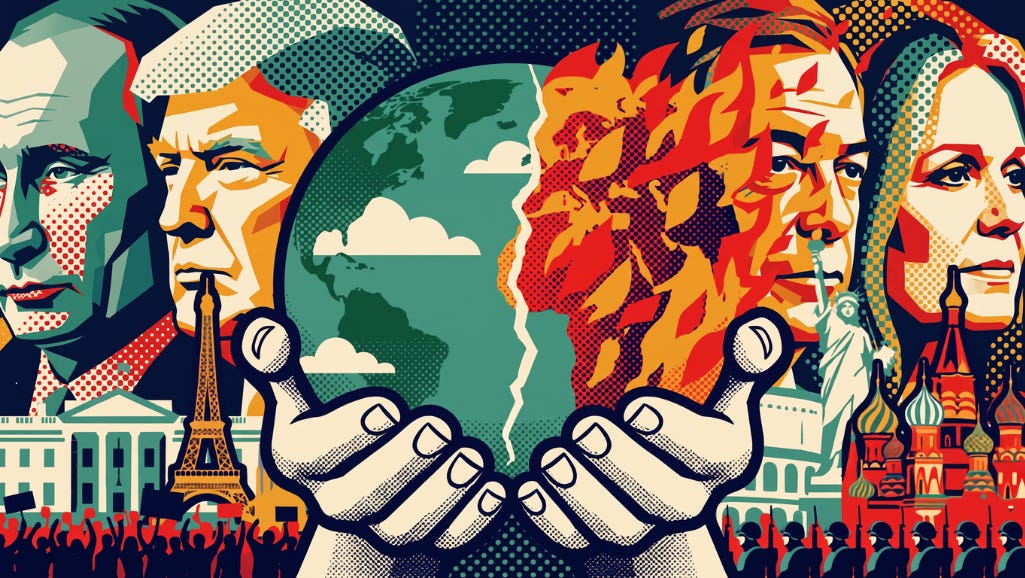
This week, the whole world stood braced - fists up, eyes on the horizon, every alarm on Earth going off at once, and it didn’t much matter which way we were facing, because wherever we looked, something was coming.
In the Gulf, a month of quiet ended when American forces struck two Iranian rocket launchers on Larak Island as the Revolutionary Guard readied mines for the Strait of Hormuz. After Trump posted an AI-generated video of Kharg Island, the port that ships most of Iran’s oil, “being blown to smithereens,” the Pentagon had to explain that no such attack had taken place, while the President announced on social media that Iran was “officially a Failed Nation. IT IS DEAD!”
The dead nation spent the week firing ballistic missiles at Jordan, Bahrain, Kuwait and the UAE, and by week’s end it was firing them at an American aircraft carrier, which answered by sinking one Iranian tanker and crippling two more….. all in the same week Trump told reporters the whole thing was “small potatoes” and the Vice President said he “wouldn’t call it a war.”
Behind the fleet, the machine was showing the strain. A leaked Pentagon briefing revealed that four of America’s own top commanders had formally objected, in writing, to keeping the war going into 2027, warning that barely a quarter of the Navy’s destroyers are fit to sail and that the Navy has been quietly raiding its payroll to pay for combat. The Army Secretary resigned after telling Trump to his face how many generals had been fired, leaving the largest branch of the American military without a confirmed leader at the top, and by the weekend we learned that 50 officers on the Joint Staff had been strapped to polygraphs to find out who’d told the press the missile racks were running empty.
Midweek, the USS Abraham Lincoln limped into port in Thailand after 286 days at sea, her hull rusted to the waterline and her crew short of soap, and when a reporter asked the captain about Trump’s remark that the deployment hadn’t been “nearly long enough,” he said only, “the president speaks for himself.”
Then the war turned up at the petrol pump. Diesel hit the highest price ever recorded in America on Friday, petrol topped four dollars on Labor Day weekend for the first time in history, mortgage rates climbed with the price of oil, and bond markets from Tokyo to Frankfurt sold off as borrowing costs reached levels unseen in decades, all because the strait that carried a fifth of the world’s oil before the war is still choked.
Trump, meanwhile, was pouring concrete. The Supreme Court waved his ballroom through, his Interior Secretary announced work would begin on a 250-foot triumphal arch beside Arlington cemetery, the Mint started selling a one-dollar coin with his face on it, and when a reporter put to him the theory that he builds monuments to himself because nobody else will, he answered, “That’s true. Nobody will do it once I’m gone.”
The man atop America’s tower found himself increasingly alone up there, with his approval rating cratering ahead of the midterms. Republicans in tight races told Trump’s team they don’t want his help campaigning, 45 of his own lawmakers and the First Lady declined to attend his convention next week, and veteran election analyst Charlie Cook told the party to brace for a result that would be “bad, really bad, or truly horrible.”
A whistleblower inside the US Postal Service warned that the system built to enforce Trump's restrictions on mail voting had been rushed so badly that one unreadable barcode could see a batch of 10,000 ballots thrown out and sent back to the state, and that work on it had carried on in defiance of a court order. Just 70 days out from the elections, the courts were having none of it, with three federal rulings against the administration hours after North Carolina posted the first ballots of the midterms.
Across the Atlantic, Britain’s answer to Trump - Nigel Farage - was caught on camera thanking undercover reporters posing as donors channelling American money for secretly funded polling. Though Farage insists his party has not taken an illegal penny, it’s not the first time he’s been accused of dodgy dealings, and the tapes have been handed to the Metropolitan Police for investigation.
Amongst it all, Gloria Steinem died at her home in New York at 92; she spent a lifetime telling half of humanity it was allowed to want more, and this week that voice fell silent. As the world grieved the passing of an icon, it also mourned the loss of more than 1,300 people swept away by last week’s flash flood in Nepal, and the more than 5,000 still missing, as rescuers digging into a hydropower tunnel pulled three workers out of it alive and a woman from the ruins of her house - a small mercy in a sea of sadness.
The ground, meanwhile, was sounding alarms of its own. Hawaii declared a statewide emergency and told residents to stock two weeks’ worth of supplies as a major hurricane bore down on the islands, the third storm to threaten them in three weeks, a flash flood tore through the Grand Canyon, nearly two feet of rain fell on East Texas, and the head of long-range forecasting at the UK Met Office said of the El Niño building in the Pacific, “I have never seen an El Niño signal this intense in our forecasts.” All this the same week the United Nations released a report conceding that the line at 1.5 degrees, the one every climate plan on Earth was built to defend, is about to be crossed.
Put it all together and it feels like we're building to something. The tension's been mounting for months now - alarm on alarm, week on week - and the whole world seems to be standing at the window with its eyes on the horizon, waiting for the onslaught it's sure is coming. As always, the sky has its own reading of what's out there; look up and it’s clear that the shape of what's approaching may not be the shape we're braced for.
If you want to know what happens next, and what the sky's really saying about it, read on, dear friends.
Receive this Wrap-Up in your inbox every Sunday!
The cosmic insights shared here are mapped to the real movements of the heavens during the past week. If you want to know more about planetary pattern recognition, read about it here


Before we dive in any further, a word of warning: some of what's in here is hard to read, and it may stir some fear.
Please go gently.
Fear is what we feel when we reach the edge of what the mind can hold on its own, and if we can sit with it rather than run from it, the wall between the mind and the heart slowly thins, and the heart knows how to hold what the mind can't.
There's hope at the end of this piece, I promise. But on the way, let's feel what's here to feel, friends.
Let's begin.
War on the Horizon
As August was drawing to a close, Europe collectively held its breath after news broke that CIA director John Ratcliffe had secretly flown to Moscow to hold meetings with Russia’s intelligence chiefs. The last time a director of the CIA flew to Moscow was in November 2021, to confront Putin’s people over the army they could see was massing along Ukraine’s border; Putin’s people said the West was imagining things, but months later the tanks rolled, and the war that’s still burning today began. So when Ratcliffe’s plane was spotted on the tarmac in Moscow last week, every capital between Helsinki and Warsaw began asking, with no small amount of panic, what Washington might know that they didn’t.
The answer leaked out over the following days, in pieces. He’d gone to warn the Kremlin, in person, against attacking a NATO country. He’d gone to tell them to stop feeding intelligence to Iran, and to reopen the Strait of Hormuz to shipping or face new sanctions. He’d floated a summit between Trump, Putin and Zelensky. The Kremlin’s spokesman waved the lot of it away, as did Trump, but then the drums started, one after another, and they haven’t stopped.
Poland’s prime minister told his country that Russia is preparing to escalate, saying that the critical window is likely in the next seven or eight months. Then, Russia’s foreign minister published an essay accusing NATO of “militarising the Far North” and calling it a direct threat to Russian security, while Moscow's ambassador to Norway warned of "a slide into direct military conflict" over Svalbard, the Norwegian archipelago high in the Arctic which is technically NATO territory, but a treaty signed in 1920 forbids anyone from building military bases on it, which means it's the one corner of the alliance with no soldiers standing on it. Russia has 20,000 Arctic troops within reach of it, so if Moscow wanted to test whether NATO will really defend every inch of its ground, that's the inch it would pick.
All of that landed on top of German intelligence's assessment that Russia’s building itself the option of fighting NATO by 2029, and on top of a shadow war that's been widening across the continent for at least the last two years, as Russia’s carried out a covert sabotage campaign using proxies. In 2024, a warehouse storing supplies for Ukraine burned in east London, incendiary parcels ignited inside DHL depots in Leipzig and Birmingham in what officials later described as a test run for sabotaging cargo flights, a plot to assassinate the head of Germany's biggest arms maker was intercepted, and ships suspected of dragging their anchors across the Baltic seabed severed the data cables between Finland and Germany and Estonia. Last month an explosive-laden drone was found at Leipzig airport, and a French drone factory was firebombed.
In response to the increasing Russian taunts, the whole of Europe has been quietly getting ready in a way it hasn't since the Cold War. Germany has set itself the goal of being ready to fight by the end of the decade and brought back a form of military service to get there. Poland is building fortifications along its border, and has promised military training to every adult man in the country. Estonia, Latvia and Lithuania are digging bunkers along their frontiers and, along with Poland and Finland, have pulled out of the treaty banning landmines so they can sow their borders with them. Sweden has posted a booklet titled "In Case of Crisis or War" to every household in the country, the European Union has advised every citizen to keep three days of food and water in the house, and Britain has been rewriting the plans for defending its own soil for the first time in a generation.
As a species, we’ve become very good at watching for war. We’ve been trained for it by every history book and every film and every parent or grandparent who lived through the last one, which is why right now the whole of Europe is watching with the intensity of a continent that remembers exactly how 1939 unfolded and has no intention of being caught out twice.
But it’s not just our fear of history repeating or Russia’s warmongering that keeps us vigilant. The experts that track historic cycles say we’re bang on due for such a crisis.
Want the Wrap-Up sent to your inbox each Sunday?
The Crisis Cycle
In 1997, two American historians named William Strauss and Neil Howe published a book called The Fourth Turning, in which they made the startling claim - after combing through five centuries of Anglo-American history - that every 80 to 100 years or so, society enters a crisis cycle, that usually culminates in a major war.
And according to them, that’s exactly the cycle we’re in now.
Their broader thesis was that history moves in seasons - or turnings, as they called them - and there are four of them, each running roughly 25 years, taking the length of a human lifetime for society to pass through them all in order.
The First Turning is a High - a spring of strengthening institutions and shared purpose, when a society that’s just survived something terrible builds itself a new order and largely agrees to live inside it.
The Second Turning is an Awakening, a summer of spiritual upheaval, when the children raised inside that order rebel against its conformity and go looking for meaning.
The Third Turning is an Unravelling, an autumn of weakening institutions and strengthening individualism, when trust drains out of everything and the culture wars begin.
And the Fourth Turning is a Crisis - a decisive era of upheaval when the old civic order finally breaks and a new one is born, usually in fire.
Look back in history and you’ll see this pattern playing out over and over, and the dates make it hard to argue with. The last High ran from 1946 to 1963 - the years of Truman and Eisenhower, the suburb and the station wagon. The last Awakening began with a shot in Dallas and ran through Woodstock and Watergate to the tax revolts of the early 1980s. The last Unravelling began with Reagan’s “morning in America” and ran through the culture wars, the dot-com bubble and the slow institutional decay of the new millennium, until it ended in the autumn of 2008 when the banks fell over. And that’s where the Crisis began that we’ve been living in ever since, through the financial collapse, the pandemic, the insurrections and the invasions.
Strauss and Howe observed that every Crisis ends by tearing down the civic order the previous High built, which seems about right - the world our grandparents fought to create is precisely the world that’s coming apart now. They also noted that the mechanism that does that tearing down is almost always a war: the Wars of the Roses in the 1480s tore down the feudal order of warring barons, the Spanish Armada in the 1580s tore down Rome's claim over England, the Glorious Revolution in the 1680s tore down the absolute monarchy, the American and French Revolutions in the 1700s tore down hereditary rule altogether, the Civil War in the 1860s tore down the slave economy, and the Second World War in the 1940s tore down the empires. All of these wars closed out Crisis cycles by tearing down what came before, which might explain why - here at the end of our own Crisis cycle, which Howe estimated resolves somewhere in the early 2030s - we’re all scanning the horizon for the army.
Want the Wrap-Up sent to your inbox each Sunday?
The Battle Written in the Stars
But while everyone right now seems to be bracing for the kind of war our whole modern world has been built to try and avoid, this week NATO came out and said it sees no imminent threat of Russian attack. Look up, and the sky’s saying the same thing. Russia’s natal chart, over the next four years, reads as a state breaking under its own weight; a collapsing power testing its enemy for weaknesses while it wrestles with a mounting list of its own. The Russian army is bogged down in a war it can’t win, and while Putin may lash out sideways with drones and cables and fires, probing the NATO alliance at its weakest points to find out whether anyone will answer, there’s no sign in his chart or in Russia’s that they’re escalating towards all-out war. All-out collapse seems far more likely.
Look further, and there’s no major power on Earth whose chart - when held against the sky - carries the signature of a war that would lead to global conflict in the coming years. America’s chart is all about restructuring and reforming - revolution, but not co-ordinated war (look at Trump’s war in Iran for proof, it’s anything but co-ordinated). China’s chart carries the most genuinely heavy military signature, peaking in the early 2030s, but even it reads more like an internal struggle over power than it does an invasion.
With Saturn squaring off against Pluto in 2028 - the same hard angle that sat over the outbreak of the Second World War, and also gave us Suez and Hungary, the Yom Kippur War, Bosnia, and the tinder that lit the Arab Spring - bombs will fall somewhere in the coming years, and a cornered Russia will likely lash out, but nowhere in the sky do we see the architecture of a world war. The sky’s energy in the coming years is going somewhere else entirely.
A global conflict like the world wars of the early 1900s requires top-down co-ordination - a leader calling the shots from the top of the tower and a compliant mass to carry out the fighting down below. That was the kind of sky the Second World War played out under, when Pluto, the planet of power, was in Leo, the sign of the king - that was the sky of Hitler and Stalin and Mussolini, of Churchill and Roosevelt and Hirohito, where whole nations mobilised behind single men, and entire economies bent to a single will, and tens of millions marched because the man at the top said march.
A world war is the pyramid’s masterpiece, and it can only be fought by a civilisation organised as a hierarchy, with a king at the apex and everyone beneath him doing as they’re told, and Pluto in Leo is the kind of sky in which such a thing can be assembled and won. Right now, and for the next 20 years, Pluto is in Aquarius - the sign of the collective, of the network, of power held among equals - which means the pyramid of concentrated power is collapsing into the hive, and the wars already running in the world are the proof of how battle goes under those conditions.
Russia, with a million men and the largest nuclear arsenal on earth, cannot close Ukraine. The United States and Israel, with the most advanced military technology ever built, cannot close Iran, and Israel cannot close Gaza. The pyramids can still start wars under this sky, but they’ve lost the ability to draw the rest of the world into them, because the thing that does that - a whole society bending to a single command - is precisely the thing Pluto in Aquarius is dismantling.
Pluto in Aquarius changes where coordination comes from, and that, in turn, changes how this Crisis will climax. A war that requires a pyramid has no sky left to be fought in; Pluto’s telling us the exact shape of the fight to come.
Pluto’s the planet of power, but it's also the lord of the underworld - of everything buried that we'd rather not look at, and that comes back up whether we like it or not. In Aquarius, the sign of humanity itself, what Pluto digs up over the next 20 years will be the thing every one of us has been part of that Pluto’s always ruled: the wealth under the ground. Coal, oil and gas are the underworld's treasure, dead things buried and then dug up and burned, and the last time Pluto was in Aquarius, in 1781, James Watt's engine turned that treasure into motion and the age of coal began. Pluto takes 248 years to come round again, and here it is, back in the same sign, and the buried thing is coming back up as heat.
While Europe’s digging trenches and sowing landmines and stocking three days of tinned food against a threat we’ve long been taught to fear, the sky is telling us that we’ve all been watching the wrong horizon.
Want the Wrap-Up sent to your inbox each Sunday?
Be part of our community. Join the Inner Circle
Crossing the Line
This week, the United Nations released a report called Limiting Overshoot, confirming that the 1.5 degree global warming target we hoped never to cross - the line drawn in Paris a decade ago that every climate plan on earth has been built to defend - would now be crossed within years.
Scientists measure how much the world has warmed against how warm it was before the Industrial Revolution - before the thermometer began to climb after we started digging up coal and burning it by the ton in the late 1700s. Last year the world came in at 1.44 degrees above that starting line, uncomfortably close to the 1.5 degrees that the world agreed to hold the warming at when 195 countries met in Paris in 2015, because that’s roughly the point beyond which the scientists said the really dangerous things start to happen, like the ice sheets destabilising, the reefs dying off wholesale, and the summers getting so hot it’s not safe to work outdoors. Every climate plan on earth since then has been built to defend that line, but this week the UN confirmed that the line is gone.
“We are set to breach the 1.5°C limit within the next few years,” said UN Secretary-General António Guterres of a report that's aimed squarely at the COP meeting in Antalya in November; the annual gathering of the countries that signed up to the UN's climate treaty, who've met for a fortnight every year since 1995 to haggle over the climate. Noticeably absent this year will be the United States, after the largest historical emitter on earth formally walked out of the Paris Agreement in January and announced it’s quitting the UN’s climate body altogether, so it will be up to the rest of the world to decide what a planet that’s just lost its line does next.
The report suggests that if every country delivered every promise it’s ever made, in full, with deep cuts starting now, the world would peak at 1.8 degrees, though on the policies governments have actually paid for and put into law, it predicts warming between 2.6 and 2.8 degrees by the end of this century, which would give us a world almost twice as far from the starting line as the one we live in now.
The whole architecture of climate policy for the last decade has been about staying under the 1.5 degree warming line we’re about to blow past, but this week’s report proposes that we must now prepare to spend decades on the wrong side of the line while we cut back carbon emissions in the hope that we can bring the planet’s fever down before the century’s out. To do that will take more than just cutting carbon emissions, because once carbon’s in the air it stays there for centuries, so even on the day the world finally stops adding to it, the temperature won’t suddenly fall - it’ll just stop rising. We have to actively take carbon back out of it, by either growing things that breathe it in, like forests and healthy soils, or building machines that suck it out of the sky and bury it underground - or both.
But that’s a pretty fragile plan, and the report says as much, because taking carbon out of the air only works if the peak stays well below 2 degrees, because past that point the forests we’re relying on to breathe the carbon in will start burning instead, and the machines would have to be built at a scale nothing on earth has ever been built at. Beyond 2 degrees, the world’s glaciers could lose a quarter of what’s left of them by 2100 - which is concerning, given that glaciers are the frozen reservoirs that feed the rivers a couple of billion people drink from, and the thing that came down the Trishuli valley last week was a glacier letting go. Global food production could fall by 14 percent by 2050, in a world that will have more mouths to feed than it does now.
And the great tipping points edge closer with every fraction of a degree. At around 1.5, the scientists already consider it likely that the ice sheets of Greenland and West Antarctica have been pushed past theirs, which means the seas will keep rising for centuries from here. At the peaks this report says we're actually heading for, two more come into view: the Amazon, which past a certain point stops making its own rain and begins turning from rainforest into dry savanna, and the great Atlantic current that carries warm water north and is the reason Britain and northwest Europe are mild rather than frozen. Both move from things the scientists thought unlikely this century to things they can no longer rule out.
“Every fraction of a degree will cost lives, destroy livelihoods, deepen inequality and push ecosystems closer to irreversible damage,” said Guterres. “Humanity is speeding past the limit to avoid climate catastrophe.” Inger Andersen, who runs the United Nations Environment Programme, said a return to 1.5 “is not assured,” and that “extreme heatwaves are already proving that climate impacts will strike faster, hit harder, and last longer.”
We hardly need an expert to tell us - we’ve just lived through Europe’s hottest June on record where 10,000 people died in a single week of heat, and then a fifth heatwave in August that put 300 million people under it, drove the Loire, the Po, the Rhine and the Danube to record lows, and forced Romania to shut down a nuclear reactor because the river couldn't cool it.
Spain and France burned their way through their history books, Algeria fought 154 fires in a single day, Indonesia is having its worst fire season since the last big El Niño, smoke from the Canadian wildfires engulfed North America and put millions of people under air quality alerts, and a city just outside Tokyo got three times its usual August rainfall in half a day.
And then, last week, the wall of water that came down the Trishuli valley in Nepal killing over 1,300 people, with more than 5,000 still missing. The El Niño building in the Pacific right now is forecast to be the strongest ever recorded, with scientists already saying 2027 could well be the hottest year humanity has ever measured.
While we’ve all been vigilantly watching for a world war since the last one, the one we’ll all actually end up fighting won’t be with guns and bombs on battlefields but with solar panels and water tanks on rooftops and in kitchens, against an enemy nobody ever thought to dig a trench against, because the enemy is the way we've all been living.
Want the Wrap-Up sent to your inbox each Sunday?
At War With Ourselves
Though Strauss and Howe predicted a war to close this turning, war itself was never the point of the Crisis cycle - it’s simply the mechanism that tears down the world the previous High built. That’s the actual function of the cycle, to mulch a way of living that no longer serves, and to understand exactly what’s being mulched, we have to look back to the start of the cycle.
The High that followed that last war - the spring of 1946 to 1963 - built the oil economy that gave us the suburb, the two-car garage, the highway, the supermarket, the jet holiday, the plastic in everything, the air conditioner humming through the night. It built the assumption that the shelf is always full and the season turns up on time, and that’s the very thing this Crisis cycle intends to tear down. Everything this week’s UN report says is causing the planet to warm was the prize for winning the last war, and the bill for it has finally come due, and another Crisis cycle has come for it right on schedule.
The war we will fight this time will be against the life we were handed as the trophy for the last one - a war on our past selves, on the habits we were raised inside, on a way of living that the planet itself has now declared it can no longer carry. The enemy this time is our grandparents’ victory, and it won’t be fought by nations hurling bombs at one another as much as it will be by each of us navigating climate change landmines everywhere in our own lives.
In the past, for ordinary people, war has always been about the home front:
Ration books.
Lawns dug up for vegetables.
Blackout curtains.
Make do and mend.
Saucepans collected for Spitfires.
Petrol coupons.
Meatless Mondays.
In wartime, whole populations changed how they moved through the world almost instantaneously, because the emergency demanded it and everyone could feel that it did; a ship sunk in the Atlantic on a Tuesday was an empty shelf in the kitchen within weeks - cause and effect felt directly, at the dinner table, by everyone at once.
That’s the shape of the Crisis we currently find ourselves in - the home front with the front line removed, whose battlefields are a kitchen, a car, a thermostat, a ballot box, a supermarket trolley, a decision about what to buy and what to plant and who to vote for and what to stop pretending, and the beaches and capitals and surrender ceremonies of the last Crisis are nowhere to be seen, which is why it doesn’t feel like a war, and why we keep looking past it for one that does.
This is the war Howe and Strauss predicted. This is the battle we’re facing, declared this week by the United Nations without a single bomb or gun, mirroring what’s written right across the sky.
Want the Wrap-Up sent to your inbox each Sunday?
The Sky that Changes Minds
Strauss and Howe never mention astrology, and I suspect they’d be horrified to find themselves in a piece like this one, but what they were tracking was patterns and cycles in history, which, ironically, is fundamentally what mundane astrology is. They just tracked their cycles with earthly measurement, whereas astrology anchors the patterns in the sky, but their cycle and the one in the stars actually speak to each other quite coherently.
Howe and Strauss had a name for the cycle of their four turnings - from High, to Awakening, to Unravelling to Crisis. That 80 to 100 year period was called a saeculum, and it maps almost exactly to the 84 year cycle of Uranus’ journey around the Sun. For the last 250 years, Uranus, the planet of shock, rewiring and revolution, has shown up at the climax of each Crisis in the part of the sky known as Gemini - the sign of the mind - rewiring the collective mind from the ground up, and breaking the Crisis cycle.
Uranus was in Gemini in the 1770s when the Revolutionary War was fought, and in the 1860s when the Civil War was fought, and in the 1940s when the Second World War was fought, and it’s back there now, where it will stay until 2032, as the world sails past its 1.5 degree warming line and into unknown territory.
Uranus in Gemini is often misread as the “war transit” but it really has nothing to do with war at all - it’s actually more about change. It’s a change to the way we think, and when the mind is confronted with change, it sees it as a threat and usually goes to war. It’s a prediction machine, using past data to calculate what will happen next as a way of keeping us safe. It has no ability to feel into the future, so it calculates what will happen next based on probability - tracking past events to predict future ones by following a pattern. Any change to the pattern disrupts the mind’s ability to predict, so change is its greatest enemy. And right now, the mind is facing its greatest nemesis of all - a change to the way the world around it operates. The weather, and therefore the world, is becoming less predictable, and therefore - to the mind - far more dangerous. The change must be stopped at all costs, says the mind, if we wish to remain safe. And so we fight.
That’s essentially what’s happened every time we’ve been to war in each of the past Crisis cycles - the world has gone into battle to fight the mind’s war on change. And here we are again, with Uranus in Gemini rewiring the mind, and the mind staging its familiar revolt.
With Chiron, the wound, in Taurus, the sign of the Earth, and Neptune, the planet of the oceans and the ice and the fog, in Aries, the sign of fire, the sky is telling us the shape of the change that’s coming - with the planet of ice sitting in the sign of fire for the whole of this Crisis’ climax.
The fires of July were the opening shots. The wall of water in the Trishuli valley was the second volley. And if this Fourth Turning has a Pearl Harbor still to come - a single shock that ends the argument and turns a divided world into a mobilised one - the sky’s candidate is the El Niño building in the Pacific right now, and the summer of 2027 it’s going to deliver.
That’s the war - the one we’re actually fighting against a changing climate, fought by the mind that created it.
The Language of the Earth
Reading all of this, you might be starting to worry that we’re all doomed, and if that’s what you’re thinking, you’re not alone. There are plenty of voices right now telling us we’re cooked - from the generals counting Russian divisions to the scientists counting tenths of a degree - and every one of them is the mind talking, declaring in a hundred different ways that the pattern has broken.
When the mind can no longer rely on the past to predict the future, it screams catastrophe because it knows it’s losing control. If it can’t guess what’s next then it can’t keep us safe, and if it can’t keep us safe, we’ll have to rely on something that can, which means the mind will be dethroned, and it can’t see past its own supremacy. To the mind, it’s literally the end of its world.
But the world is not ending - the way we’ve been living in it is. Things will have to change, but the world itself will endure, as it has through worse; what’s ending now is the world as we’ve known it, and the world as we loved it, and in many ways that’s the hardest change of all.
Though it may not always look like it, what’s happening now is the Earth beginning to right itself, painfully and sometimes even violently, forcing humanity into the kind of discomfort that prompts another kind of change - a change in behaviour, so we stop asking the Earth to take the hit so we don’t have to, and start moving through the world in a way that works for us and for the planet we inhabit in equal measure. This is the end of domination; the Earth no longer works for us. From here, we work with it, and to do that we must learn to speak its language.
The Earth has no words or numbers - it speaks in cause and effect, felt directly: the tree lopped and the shade gone, the water drawn and the river low, the soil stripped and the dust on the wind. We spoke that language once, because for almost all of our species’ time on this planet it was the only way to stay alive, and the mind’s languages - the thermometer, the forecast, the satellite feed - are merely translations of it, brilliant ones, that somewhere along the way we mistook for the original. Some of the oldest cultures on Earth never made that mistake, and they’re still speaking it now.
In Australia, the Noongar people of the south-west have six seasons, and none of them begins on a date. Bunuru arrives when the marri blossoms, Djeran when the salmon run, Kambarang when the moodjar tree bursts into orange flower. Nobody consults a calendar - the land says when, and for 60,000 years on the driest inhabited continent on Earth that was enough, because a season you feel arriving can’t be thrown out by a shifting pattern. It arrives when it arrives, and you move with it.
High in the Andes, Quechua farmers have watched the Pleiades rise in the late-June dawn for at least 400 years, and they decide when to plant their potatoes by how bright the cluster looks. Clear and sharp means the rains will come on time; dim and hazy means plant late. In 2000, a team of scientists put satellite data against the farmers’ method and found it worked, because the high, thin cloud that dims the stars in June is El Niño’s fingerprint, and El Niño is what dries out the rains in October. The farmers had been reading El Niño in the sky for centuries before anyone gave it a name.
On Boxing Day 2004, on the Surin Islands off Thailand, the Moken sea people watched the ocean pull back from the shore, heard the cicadas fall silent, and remembered a story their elders told about the “laboon”, the wave that eats people, which drinks the sea before it comes. They walked to high ground and took the tourists with them, and while the same wave killed more than 200,000 people around the Indian Ocean, the Moken of Surin lost nobody. What saved them was a feeling, a story to hold it in, and the willingness to act on it before the mind could argue.
And in the far north, the Inuit have a single word, “sila,” that means the weather, the air and the world outside, and it also means wisdom. A wise person is “silatujuq” - someone with a large sky. Weather and wisdom are one word, because for most of human history they were the same skill.
The way forward keeps the satellites. The instruments that confirmed the Pleiades, the seismographs, the climate models are the mind’s work and they’re brilliant, and the cultures that never stopped listening would be the first to use them. What they never did was let the translation replace the original. They keep feeling the land, and they let the instruments serve the feeling rather than the other way round, which is the skill that’s been practised for tens of thousands of years by the people who’ve lived on this planet longest.
They never forgot.
We’re being asked to remember.
Call and Response
And that’s really what all of this is about. Beginning again. The Earth is asking us, rather forcefully, to return to a way of operating that once held all things in greater balance. Not the mind imposing its will over all that it surveys, but the mind in service of the heart, where what we think and do is inspired by what we can feel.
We’re being called into a deeper part of ourselves that knows how to navigate by feeling, that senses what’s needed for the next moment, without the need for a calculated forecast. That felt sense is what’s been missing in all the many years we’ve been attempting to tackle the climate crisis - we've known what's warming the planet and how to stop it for decades. The solar panel is the cheapest electricity in history, the batteries work, the forests know how to breathe carbon, and every country on earth has already written down what it would do about it. The plan's been sitting on the table for years. The mind wrote it, but in all the years the mind hasn’t been able to make us pick it up.
It can't because the mind only moves for what it can feel, and it can't feel a stranger's summer or a neighbour's harvest or a tree it will never see. It discounts them, the way we all discount a bill that isn't due yet, and that discount is the entire economics of the modern world - the cost that lands on someone else, somewhere else, sometime else, and so counts for nothing. The facts have had four decades to move us, and still we’re dithering - the mind has failed us, and as it’s freaking out about the discomfort of change, it’s time to lean into something deeper.
The heart is the deeper part of us that was built for exactly the terrain the mind is now so frightened of - a world that no longer runs to schedule - and it’s been waiting, patient as water, for the mind to run out of predictions and finally hand over the wheel. When the heart looks at this week’s UN report, it senses something the mind can’t. It hears a call.
And that’s how our world has always evolved, friends - by call and response. Every one of Strauss and Howe’s Fourth Turnings was a calamity while it was happening, but through that calamity rose opportunity - call and response. Granted, nobody standing in the rubble of 1945 was calling it an opportunity while they were living through it, and yet the response was the NHS, and the welfare state, and the Marshall Plan, and the Declaration of Human Rights, and the longest run of peace and prosperity the West has ever known. The winter was what made the spring possible, because it was the thing large enough to force a whole civilisation to respond together. This winter is larger than any before it, because for the first time the calamity is of the mind's own making, and a crisis the mind made can't be answered by the mind, only by the faculty it spent an entire age suppressing.
The calamity is the call.
The new world is the response.
This crisis is the door that leads into the Age of the Heart.
These are the days where the mind is being called to finally hand over to something that can feel the tree before it’s lopped, and the water before it’s run, and the earth before it’s drilled, and then bring every ounce of its formidable cleverness to bear in service of what the heart already knows.
The solar panels and the batteries and the heat plans are the mind’s work, and they’re brilliant, and they’ve been sitting there for years waiting for the will to deploy them. The will is the heart’s work. The mind in service of the heart is the most formidable instrument available to a human being, and this is the war it was made for.
So yes, the mind is right that this is the crisis.
It's just wrong about what the crisis is for.
The Home Front of the Heart
Every Crisis in Strauss and Howe’s 500 year study gave way to a High - like winter turning to spring - and though it feels like doom from where we stand now, the sky assures us that High is coming, and it’s closer than most of us might think.
In 2032, Uranus and Saturn cross together into Cancer - the sign of home, of family, of the people we look after and the places we belong - and that’s when the pressing of these Crisis years finally abates and the building of something better begins. The last time Uranus made that crossing, in 1948, what got built in the rubble of the war was the entire post-war architecture of care, and it was built fast, within 18 months, by people who had just learned what the alternative looked like. That was the heart’s first draft of a civilisation organised around looking after each other, and it was a good draft, but the mind was still holding the pen, and it built the pyramid version - big governments handing care down to grateful populations, and an oil economy underneath the whole thing to pay for it.
This time the building happens with Pluto in Aquarius, all the way to 2043, which means the second draft gets written by different hands - by the network rather than the throne. By 200 nations with nobody above them and by billions of households who’ll spend the next six years learning to feel what their choices cost, and it gets written against the first threat in the whole history of the saeculum that’s genuinely common to every human alive.
Strauss and Howe say a Crisis resolves through what they call the regeneracy - the moment a divided, exhausted society rediscovers a shared purpose because it finally faces a shared danger, and that shared danger becomes a shared feeling which then produces a coherent response. Every regeneracy before this one was forged against another nation, but this one gets forged against the weather, which recognises no border and checks no passport, and that’s why the age that’s coming is the one that can meet it. This Crisis is shaped exactly like the hive that’s rising to answer it.
That’s not to say that the climate will have righted itself in a few years’ time - that’s going to be a long project, but the sky assures us we’re up to the task and there’s hope ahead. In 2038 Neptune, the collective dream, moves into Taurus, the sign of the Earth, and the last time it did that, in the 1870s and 80s, we dreamed electricity out of the air and into the walls of our houses, and this time it will do for the regeneration of the earth what that visit did for electrification.
In 2044 Pluto finishes its work in Aquarius and moves into Pisces, where it last travelled while the Romantic poets insisted that feeling was a way of knowing. That was the heart as counterculture, and this time it arrives as the culture - as hearts that can feel the tree being lopped build a civilisation that doesn't want to lop it in the first place, planting forests to undo the damage a civilisation that forgot its heart had done.
So here’s the home front, friends, and it’s a lot closer than the horizon. It’s the tightening in the chest when the news of the day leaks in - the drones, the degrees, the death, the despair, and the doom - and that tightening is the Earth’s language arriving in the body, as cause and effect felt directly, the first word of it most of us have let ourselves hear in a very long time. The mind hears it as fear and scans the horizon, finds an enemy, and goes to war, but fear is just the sensation we meet when the mind has reached its outer wall, at the limits of what it can hold; it’s the door in the wall between the mind and the heart, and it opens the longer we stay with it, so stay. Let it be exactly what it is, without reaching for the argument that would explain it away.
Stay, and the alarm thins into grief - for the summers we assumed we’d keep, for the world we were handed, and loved, and are losing. Grief is not dysfunction - it’s just the distance between what we wished for and what we got, between the world we hoped to keep and the world that actually is. We’re allowed to feel it, and if we stay with it we’ll find more just beyond it: feelings that lead to feelings that lead to feelings, which is the language of the heart.
This is the language we’re being asked to become fluent in, so we can sense the tree before it’s lopped, and the water before it’s run, and the air before it’s breathed, and every living thing we share this planet with, and the Earth can speak to us and we will listen, and feel it as part of us. That’s the feeling the Noongar know a season by, the one the Moken trusted over the argument, the one the farmers in the Andes read in the dawn sky, and the moment we feel it we’re speaking the Earth’s language again - the one that’s been underneath the fear the whole time, waiting for us to stop running.
A person who’s felt the tree doesn’t need to be told what to do about the tree. The feeling moves us on its own - to the garden, or to the ballot, or to our neighbour, or to the conversation we’ve been avoiding - the way it moved our grandparents to dig up the lawn to plant veges during the war, and moved the Moken up the hill, without a forecast and without a plan. Enough of us feeling it, and following where it leads, is how the heart rises, person by person, out of the confines of the mind and into what the Inuit would call a larger sky.
That’s the home front, then and now.
That’s the war we’ve been waiting for.
That’s the Age of the Heart, arriving the only way it can.
The mind’s been waiting for an army.
The heart’s been waiting for exactly this.
If you need a place to land after reading this, or if you want some support as we navigate the days ahead, come join me in the Daily Lighthouse. I’ll be there, each day with you, or if you prefer it in an audio listening format, head over to the Resonance Room.
If anything written here has stirred something heavy in you, please reach out to someone who can sit with you in it, whether that's a person you love or a crisis line where you live. The heart can hold a lot, but it was never meant to hold it all by itself.
See you in the stillness, friends.
Onwards!

If this writing resonated with you, please share it with your friends.

If you’re interested in exploring your own natal chart, I was part of the team that built Ask Arion - an app that helps you read what the sky has to say for you personally. It’s free to sign up, and a great way to start your journey with the stars.


Thank you, dear Wizard - very helpful and hopeful. A story about my relationship with a lime tree. I’ve planted several fruit trees over time, and always speak to the trees, touch them and thank them for their fruit. But after 14 years, a lime tree I’d planted had never produced a lime. I consulted experts who said: “prune more branches”, “add iron and sulfur”, “water it much more” - and so on. None of these actions made any difference year after year. It would produce hundreds of blossoms that would all fall off. Early this spring, I realized I hadn’t actually spoken to this particular tree as I had to all the other trees - and I said: “I don’t know what else to do for you, but you know what to do - and I trust you. Thank you.” I stopped trying to “make” it fruit. And this year for the first time there are several limes growing to full size. Think what you will, but everything in Nature is a relationship. The “scientific mind” says this is baloney. The heart knows it is true.
POINT OF INTEREST: HEMPCRETE IS CARBON NEGATIVE. IT PULLS CARBON RIGHT OUT OF THE AIR.