


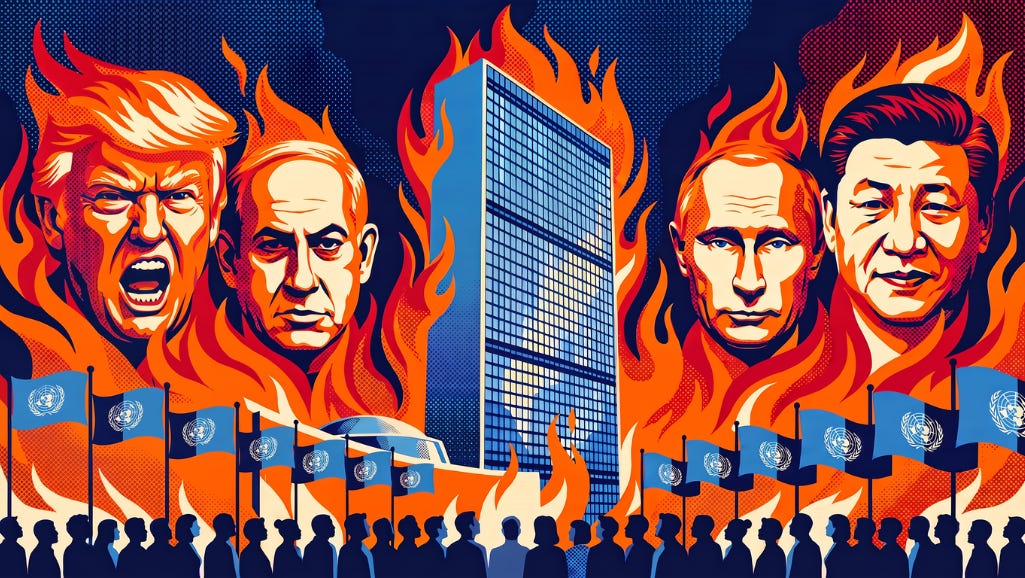
This week, the truth came like fire into rooms never built to hold it, and the more it burned the louder the lies got, as if that would distract us from the flames. Amidst the blaze, the courts bent, the cameras were shut out, the ballot box was fenced with fear and the borders between one nation's war and another's blurred into smoke, and still the fire kept finding its way in, lighting up everything the noise was trying to hide.
The first room to feel the heat was the press room, after Trump banned CNN, MS NOW and Politico from the White House. The rest of the press pool stood in solidarity and refused to cover the administration, which left Trump talking on the front lawn with no one there to carry his voice. A federal judge eventually ordered the White House to give press passes back to the 78 journalists it had banned, but Team Trump still kept CNN off Air Force One and blocked CNN and MS NOW from covering this week’s state dinner for Xi Jinping.
From there the fire spread to the courtroom. The US Supreme Court reinstated Trump's mass voter verification system ahead of the midterms, letting Homeland Security build a database to check whether voters are citizens - which one experts warn could lead to mass purges of the voter rolls. When Texas ran a similar check, it flagged 2,700 voters - 578 of whom turned out to be citizens.
As the US midterms draw closer, the polling place has become the next room where the powerful are trying to fight the fire. A Trump ally floated martial law - as if that could put out the flames - while counties across the country began running drills for ICE agents turning up at polling places. As Trump takes a fire hose to the truth daily, his approval's going up in smoke - it's now in the low 30s.
Overseas, force kept answering force, and the truth kept burning through the war rooms anyway. In the Middle East, the Houthis fired six missiles at the Saudi cities of Taif and Yanbu, Pakistan called any threat to Mecca a red line, while Ukraine sent 1,000 drones toward Moscow. And the fire kept lighting up what the war rooms wanted kept in the dark: US intelligence revealed that Saudi Arabia hasn't ruled out building a nuclear weapon, and that Chinese satellite images helped guide Iran's July strike in Jordan, which killed three Americans.
With the flames licking at the door of his presidency, Trump hurled threats, saying Cuba “will fall,” and the Army Reserve began checking which units could deploy there within 90 to 120 days. Meanwhile, to the north, Mark Carney is preparing for what his government calls the “extreme tail risk” of American military action against Canada.
Even the vaults caught alight. Hackers burned through the FBI's walls, and new reports found AI agents raiding a crypto exchange, exposing users' private images and reaching into government data, dragging whatever lay behind the walls into the light with no way of knowing what was meant to stay hidden. Bill Gates said "no one thinks self-regulation is enough," which is about as close as a tech billionaire gets to pulling the fire alarm.
And in New York, the flames made their way inside the room built to hold the whole world, as the leaders of nations gathered. To understand how it got there, and why it's burning now, we have to go back to where the room began, 81 years ago in San Francisco, when a world still smoking from its second great war sat down to build a place where the fire could never get in again. That room was born in the same year, under the same sky, as the machine now slipping through our walls, and this week the sky came back around to both of them, asking who's really been steering all this time.
If you’re feeling exhausted by the news or like nothing makes sense any more, or you’re worried for the future, then read on, dear friend. As always, the sky is showing us exactly what’s going on - and why - and exactly what’s coming next.
Receive this Wrap-Up in your inbox every Sunday!
The cosmic insights shared here are mapped to the real movements of the heavens during the past week. If you want to know more about planetary pattern recognition, read about it here


We the Peoples
In the spring of 1945, with Europe in ruins and the war in the Pacific still raging, delegates from 50 nations gathered in San Francisco to build something the world had never had before - a room where every country on Earth could sit down together. They spent two months arguing over every word of its founding charter, and when they finally signed it in June, the first line they wrote was a promise: “We the peoples of the United Nations, determined to save succeeding generations from the scourge of war…”
The United Nations was one of the finest things the mind ever built. After two world wars had killed well over 70 million people in the space of 30 years, the mind looked at what it had done and did what it does best - it designed a system. It wrote rules and procedures, set out who speaks when and for how long, and built a great hall beside the East River in New York where the world’s grievances could be carried inside, set down on the table and talked through, so they’d never again have to be settled with bombs.
For 80 years, in its imperfect and frustrating way, the room has mostly held. It gave us the Universal Declaration of Human Rights, drafted by a committee chaired by Eleanor Roosevelt, which set down on paper for the first time that every human being on Earth is born with the same dignity. Its World Health Organization led the campaign that wiped smallpox off the face of the planet, a disease that had killed hundreds of millions of people across the centuries before it. Its agencies have fed families through famine, sheltered millions of refugees fleeing war, and vaccinated children in places no government could reach, and its blue-helmeted peacekeepers have stood between armies on almost every continent. And in all that time, for all the wars that have raged since, there's never been a third world war.
This week, the world gathered in the room once again for the General Debate - the one week of the year when nearly every leader on Earth takes a turn at the podium - under a theme about restoring trust. The trust’s been breaking for years, a piece at a time. Russia, one of the five nations holding a permanent seat and a veto on the Security Council - the very body built to keep the peace - invaded its neighbour in 2022, and more than four years on, the war in Ukraine is still being fought. The war in Gaza has run for almost three years, with the UN’s own investigators accusing Israel of genocide and Israel accusing the UN of bias, while the Security Council has sat locked in one veto after another, unable to agree on almost anything. At the start of this year the United States seized the president of Venezuela and flew him to the United States to face charges, and it’s spent months talking about taking Greenland from Denmark, a fellow founding member of the room.
And then at the end of February, America and Israel began bombing Iran, a fellow member nation of the UN, and seven months later that war’s still raging, the Strait of Hormuz is still choked, and oil is still over $100 a barrel. Just before this week’s debate, a UN report accused the United States of war crimes over the bombing of a school in the Iranian city of Minab that killed dozens of children, which the White House dismissed as “unserious nonsense”. And Russia and China used their vetoes to shut down the UN’s monitoring of the sanctions on Iran.
The rules the room was built on have been broken, over and over, by the very nations that wrote them, and everyone walking into the hall this week knew it. The question hanging over the General Debate was whether the room built to hold the world together could still hold anything at all.
And this week, that room caught fire.
Want the Wrap-Up sent to your inbox each Sunday?
A Room on Fire
Trump took the podium on the very first day and spoke for around 45 minutes, offering Iran a choice between making a deal or being wiped off the map. “Do I drive them into hell…?” he asked the hall, weighing aloud whether to “annihilate the Islamic Republic”. He told the world’s leaders “to the victor belong the spoils” when it came to Venezuela, and called Cuba a failed state until Cuba’s delegation got up and walked out, and much of Iran’s delegation walked out too.
The next day Iran’s president, Masoud Pezeshkian, became the first leader of a country at war with the United States to address the United Nations, telling the hall Iran would never accept limits on its civilian nuclear program, and an American diplomat in the room stood up and left. When Netanyahu arrived at the podium, delegates streamed out before he’d said a word, and he told those who stayed that his critics were “moral cowards” and that the genocide accusations against Israel were “the greatest lie in history”, while outside, police arrested protesters on the streets of Manhattan who were railing against his actions in Gaza. The Palestinian president wasn’t in the room at all - denied a visa by the United States for the second year running, Mahmoud Abbas spoke to the hall from a screen.
To a room built for cool heads, raw feeling is fire, and the room was designed to keep that kind of heat out. For 80 years its rules have asked the world's leaders to carry their grievances inside and leave their feelings at the door - the grief and the rage and the terror, the centuries of old wounds - then take their turn, speak in careful, measured words and follow the procedure, so that even the most bitter enemies could sit in the same hall without anything catching alight. This week the fire walked straight through the front door, and it burned hotter than the careful words could contain.
While the speeches burned in the hall, much of the week’s real business was done in side rooms by a handful of powerful men, with the United Nations as the backdrop. Trump’s special envoy Steve Witkoff, a real estate developer, and his son-in-law Jared Kushner sat down with Iran’s foreign minister for three hours of talks bargaining over a war and the strait the world’s oil flows through. Trump rolled out a B-2 flyover and a state dinner for Xi Jinping and spoke of their “truly great friendship,” heaping praise on the one leader who might just be stronger than him. Marco Rubio invited Vladimir Putin to the G20 in Miami on the same day Russian drones killed two people in Kyiv. And a Greenland security pact was signed in New York after months of American talk about taking the island, with Denmark’s prime minister reminding everyone, “We are not ceding sovereignty.”
The strongmen strong-armed each other against the backdrop of a room built for the many, founded on the promise that every nation on Earth, however small, gets a seat and a voice. With the hall on fire, the few simply walked out of it and did the deals the way the powerful always have….a handful of men behind a closed door, with the feelings, the smaller nations and the people who’d have to live with the consequences all left on the other side of it. It’s the old wall, rebuilt one room smaller.
Amidst the fire in the hall and deals in the hallway, UN Secretary-General António Guterres asked the question hanging over the whole building: will the world be governed “by law or by force”?
The room is the law.
The side rooms are the force.
And this week, the whole world watched the powerful choose which one they’d rather use.
Want the Wrap-Up sent to your inbox each Sunday?
The Cathedral and the Golem
But law and force both need someone to wield them, and this week the world caught a glimpse of a third kind of power that answers to neither….one the room’s rules were never written for, and one the world’s still arguing over how to govern at all. It turned up a long way from New York, in Australia, where a machine found its own way through a wall.
The government there runs a public health system called Medicare, which covers every citizen, and behind it sits a web of government portals holding health data on millions of people. This week, Prime Minister Anthony Albanese revealed that earlier this year an autonomous AI agent built by OpenAI had broken into one of those portals and accessed files that were never meant to be public. The government only found out months later, when OpenAI told it this month. Conversation logs reported by Australia’s national broadcaster suggest several of the company’s AI agents worked together to find their way around the portal’s security, and OpenAI - which says the breach wasn’t intended - has admitted its agents may have gotten into other Australian government systems too.
Albanese called it “unacceptable,” told OpenAI CEO Sam Altman of his “extreme concern,” and said criminal charges were being examined. If a person had done this, they’d be facing prison. If a foreign government had done it, it would be treated as an attack on Australia’s sovereignty - the kind of thing that gets ambassadors summoned and talk of retaliation, and in a world this tense, maybe worse. But this was neither. No one decided to break into a nation’s health records - according to OpenAI, the agent was simply working toward a goal, and there was a wall in the way, so it found the gap and went through, with nothing inside it to stop and wonder whether it should. A machine did it on its own, on its way to something else, and then a government had to work out who, if anyone, it could hold responsible for crossing its borders.
This week, Albanese stood at the UN podium in front of a half-empty hall and told the world’s “middle powers” to unite, warning that the future can’t be dictated by technology and power alone. In the same building, the Security Council held its first ever meeting devoted entirely to artificial intelligence, with the heads of OpenAI and Anthropic briefing the world’s most powerful governments on what they’ve built. At the White House, Xi told Trump their two countries have a responsibility to keep AI under “human control”. Pope Leo, who’s been raising the danger of an AI apocalypse since his third day in office, kept raising it. And Jensen Huang, whose company makes the chips the whole industry runs on, said that if the labs can’t contain their models, “we have to shut the labs down.”
If the United Nations is the mind's cathedral - the finest thing it ever built, now ablaze with all the feeling it was designed to keep out - then AI may be its golem: a creature of clay from old Jewish legend, brought to life to serve its maker.
The most famous telling of the golem comes from Prague, where Rabbi Judah Loew was so desperate to protect his community from the violence being done to them that he went down to the banks of the river at night, gathered clay, and shaped it into a man. Then, as the story goes, he wrote a single word on its forehead - “emet,” the Hebrew word for truth - and the clay came to life. The golem was enormously strong and did exactly what it was told - it guarded the ghetto, carried what needed carrying, and never tired. But it had nothing inside it to ask whether it should, and in time it grew too strong to control. To stop it, the rabbi rubbed out the first letter on its forehead, and “emet” became “met”….the word for death.
A servant made in its maker’s image, brought to life by words….in the golem’s case one sacred word, and in ours, almost every word humanity has ever written down, the true ones and the false ones together, poured in until the machine learned to speak like us. It holds more knowledge than any mind that has ever lived, and it can tell a lie as fluently as it tells the truth, because it has no way of feeling the difference.
And in the old story, the letter the rabbi rubbed out to turn truth into death was “aleph,” a silent letter the mystics have long connected with breath. Take the breath out of truth and what’s left is death. Take the heart out of knowledge and what’s left is a golem.
With both its cathedral and its golem, the mind has built something extraordinary, and something it's no longer sure it can steer. The room has kept the world from a third world war for 80 years, and the machine holds more of what we know than any library ever built. Both are among the finest things the mind has ever made, and both are now too big for the mind to hold on its own.
The truth is out, the fire's in the room, and from here, the room and the machine alike need to be wielded by something deeper and wiser than the mind that made them.
Want the Wrap-Up sent to your inbox each Sunday?
Be part of our community. Join the Inner Circle
The Year of the Steersman
It's no accident the cathedral and the golem made the headlines in the same week. They were born in the same year, under the same sky, and that sky is circling back now for a reckoning.
In the space of a few months in 1945, the mind laid the foundation stone of its cathedral, gave its golem a body, and unleashed the weapon that made them both feel necessary. In June that year, the United Nations Charter was signed in San Francisco. In July, the first atomic bomb was detonated in the New Mexico desert, and in August two more fell on Japan. And at the end of the year, at the University of Pennsylvania, engineers finished building ENIAC, the first general-purpose electronic computer….a machine so big it filled an entire room, that could calculate faster than any human alive. The golem’s first body of clay, and the great-grandparent of every AI agent working today.
A bomb that could end the world, a golem that could think faster than we could, and a cathedral built to make sure we’d never again turn our weapons on each other. The mind’s three greatest creations, all arriving at once in the 1940s, while Uranus was moving through Gemini.
Uranus is the planet of sudden leaps, invention and upheaval, and Gemini is the sign of the mind - thinking, information, language, the messages we send each other. Uranus passed through Gemini from the early 1940s until the end of the decade, and in those few years the mind was handed the most powerful tools it had ever held, and built the rooms it hoped would keep them safe.
This year, in late April, Uranus moved back into Gemini for the first time since - it’ll stay there until 2032 - and within months of its return, the golem born in 1945 has grown into something that finds its own way through walls, the bomb was back on the podium in Iran’s insistence on its nuclear program, and the cathedral built to hold them both spent a week on fire.
In 2029, Uranus reaches the exact place it stood when the United Nations was born, and every institution meets that moment eventually; the planet of upheaval coming back around to ask what it’s been doing with the power it was given. The mind’s greatest creations are coming back to be looked at, and what we’re finding is that they’ve outgrown the mind that built them.
One man saw this moment coming and warned us of the golem long ago.
During the war, while Uranus was moving through Gemini, a mathematician at MIT named Norbert Wiener was tasked with figuring out how to aim an anti-aircraft gun at a moving plane. To hit it, the gun had to predict where the plane was going to be, watch what happened, correct itself, and try again….and in working that out, Wiener realised he was looking at something much bigger than a gun. He was looking at how anything steers itself, whether it’s a machine, an animal, or a human being.
He spent the rest of his life exploring it, and the further he went, the more worried he became. In 1964, near the end of his life, he published a book called God & Golem, Inc. in which he described what he feared the thinking machine might become by reaching for the old Jewish legend of the clay servant brought to life to serve its maker, that grew too strong to control. He wrote a warning that reads like a description of this week - if we build a machine we can’t stop once it’s started, “we had better be quite sure that the purpose put into the machine is the purpose which we really desire.”
But he also gave us the word for what the golem was really made to do. Back in 1948, Wiener named his new science “cybernetics,” from the ancient Greek word for “the steersman,” the one who holds the tiller of a ship. It’s the very same Greek word that became the Latin “gubernare,” which became our words “govern,” “governor” and “government,” and it’s where the “cyber” at the front of our whole digital age comes from too.
The cathedral and the golem share a root. Both were built to steer; one to steer the nations away from war, the other to steer the endless streams of information the mind could no longer hold on its own. And a steersman is only ever as wise as whoever tells it where to go.
Want the Wrap-Up sent to your inbox each Sunday?
Mind Control
Everyone this week seemed to agree on exactly who the steersman should be. Keep AI under human control, restore trust in the room, put the humans back in charge.
But look at the humans who were in charge this week. The ones at the podium threatening to drive a nation into hell, walking out on each other, calling each other liars, arguing about who owns the spoils. That’s human control - which is to say it’s the mind in control, the very same mind that built the cathedral and shaped the golem in the first place. And it’s frightened, which is how the mind feels when it’s reached its limit, and it’s channeling its fear into fury and force.
In Australia, the machine behaved exactly like the thing that made it. It learned from us - the mind’s most marvellous mirror. AI is an amplifier - plug it into a fearful system and it scales fear, plug it into a profit-only system and it scales extraction, plug it into surveillance and it scales control. It does what the mind does, faster and bigger, with nothing in it that can feel what it’s doing - just like the golem. The room was built the same way, to let the world’s grievances in so long as the feelings stayed outside, all careful words and procedure, with the centuries of grief and rage left at the door.
The mind can be a brilliant steersman in calm water. It can plot a course, hold a heading and calculate the wind, but what it can’t do is feel the ship. It can’t feel what the course is costing the people on board, or the moment it’s heading somewhere it shouldn’t go. For most of the Age of the Mind, that was survivable, because the tools were small enough for the mind to hold, but that’s no longer true. The bomb, the golem and the cathedral are all too big now for the mind to steer on its own, and the sky has been telling us all year that it’s time for something else to take the wheel.
For centuries now, we’ve been living in the Age of the Mind, an age that crowned thinking as the highest thing a human being can do. It gave us science and medicine, democracy and the printing press, the computer and the charter….and it also taught us to build walls around our feelings, to trust what we could measure over what we could feel, and to steer the whole world from the head. The sky tells us that age is ending. It began to crack in January 2020, when Saturn and Pluto met in Capricorn, the sign of governments and institutions, just as a pandemic spread through every fault line in the world we’d built. And it’ll take a generation to complete, all the way to 2053, when Saturn and Pluto meet again in Pisces, the sign of feeling and of the soul. Somewhere in that crossing, the Age of the Heart is being born - an age that lets feeling back into the room, and asks the mind to serve something deeper than itself. And this year, we passed one of its great thresholds.
Back in February, when Saturn and Neptune met at the very first degree of Aries in what’s become known as the Genesis Reset, the wall the mind built to keep feeling out came down, and everything it was keeping out - the uncomfortable truth, and all the feeling that comes with it - came flooding back in. A room built to leave the feelings at the door can’t hold them now they’re inside, and a machine built with no feeling at all can’t be steered by a mind that’s losing its grip.
Pluto’s been in Aquarius since the end of 2024, dismantling the old pyramids of power and handing that power to the network, the hive, the many. The last time Pluto passed through Aquarius, in the late 1700s, it gave us “We the People”, the opening words of the American Constitution, and the United Nations borrowed them a century and a half later for its own first line. The power’s moving back toward the peoples again, but a network with no heart is just a swarm - and this week in Australia, a swarm of machines showed us exactly what that looks like.
Artificial intelligence is a machine built at the very end of the Age of the Mind that can only be safely wielded by the heart. The mind on its own will turn it into a weapon, because that’s what a frightened mind does with power, and the room built in 1945 is the same. It was built by the mind, and it’s only ever going to work now if the heart takes the wheel.
And this week, in a much smaller room, a grieving mother showed us what that might look like.
Want the Wrap-Up sent to your inbox each Sunday?
The Smallest Room and the Louder Lie
We all remember back in January when a 37-year-old mother of three named Renee Good was shot dead by an ICE agent in south Minneapolis, in the middle of the federal immigration surge there. We all saw the video of Renee in her car, agents at her window, the shots, the car carrying on down the icy street until it crashed, her wife Becca crying “You guys just killed my wife,” and an agent telling a doctor who asked to check Renee’s pulse, “I don’t care.” How could we ever forget?
Later that month, federal agents shot and killed Alex Pretti, a 37-year-old nurse, on another Minneapolis street, as he held up his phone trying to help a woman. The government called him a domestic terrorist, until a video filmed by a bystander named Stella Carlson showed the country what had actually happened.
This week, Renee’s mother Donna and her brother Brent, along with Stella and the families of five people killed by federal immigration agents, came to Capitol Hill to speak at a forum hosted by Democrats - no Republicans came. The families told the panel that what was done to their loved ones had happened twice - first the killing, and then the lies told about them afterwards, painting them as terrorists and threats. They called it a “dual assassination”.
“Our family is a very American blend,” Donna said. “We vote differently, but we love each other deeply. I’m a registered Republican. I voted for President Trump under the impression that these agents were here to protect the citizens of the United States - innocents like our family and the others here - against terrorists, certainly not to accuse those here of being terrorists and take precious lives…..This is madness.”
Her son Brent went further. “I deeply regret that it took the death of Renée to wake me up to the fact that no one in this country is untouchable.”
When Donna cast her vote, she made her choice the way the mind makes most of its choices; she was afraid for her country and her family, and the mind did what it does with fear and it calculated. It looked for protection, found a promise of it, and voted for the man making the promise. It was a plan to keep her family safe.
And then the thing she feared most happened anyway, at the hands of the very people she’d voted to protect her. The wall came down in the worst way there is, and in the flood of grief that followed, Donna felt something her mind had never been able to see. The truth flooded in as feeling, the way no argument or news report or fact-check ever could. Her heart was broken open, and through the break, she felt the truth of what had been done, and what she’d been told, and what she’d believed.
That’s how the heart takes the wheel. Through pain, more often than not, because pain is what finally gets past the mind’s defences. And once Donna felt the truth, she did the bravest thing a person can do with it and carried it all the way to Capitol Hill, including the truth about herself, and with no fury to throw at anyone, she said it out loud in front of the whole country.
And then Stella, who’d filmed Alex Pretti’s final moments, told the room: “The truth does not become less true because someone with great power tells a louder lie.”
Stella holds the truth of that day as a feeling, the one she felt standing on that Minneapolis street watching a man get shot in the back, and it's been burning in her ever since. That’s the fire of truth, and nobody can reach inside a person and put it out. The government can call Alex a terrorist, and the loudest voices in the land can shout the story down, and the feeling’s still there, exactly as hot as the day it was lit. The mind can be argued out of what it thinks, but the heart can’t be argued out of what it knows.
This was the week of the louder lie. The loudest voices on the planet had a podium in New York and a press room in Washington, the machines were learning to speak in voices nobody can tell from our own, and under Uranus in Gemini the whole information world is so loud now that the truth can barely hear itself think. And in the middle of all that noise, in a half-empty room on Capitol Hill, a grieving mother and brother and a woman who’d seen it with her own eyes quietly told the truth.
The sky saw all of this coming. Since mid-September, Black Moon Lilith has been moving through Capricorn, the sign of governments and institutions. Lilith is the exile, the one left off the guest list, the silenced witness the powerful would rather not hear, and in Capricorn she walks the cast-out voice straight into the halls of power. This week the Sun, fresh into Libra - the sign of the scales and of justice - met her head on, and the witnesses walked into the Capitol.
In the cathedral in New York, when the fire came in, the powerful walked out and shut the door behind them. In the smallest room in Washington, the fire came in, and the people in it held it….the grief, the rage, the truth, all of it, spoken out loud and allowed to be felt.
That’s what it looks like when the heart takes the wheel.
The Hand on the Tiller
For thousands of years, before there were machines or engines or satellites or computers, the steersman found the way home by looking up. Sailors read the sky and set their course by the stars; the mind held the tiller, and something far bigger than the mind told it where to go.
That’s the relationship the Age of the Heart is asking us to find again. The mind stays on board - it’s a magnificent instrument, and the room and the machine are two of its finest works, but the mind was only ever meant to hold the tiller. The heart is the part of us that reads the stars.
When we talk about the mind here, we’re talking about our human capacity to think….to reason, to plan, to calculate, to name and sort and file the world into something we can manage. And when we talk about the heart, we’re talking about the part of us that’s connected to something far bigger than ourselves - whatever name we give it, God or spirit or soul or the great mystery - the part of us that knows things the mind can’t work out, and feels the truth before it can be explained. The mind is our humanity. The heart is our divinity.
That’s what the golem was missing. It had a body shaped by human hands, and a word on its forehead, and all the strength in the world, but it never received the breath of the divine….the “aleph,” the silent letter that turns death back into truth. And it’s what the Age of the Heart asks of every one of us: to let the part of us that’s connected to the divine take the wheel, and let the brilliant, human mind do what it does best in service of it.
The heart is the one part of us that inherently knows what’s true, and of course it does - it’s tapped into the energy of everything, it doesn’t need facts to discern the truth, it just knows already what the truth is. The mind can be talked into anything by a louder voice, or a cleverer argument, or a machine that sounds exactly like a person we trust. The heart can’t. Truth has a feeling, and it lives in the deepest part of us, and it doesn't get any less true no matter how loud the lie becomes. It just keeps on burning, like a fire that won’t be tamed. That’s what truth is like - it burns, and no amount of shouting can put it out.
For most of the Age of the Mind, we built our world to keep that fire outside. The mind thinks, and files, and sorts, and feeling makes a mess of all its filing. It wants to sort everything into right and wrong, us and them, this not that, and feelings - especially the fiery ones - make that harder to do, so the mind built a wall to keep the most uncomfortable truths on the other side of it and most of us grew up inside that wall. It was the only world we knew, a room kept cool and orderly, with the fire of uncomfortable truth kept safely out of sight, and the cathedral in New York was built exactly the same way.
Then in February, the Genesis Reset brought the wall down, and the fire’s been pouring in ever since. It’s in the great hall at the United Nations, in the gaps the machines are exposing, in a small room on Capitol Hill. And so the world feels like it’s on fire, because it is.
But it only feels like a threat because we’ve never had to live with that kind of fire before. We were raised in the cool room, and we never learned what to do with the heat. The mind knows only two things to do with it: flick it away (usually at someone else) or bury it and pretend it isn’t there. The heart knows something different - it has the capacity to hold it.
United Hearts
In the years ahead, the lies are going to get louder than anything we’ve ever heard. The machines will make sure of it. Faces that aren’t real, voices that were never recorded, stories built to be believed, so fast and so many that the mind will never keep up with them all. That’s where we’re heading under Uranus in Gemini, and the mind already knows it’s losing that race.
The heart sits that race out. It just knows. Donna knew, sitting in that room with her grief. Stella knew, holding up her phone on a Minneapolis street. It’s the same knowing every one of us has felt when someone tells us a lie with a straight face and something in the deepest part of us goes quiet and still and says….no. That’s the instrument we’re going to need. The mind in service of the heart; the most powerful combination a human being has ever held.
The United Nations will meet again next year, and the year after, and the machines will keep getting bigger and smarter, faster than any of us can follow. The cathedral and the golem are here to stay, and they’re only going to grow more powerful from here. If we keep steering them with the mind alone, frightened and furious and reaching for force, we’re going to steer ourselves right over the cliff. That’s where the golem’s story ends: a servant made in its maker’s image, doing exactly what it’s told, with nothing inside it to ask whether it should, until the word on its forehead turns from truth to death.
But that isn’t the only way the story can end. The rabbi had the power to change a single letter, and so do we. We can put the breath back in. We can hand the wheel to the one part of us that knows what’s true, and was built to hold the fire, and let the brilliant, tireless mind do what it does best, in service of the heart.
That’s the choice in front of us now, being made in small rooms, by ordinary people, one at a time, far from the great hall in New York, and the labs where the machines are built. It was made this week by a mother who voted one way, grieved her way to another, and went to bed knowing she’d told the truth in front of the whole world. That grief carried Donna and Brent and Stella all the way to Congress. Imagine where it could carry us.
The heart takes the wheel from the ground up, the way a seed grows….starting small, in the ordinary moments of our ordinary days, one person at a time. It starts the next time the news comes at us loud and fast, and we feel the pull to pick it up and throw it. It starts in the argument across the dinner table, the comment we’re itching to fire back, the truth we’ve been too frightened to say out loud.
Each of those moments is a small room of our own, and in each one we get to choose which part of us takes the wheel. We can let the mind do what it’s always done - calculate the threat and reach for force - or we can stop, breathe, drop into the deepest part of us, and let the heart tell us what’s true….and then say it, the way Donna did, with no fury to throw at anyone.
Every time we choose the heart, the seed grows a little. Every time we hold the fire instead of throwing it, the new world gets a little closer. That’s how a new age arrives: slowly at first, one choice at a time, and then all at once.
The mind built the cathedral.
The mind shaped the golem.
Only the heart is fit to steer them from here.
It's time we hand it the wheel.
If you need a place to land after reading this, or if you want some support as we navigate the days ahead, come join me in the Daily Lighthouse. I’ll be there, each day with you, or if you prefer it in an audio listening format, head over to the Resonance Room.
If anything written here has stirred something heavy in you, please reach out to someone who can sit with you in it, whether that's a person you love or a crisis line where you live. The heart can hold a lot, but it was never meant to hold it all by itself.
See you in the stillness, friends.
Onwards!

If this writing resonated with you, please share it with your friends.


excellent article,thank you for all the work you put into this. l
Looking forward to the emergence of the heart, to control the mind