


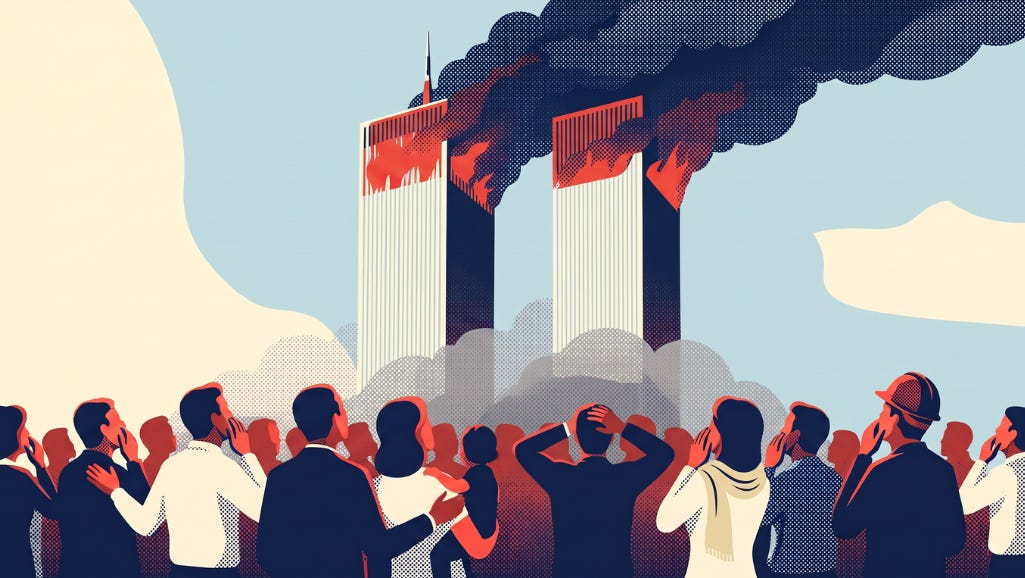
This was the week the buried things came up out of the ground - files nobody was supposed to find, stories nobody was supposed to tell, and questions nobody was supposed to ask, all rising from the rubble of the collapsing tower of power, twenty-five years after the dust first filled the air.
In the days leading up to the 25th anniversary of the September 11 attacks, New York Mayor Zohran Mamdani released a raft of documents that showed city officials knew the air was poisoned with asbestos in the weeks after the towers fell while they were telling New Yorkers the air was safe. Illnesses from that air have now killed more people than the planes and the towers did.
While Mamdani was unveiling long buried truth in New York, Trump was in Washington conjuring stories of being carried out of a creaking building near Ground Zero by two firemen who “grabbed me under the arm” and “literally lifted me up”, and about the crew of construction workers he brought downtown to help. Fact-checkers found no evidence for any of it - Trump was in midtown on the morning of the attacks, and his own nephew, Fred Trump, broke a long silence to say the only crew his uncle could have sent “would have been secretarial and accounting employees from Trump Tower.” The whole thing appears to be a complete fantasy.
When all four living former presidents gathered at Ground Zero on Friday to observe the anniversary, Trump skipped the ceremony - reportedly after being refused a microphone at an event no politician has been permitted to speak at since 2012 - and turned up instead at the Pentagon, where he was allowed to speak, and used the moment to tie his war on Iran to the attacks, while Pete Hegseth went even further, saying “We're still sending terrorists where they belong - to hell. And tankers to the bottom of the ocean where they belong…..We control the Strait. We will finish this fight.”
But America doesn’t control the Strait - far from it. It’s been essentially closed for months, under the control of Iran, and this week the Houthis - Iran's proxy in Yemen - seized the port of Mocha and the Red Sea coast near the Bab el-Mandeb strait, the chokepoint the Saudis had been using to get their oil out since Hormuz closed. “Everything that was under our control on the western coast has fallen,” a Yemeni officer said this week, as Saudi Arabia shut down the pipeline that carries its oil across the peninsula after its pumping stations were hit. Iran now has a grip on both sea lanes through which the Middle East's oil reaches the world, sending prices through the roof across the globe.
In America, oil hit $110 a barrel, and diesel passed $6 a gallon for the first time in history, and since diesel is the fuel that moves the trucks and the trains and the tractors, that number will end up in the price of groceries by Christmas. In response to the crisis of his own making, Trump floated renaming Hormuz the “Trump Strait,” called the war “small potatoes,” and said it would end “immediately” after the midterms, even while his own advisers have reportedly warned him it could run for the rest of his term.
Canada’s counter-tariffs on $20 billion of American goods took effect this week, and Prime Minister Mark Carney used the day to lay out a plan to unhook the Canadian economy from the American one and deepen ties with Europe instead. Trump answered with a ban on selling Canadian jets and Canadian goods in government purchasing, and new bans on Canadian dairy, alcohol and motorcycles from the end of the month. Carney’s approval rating is over 70%, while Trump’s is in the toilet, which might be why half the seats in the arena were empty when he held a Republican convention this week to stir up support ahead of the looming midterms.
At the event, while Ted Cruz was on stage talking about Zohran Mamdani and two Democratic Senate candidates, a man in the crowd shouted “he should be shot!” three times, and Cruz carried on without a flicker. The same night, three Epstein survivors and the journalist who'd brought them in, all carrying press credentials, were escorted out of the arena minutes after she asked a Republican candidate about the files. It was the same week that the Washington Post confirmed that Norway, Poland, Latvia and Britain have all sent formal requests to the US Justice Department for access to the Epstein files, and none of them has had an answer, while in Congress, Thomas Massie’s petition to force a vote on the withheld files passed 100 signatures.
Trump had the crowd at his Trumpapalooza raise their right hands and repeat after him, saying "I pledge to the greatest president in the history of the United States, that loves us so much he can't even breathe, that I will go out with my family, my friends…I don't care if I'm registered or not, I'm gonna try and cheat like hell like they do….and we are going to vote on November 3rd." Then he told the crowd that if they don’t vote, they’ll go to hell.
Trump also said that every American adult would get $5,000 if Republicans won the midterms - the party that’s staunchly against handouts offered what former Freedom Caucus chair Bob Good called the kind of socialist scheme Republicans accuse Democrats of. The “Trump Dividend,” thanks to “our tremendous strength and success economically,” would cost $1.2 trillion at a time when the US national debt has just reached $40 trillion - when Fox News asked why, given Republicans already hold both chambers, he can’t just pay it now, Trump said: “Because the Democrats can’t do it. Because with them it’s negative growth.” Whatever that means.
In Missouri, where Republicans redrew the congressional map last year at Trump's behest to carve up a Democratic seat, the state's own Supreme Court ruled the new map can't be used. Twice this week the US Supreme Court refused to overrule it, so Missouri will vote in November on its old lines, except that it already ran its August primaries on the new ones, and nobody yet knows how that gets unwound with the election barely fifty days away. The courts also spent the week blocking Trump's order to have the US Postal Service reject mail ballots, an appeals panel finding “no record evidence of past fraud” behind it, while the Justice Department went to the Supreme Court a third time to try and get it back.
Overseas, Trump’s no more popular than he is at home. When he touched down in Ireland for a golf trip this weekend, thousands marched through Dublin chanting “Donald Trump not welcome here,” pointing to Gaza, the war with Iran and rising costs. Then he put his foot right in the oldest argument in the country by saying he'd “love to see” Northern Ireland leave the United Kingdom and unite with the Republic, a question that fuelled thirty years of bombings and killings until the 1998 peace deal left it to the people of the North alone to decide. It seems almost every time he opens his mouth these days he triggers some kind of international incident.
Elon Musk seems to have a similar problem, tweeting his congratulations when the far-right AfD took 44% of the vote in the German state of Saxony-Anhalt - the biggest result for a nativist party since the Nazi era, on a manifesto built around mass deportation. Viktor Orbán chimed in too, posting “Buckle up. This is just the beginning.” Tens of thousands marched against it in Berlin and a dozen other cities, as something long thought buried reared its head in a week when that was happening everywhere.
As the buried things are coming up, the people at the top of the tower are doing what all rulers do when the ground starts moving under them, turning up the fear and handing out enemies, with pledges to cheat like hell, and hell itself for anyone who doesn’t fall in line. “Buckle up, this is just the beginning,” is right, but the beginning of what exactly? The sky says what’s actually beginning won’t please those in power.
A quarter of a century ago when we were asked to hold the unfathomable, the world responded in fear and fury, and now we’re drowning in it. This week, we were asked to hold that same weight again, in a story as tall as a tower and as small as a courtroom - at Ground Zero, in Massachusetts at the close of a mother's murder trial, and everywhere in between - and a different response began to emerge, to a question that's been waiting twenty-five years for a heartfelt answer, ever since the morning fear filled the air and the whole world breathed it in: what do we do with a thing too terrible to hold?
If you’re feeling exhausted by the news or like nothing makes sense any more, or you’re worried for the future and want to know what comes next, then read on, dear friend. As always, the sky is showing us exactly what’s going on - and why - and exactly what’s coming next.
Receive this Wrap-Up in your inbox every Sunday!
The cosmic insights shared here are mapped to the real movements of the heavens during the past week. If you want to know more about planetary pattern recognition, read about it here


Out of the Blue
It was a Tuesday morning in New York on the last warm week of summer, and the sky was clear, blue, and cloudless as kids made their way off to school, and commuters bustled through the streets and subways on their way to work. Out of that picturesque sky came a passenger jet - American Airlines Flight 11 - flying low among the buildings. Two flight attendants on that plane had called the airline from within the plane to report that it had been hijacked and that people in business class had been stabbed.
“Something is wrong. We are in a rapid descent. We are all over the place,” flight attendant Madeline “Amy” Sweeney told the airline's flight services office in Boston. “I see water. I see buildings….We are flying low….Oh my God, we are way too low.” And then, at 8.46am, the plane hurtled like a torpedo into the North Tower of the World Trade Center, in a burst of fire and flame.
People on the streets below heard the sound and looked up to see a mighty hole in the side of the building with smoke pouring out of it, but didn’t know what caused it. For seventeen minutes the whole city and, soon enough, the whole world looked up at that gaping, burning hole, trying to make it make sense.
Then, a second plane - United Airlines Flight 175 - came in low across the harbour, carrying passengers who were calling their loved ones from onboard to say their goodbyes. “I’m on an airplane that’s been hijacked,” Brian Sweeney said in a voicemail he left for his wife. “If things don't go well, and it's not looking good, I just want you to know I absolutely love you. I want you to do good, go have good times. Same to my parents and everybody. And I just totally love you, and I'll see you when you get there. Bye, babe. I hope I call you.”
At 9.03, that plane slammed into the South Tower, with news stations worldwide beaming the footage live. As New Yorkers filled the streets, smoke filled the sky, and the footage filled the airwaves, the unfolding reality slowly sank in across the globe, all at once. This was an attack. There had been people in those planes. There were people in those buildings. How do you put out a fire that’s a thousand feet in the sky? How do you rescue civilians trapped in a burning building with the wreckage of a Boeing 767 and its fuel burning inside it?
And then the people started to fall.
Above the fire in the North Tower, more than 1,300 people were trapped on floors where the stairwells were gone and the heat had passed a thousand degrees, and with the smoke behind them and the windows in front of them, they began to come out of the building. Somewhere around 200 people fell or jumped that morning, nearly all of them from the North Tower; some alone, some holding hands, hitting the ground at around 150 miles an hour. The cameras caught it live in the moment, though these days the footage is rarely shown - it’s simply too horrific to behold.
On the street below, the crowd moaned each time another body came down from the sky, and many reported hearing the sound of falling concrete until they understood what it was. The first firefighter to die on that day was struck and killed by a person falling from the South Tower. Nobody has ever been able to say for certain who fell, and the medical examiner ruled every death that morning a homicide, because in the words of one fire marshal, this should never be thought of as a choice.
Just before 9.40am, images emerged of the Pentagon on fire after a third airliner - American Airlines Flight 77 - went into the building, and the attack on New York became an attack on the country, and every aircraft in American airspace was ordered to the ground for the first time in history.
Soon, word spread that a fourth plane - United Airlines Flight 93 - was still up in the sky somewhere over Pennsylvania, hijacked, just like the others. Tom Burnett rang his wife Deena from that flight and told her a group of them were going to do something, and Jeremy Glick spoke to his wife Lyzbeth for a long time and asked whether he should fight. Mark Bingham rang his mother. Flight attendant CeeCee Lyles left her husband a message telling him she loved him and to tell the children. And Todd Beamer, unable to get through to his wife, spoke for thirteen minutes to a phone operator named Lisa Jefferson, said the Lord's Prayer with her, and was heard to say "let's roll" before the line went quiet.
At 9.59am, the South Tower of the World Trade Center came down, minutes before United Airlines Flight 93 crashed into a field near Shanksville, its passengers having fought the hijackers for the cockpit rather than let it reach Washington, where its destination was most likely the Capitol or the White House.
And by 10.28am, the North Tower followed the South, and descended to the ground.
Want the Wrap-Up sent to your inbox each Sunday?
The Air We’ve Been Breathing
The towers that fell that day didn’t fall over so much as they fell through themselves, and out of the bottom of them came a wall of dust that rolled up the streets of lower Manhattan faster than people could run, swallowing whole blocks and turning the morning black, and then settling, inches deep, on absolutely everything. On the cars and the awnings and the windowsills, and in the lungs of everyone who’d been on those streets. It was the pulverised remains of two 110-storey buildings - concrete, glass, steel, and every fireproofed beam and floor tile that had been sprayed with asbestos when they went up in the 60s and 70s - and it hung in the air over the city for weeks.
Nearly 3,000 people died in those planes and those towers that morning. Within hours, thousands more were climbing into the rubble to look for them.
Firefighters who’d lost 343 of their own that day dug for the ones still under the mangled pile of burning steel and cement. Police, paramedics, ironworkers, volunteers who’d driven in from other states, office workers who’d simply walked back downtown to help - they all worked in bucket lines, passing debris hand to hand, day and night, for weeks that turned into months, as the fires under the pile burned until December. Most of them wore paper masks, or nothing, while residents who lived in buildings nearby were told they could go home, and were advised to open the windows and wipe the dust off the sills with a wet rag.
A week after the attacks the head of the Environmental Protection Agency told the country the air in lower Manhattan was safe to breathe, and the city’s own health officials testified there were no elevated levels of asbestos indoors. The message, from the top, was that the danger in New York was over and that the ongoing threat was in caves on the other side of the world.
The day after the attacks NATO invoked its mutual defence clause for the first time in its history, and the world rallied to stand alongside America against the enemy that was "over there." Within days the nation’s fear had been given a face - Osama bin Laden and al-Qaeda, sheltered by the Taliban in Afghanistan - and within four weeks American bombs were falling on Kabul. Eighteen months later the same fear was pointed at Iraq, a country that had nothing to do with the planes, and the war that started as a manhunt became a war on the whole region.
There’s no question that al-Qaeda was a very real enemy that posed an actual threat, but in the scramble to find someone to blame, the thing the attacks had let loose on America itself went unlooked at. To take the war to Iraq, Washington produced evidence of weapons of mass destruction that turned out never to have existed, while the evidence of a danger that did exist was quietly filed away. The most immediate danger was in the rubble and in the air, in the form of asbestos, lead, mercury, pulverised glass, and the smoke from a fire that wouldn't go out. The people digging were breathing it twelve hours a day, and the people who'd gone home were breathing it in their kitchens, and they've been dying from it ever since, in far greater numbers than died on the day.
This week, twenty-five years after the towers came down, the Mayor of New York, Zohran Mamdani, released 170,000 pages of city documents that show officials knew the asbestos was everywhere, and knew it was a threat, while they were telling the public it was fine. The city had spent years insisting the records didn't exist, but just last year, 68 boxes turned up in a municipal office, and inside them was a letter from the city's own lawyers ordering that the files be preserved as evidence for the lawsuits they expected.
There's a memo from October 2001 to the Deputy Mayor about how to limit the city's liability for toxic exposure, and one from February 2002, from a special adviser to the mayor, conceding "at least a low level of asbestos in the dust in many buildings in lower Manhattan" and recommending that "we should discontinue telling people to clean their apartments with wet mops and rags," because a congressman's questions risked "major public relations problems" and a "barrage of lawsuits." It's all there in the documents finally released this week. They knew, and they said the opposite, and they ordered the proof kept and then said it didn't exist, and it stayed buried for a quarter of a century while the air killed more people than the planes and the buildings ever did.
We were told the threat was over there - in the caves, then in the deserts, in weapons that were never there at all - and we marched off to war with it for twenty years, killing hundreds of thousands of people who'd had nothing to do with the planes, when all along the thing that would kill more Americans than the attacks themselves was right here where we live. It was invisible, and it was slow, just like the fear that set in that day, seeping into just about everything, settling just about everywhere. We all breathed it in, wherever on earth we were standing, and it’s been killing us slowly ever since.
The people in charge told us it was safe and healthy - that it was right to follow that fear into fury, and funnel that fury into fortification against whatever it was we were afraid of. And so we started building walls - first it was walls at airport security, so no plane could ever be hijacked again, and then it was walls of surveillance, to find the enemy on home soil. There were walls to keep out Muslims, and then the Mexicans, and then it was walls between red and blue, between every us and every them, right down to the them that lives next door.
In twenty-five years we built a whole architecture out of fear, so that we’d never have to feel it directly again; the queue at the airport, the camera on the corner, the database, the watch list, the two-decade war. And the fear itself got buried, the way the asbestos did, under a story about heroes and villains, and us and them, so nobody would ever have to open the box and look at what was actually in there.
The literal dust and the fear are the same substance in every way that matters.
Both were in the rubble that morning.
Both were breathed in by millions.
Both were declared safe by authority.
Both took decades to kill.
And both have now killed more people than the day itself.
The health system in New York is still caring for the people who breathed the first one, but nobody’s been caring for the people who breathed the second, because we all did, and because we were told it was the cure.
Want the Wrap-Up sent to your inbox each Sunday?
The Collapsing Tower
The vision the world watched of the tower coming down that dreadful day twenty-five years ago turned out to be an omen - a sign of things to come. The physical embodiment of something that was about to happen in our world at a level the cameras can’t reach.
The men who hijacked those planes knew exactly what they were aiming at. The World Trade Center was built to be the financial capital of the world - a single address where the whole machinery of global commerce lived under one roof; the shipping lines and the customs brokers, the commodity exchanges and the banks, stacked a quarter of a mile into the sky above the harbour where the ships came in. When the towers opened in 1973 they were the tallest buildings on Earth, and the architect, Minoru Yamasaki, dedicated them as “a living symbol of man’s dedication to world peace,” because in his words, world trade meant world peace.
The World Trade Center was the Age of the Mind’s own cathedral - a monument built by money, to money, in the belief that money would hold the world together, championed by the Rockefellers, the family that more or less ran American capitalism, and named for the idea it was built to serve.
That’s why it was the target, and if you lay out that morning you can see the attackers naming the three pillars of American power in each of the buildings they aimed for that day - the World Trade Center for the money, the Pentagon for the military, the Capitol or the White House for the government. Two towers fell that day, and so did the thing they stood for - the tower of top-down power has been coming down slowly ever since.
Every ruler who’s ever sat at the top of the tower has felt the precariousness of their position, looking down at the foundations and realising they’re standing on the backs of the many, and that if the many ever got wise, they could bring the whole thing crashing down, king and all. And every ruler who’s ever felt that has known the one thing that keeps the many in line - the thing that keeps them offering their backs even when it kills them - is fear, pure and simple.
The Pharaohs of the Exodus story knew this when they enslaved the Israelites. The Assyrians knew it when they carved their massacres into their palace walls for visiting envoys to read. Rome knew it when it lined the road to the capital with 6,000 crucified slaves, and the Church knew it for a thousand years with a single picture of hell. The kings of England knew it with heads on spikes at London Bridge, and revolutionary France knew it well enough to call its own government the Terror, and Stalin knew it, and ran the biggest country on earth on the threat of a 3am knock at the door. Machiavelli wrote it down for all of them - “It’s safer to be feared than loved.”
Few and far between is the story of the king who loved his subjects into submission - love doesn’t build towers. Towers are always built on fear.
So no wonder when those towers came down on September 11, the people who sat atop the structure they stood for did what every ruler before them had done and stoked the swirling fear. It’s fine, they said, breathe it in, fill your lungs with it. And then funnel it into fury and aim it outwards, in whatever direction that we point. Where exactly doesn’t really matter, as long as the people remain afraid, because frightened people are easy to control, and they’ll offer their backs freely, often without even realising, for those in power to stand on top of.
Want the Wrap-Up sent to your inbox each Sunday?
Be part of our community. Join the Inner Circle
Monsters Among Us
For years, we've been living in a world not unlike that depicted in the film Monsters, Inc., where the city is powered by children's screams, and monsters clock in every morning to go through the closet doors and frighten kids in their beds, because that's where the energy that powers the city comes from. When the city faces an energy crisis as the children get harder to scare - as they realise the truth about the monsters in their midst - those in charge plan to kidnap them and extract the screams by force, and when some of the monsters recoil at the notion, they fan the flames of the lie that children are toxic and can kill them with a single touch, enlisting them through fear to do what needs to be done to keep their power supply in place. Swap the children for the rest of us, the screams for the nightly news, and the closet doors for the screens in our pockets, and you've got a reasonable picture of how the tower’s kept its lights on all these years.
Pointing a frightened population towards a perceived enemy is what the monsters did in our world too. In the days after the towers came down, as a whole country asked why anyone would do this to them, the answer came from the top of the tower in the form of a galvanising deceit. "They hate our freedoms," President George W. Bush declared, when the truer answer would have been to say they hate that our freedoms have come at their expense.
The CIA knew as much nearly fifty years before the towers fell, when it coined the term “blowback” to describe the likely consequences of the coup it ran in Iran in 1953 after Iran nationalised its own oil and London and Washington decided it belonged in their hands instead. A year before the 9/11 attacks, a scholar named Chalmers Johnson published a whole book with that very title, warning that America’s empire of bases and interventions would one day arrive on its own doorstep. America needed oil to keep its place at the top of the world, and it rarely asked before taking it from the people who owned it. The smash and grab that Trump’s been trying with Venezuela and the bombs he’s been hurling at Iran are just a more blatant version of what America’s been doing for decades.
Osama bin Laden published his reasons for ordering the attacks years before 9/11, and they had nothing to do with freedom; American soldiers stationed on the holy ground of Arabia to guard the Saudi oilfields, sanctions on Iraq - the price of a war fought over Kuwait’s oil - said to have killed half a million children while a Secretary of State said on television the price was worth it, and Washington’s hand behind everything done to the Palestinians. Nothing in that list excuses a single death on that September morning in New York in 2001, but everything in that list was knowable, and when the towers came down, fear was stoked precisely so that none of us would ever look at it.
That’s the truth the monsters never wanted us to see. The tower we were holding up had been making life unbearable in whole regions of the world so that America could sit at the top of it, and all of us - every one of us in the West filling the car with cheap petrol, whose comfort ran on the arrangement - were part of the machinery, without ever having been asked. When the attack came from the backs the tower stood on, the tower’s answer was to make sure we never looked down.
In Monsters Inc., the children the monsters were taught to fear turn out to be every bit as frightened as the monsters are, and once one of them stops to notice, the whole city changes. Laughter, it turns out, makes ten times the power that screaming does, and by the end of the film the monsters are going through the closet doors to make the children happy, because that’s where the real energy was all along.
That was the opportunity sitting in front of America on the morning of September 12 2001. For one breath the whole world stood at the same wall, feeling the same thing, and there’s a world in which the president could have stood up in that moment and said “For too long we’ve wielded fear like a tool, and all it’s ever made is more fear.” He could have ended it there, in the rubble and the ruin. “We’re going to grieve first,” he could have said, “and we’re going to feel this all the way down, and then we’re going to the walls we have built out of fear and we’re going to stand at them until they come down, because fear’s run this world long enough, and from here, it’s going to run on something deeper.”
But instead what he actually said was “they hate our freedoms.” And three days after the towers fell he stood on the rubble with a bullhorn and promised that the people who knocked the buildings down would pay. He didn’t say the other thing, so we didn’t do it, and we’ve spent the last quarter of a century fighting with the world and fighting with ourselves, terrified of what’s out there, mostly because we’re terrified to look at what’s actually in here.
And now, as the tower of power comes down everywhere at once, the opportunity is still sitting in front of us, right where it’s been for all these years. The them we’ve been taught to fear, on every side and in every direction, turns out to be as frightened as we are, standing at the same wall, wanting the same handful of things…..to be safe, to be fed, to be seen, to be told the truth about the air.
The fear economy only runs while we keep our backs turned to each other. The moment we turn around and feel what the other one needs, the lights come on, and there’s more power in that than fear ever produced.
Want the Wrap-Up sent to your inbox each Sunday?
The Wall and the Lightning
There’s a sky story running above all of this, that connects that tumultuous day twenty-five years ago with the tumult we’re facing now as the tower of power comes down.
On the morning the twin towers fell in 2001, Saturn, the planet of walls and limits, was moving through Gemini, the sign of the mind, and it stood directly opposite Pluto, the planet of power, in Sagittarius, the sign of belief, the crusade, and the story we tell about who we are and who they are. That’s the sky of 9/11 in one sentence - the wall went up around the mind, and power stood across from it wearing the robes of a holy war. Fear got a story, the mind got its walls, and within a fortnight it was “they hate our freedoms,” and within a month it was an all-out war on terror, though terror was what it was actually for.
Pluto’s been walking a long road since then. From Sagittarius, the belief that justified the tower, it moved into Capricorn, the sign of the tower itself - governments, institutions, the structures of power - and spent sixteen years there dismantling them from the inside, cracking the foundations in 2020 when Saturn met it there, and the world was transformed by a global pandemic. And in 2024 it moved into Aquarius, the sign of the many, where it will stay until 2043.
The story.
Then the structure.
Then the people.
Pluto in Aquarius is power leaving the top of the tower and passing down to the ones the tower has always stood on, and there’s nothing any king can do about it, because that’s the direction the sky moves.
Last time it took planes to bring the tower down.
This time it’s the many looking up, and noticing what we’ve been holding.
And this week the lightning arrived in the exact room where the wall went up in 2001. Uranus, the planet of sudden change and the kind of shock that rearranges, stopped dead in the sky and turned around in Gemini - the same sign Saturn was walling in twenty-five years ago. In 2001 the sign of the mind got a wall, and now in 2026 it gets lightning; the disruption in the sky, on the twenty-fifth anniversary of the disruption in the sky, just as the New Moon landed in Virgo where the Sun stood over New York that morning, like a fresh page, planted on the exact spot the old fear was written.
The tower coming down now is the Age of the Mind, the whole architecture we built out of fear so we’d never have to feel. When the towers fell in 2001, from the rubble grew fear, which we converted into fury, marched it off to war, and then we rebuilt the tower on the same ground, only taller this time; the Freedom Tower, standing exactly 1,776 feet high - the year America first declared itself an us against a them - was the mind’s answer to the rubble. A bigger tower with the founding grudge built into its height.
This time, as the tower collapses, the same fear’s emerging from the rubble.
Climate change will kill us.
AI will kill us.
Trump and the Republicans will kill us.
The immigrants will kill us.
The Democrats.
The Muslims.
The Chinese.
The neighbour with the wrong sign in their window.
Fear rising from everywhere all at once, and every bit of it is the same offer we were made in September 2001…..breathe it in, fill your lungs, funnel it into fury and aim it wherever we point. Some of those dangers are real, just like the dust was, but the danger being real has never once meant the fear should choose the response. That only ever rebuilds the tower, taller this time.
The call amidst this collapse is quieter than a bullhorn. Don’t funnel the fear into fury and reach for a verdict, or look for someone, somewhere to blame, at which to aim all that anger. Instead, we’re called to sit with it, and stay at the wall with all the fear and feeling until it thins, because the fear is the boundary of the mind, the very edge of the room it lives in, and just beyond it, on the other side of the wall, is the open expanse of the heart.
That’s where this crossing has been taking us since the foundations cracked.
Out of the mind, and into the heart.
And the rubble is where the door is.
Want the Wrap-Up sent to your inbox each Sunday?
The Heart in the Rubble
So here we all sit, in the rubble of the collapsing tower, with the old fear offering to rebuild it, and the hope this time is that we'll stay with the feeling long enough to reach for something deeper. We saw that kind of reaching happening these last few weeks, as the world found itself in the grips of a Massachusetts murder trial that ended this week in a way no-one expected. Fair warning - what we’re about to dive into is loaded with feeling, so let’s go gently, and if you’re feeling fragile, please proceed with care.
Lindsay Clancy was a young mother on trial for the murder of her three children - Cora was 5, Dawson was 3, and Callan was just 8 months old when, on a January evening in 2023, while her husband Patrick was out picking up takeaway, she took each of them to the basement of the family home in Duxbury and strangled them with exercise bands, then cut herself and threw herself from a second-storey window, sustaining injuries that have left her in a wheelchair for life.
Until a few months before that night she’d been a labour and delivery nurse at Massachusetts General Hospital, a woman whose job was bringing babies into the world. After Callan was born she stopped sleeping, and then came the anxiety, then the depression, then what she described to her doctors as “intrusive thoughts I never had before,” and by mid-December, “persistent, intrusive thoughts of suicide.”
She did everything the system advises - she saw a psychiatrist fourteen times in four months, and went through an outpatient program, and was admitted to McLean Hospital, one of the most famous psychiatric hospitals in America, and was sent home after five days. Along the way she was prescribed a cupboard full of medication and one of her providers suggested what she had might be bipolar disorder, but nobody named the thing that was actually happening to her. Three weeks after she left McLean, her children were dead.
The defence never disputed what Lindsay did, but argued she bore no criminal responsibility for it, because she was in the grip of postpartum psychosis, a condition that arrives in one or two of every thousand births, that hits women with no history of mental illness, that can bring hallucinations and delusions and commands, and that is, in the words of one forensic psychiatrist who testified, “the scariest mental illness that I know of.” A forensic psychologist told the jury that Lindsay had heard a male voice ordering her to kill her children and herself. She'd spent months telling her doctors about the thoughts that led there, and nobody in all that time had properly diagnosed what was happening to her, which is why her lawyer, Kevin Reddington said of her medical care that he was "appalled and disgusted…..it's repulsive what happened here."
The prosecution, on the other hand, called Lindsay an intentional killer. By their assessment, Lindsay was a woman who wanted her children gone, and had the wit to plan it, and their closing instruction to the jury was that “this case is not about our mental health system or how it treats women.”
In days gone by, our world’s had little compassion for mothers who kill their children, and it’s understandable for reasons that hardly need explaining, but something happened during the Lindsay Clancy trial that’s almost unheard of in a matter of this kind - the outpouring of compassion from the public for the woman who murdered her children, in this instance, was overwhelming.
From the first week after the killings, when Patrick Clancy published a statement asking the world to forgive his wife as he had, mothers who’d been through the same thing started speaking. Women who’d stopped sleeping after a birth and become convinced they were being followed. A mother who’d heard voices telling her that her newborn daughter was the second coming of Christ, whose husband finally drove her to a hospital. Survivors who’d waited months for a diagnosis and had been told, like Lindsay, that it was probably bipolar by a system that repeatedly fails to identify or treat the thing that’s been killing mothers and babies in their own homes for years.
There were those who tried to flatten the matter into black and white, whose compassion for the dead children cancelled out any possibility of compassion for the mother who killed them, but right alongside them rose an army of women and men who were able to hold Lindsay in their heart at the same time as the children she harmed, and when the jury went out last week, it became clear that many of the jurors were doing the same.
They deliberated for six days before sending the judge a note, saying, “It is with a heavy heart that we report we are unable to come to a unanimous decision.” As it turns out, eleven of the twelve had been ready to deliver a verdict - not guilty by reason of what had happened to her mind, which would have seen Lindsay committed to a secure hospital for treatment rather than a prison for punishment. Eleven people were ready to say three things at once - what she did was terrible, and we understand how it happened, and we choose compassion - but when the twelfth juror couldn’t bring himself to say the words despite admitting he had reasonable doubt, the machine that exists to produce a verdict produced nothing at all.
The machinery of the Age of the Mind - don’t feel, just file - practically ground to a halt in one of the biggest murder trials of the decade, on live television for all to see, the same way the towers came down twenty-five years ago. Back then, as we were asked to hold the unbearable thing, we did as we were told and felt the fear, funnelled it into fury, pointed it at an enemy we could obliterate, and filed the fear away so we wouldn’t have to feel it. This week we all watched on our screens as a jury was handed the same kind of unbearable thing and refused to do anything but feel.
The question asked in the rubble of 2001 was asked again this week, and this time, at last, it got a heartfelt answer.
Feeling Over Filing
What that jury room was reaching for was something genuinely unprecedented for a trial of this kind in America. Eleven people in Plymouth County refused to make Lindsay Clancy into a monster just so they could feel better - they sat with the feeling for days and refused to hand it to anyone. The ending was imperfect - nothing was solved, nobody got their exit - but what was left standing in the room when the verdict failed to arrive was the feeling; for Lindsay, for her three children, for a husband and father who’d lost everything and had chosen to forgive. The man with the most right to reach for a verdict and make a mother into a monster declined to, and for once, most of the rest of us did the same.
Here in the midst of the collapsing tower of power, the familiar voices of fear are there, as always, reaching for verdicts that make monsters and rebuild the tower. But something stronger and deeper than fear is rising from the rubble too, as eleven strangers held the unbearable and the understandable in the same hand this week, and the world mostly held it with them. What’s rising is feeling that’s finally allowed to be felt, and the more we allow ourselves to feel it instead of fleeing in fear or fury, the more we’ll know what to do with it.
This is the Age of the Heart rising as the Age of the Mind collapses. The heart doesn’t need a monster or a villain, or the explanation that makes the fear manageable. It can hold the whole of a thing exactly as it is, and from inside that holding a different kind of knowing arrives, the kind the mind can’t reach from inside its room. The wisdom of the heart steering, with all the mind’s precision in its service, instead of the fear of the mind steering with the heart locked out. Twelve people in a jury room did it these last few weeks, and eleven of them got all the way there. It’s learnable, and we’re learning, here in the rubble.
The kind of verdict the heart reaches asks for three things the mind never does, not just in the case of a mother who murdered her children, but for the World Trade Center and everything in between - the truth told in full, safety for everyone, and whatever repair is possible, for the living and in the name of the dead. That’s what the mind is for in the age we’re walking into - all of its precision, all of its capacity to weigh and decide, put to work in the service of what the heart already knows; that there is no us and them, they are both one and the same, and so when the verdict comes, it comes via the heart, shaped more like compassion than retribution.
When Them Becomes Us
America is a nation built on us against a them. The whole country was founded as an us against Britain, and it’s never once, in two and a half centuries, gone without a them to define itself against.
North against South.
White against Black.
Us against the communists.
Us against the Russians.
Us against the Chinese.
After that morning in 2001, us against the Muslims.
And now that the outside enemies have worn thin, the them has come home, and it’s Republican against Democrat, red against blue, one half of the country against the other half, with the tower’s keepers pulling the lever as hard as they can to keep it that way. The them is the tower’s fuel the way Monsters, Inc. runs on screams; take the them away and the whole architecture of fear has nothing to burn.
Twenty-five years ago, in the rubble of 9/11, the monster was the Muslim, but this week, it was a Muslim Mayor of New York who cared enough to open the boxes and finally tell a city the truth about the air. This week, he stood at Ground Zero beside four former presidents and offered his hand to former mayor Rudy Giuliani, who'd said Mamdani shouldn't come at all, and Giuliani took it and said “I'll pray for you. It's a really hard job.”
A few feet away, a man reading his father's name used his turn at the microphone to condemn anyone using that morning as a reason to hate Muslims. And for the first time, after the six moments of silence for the planes and the towers, a seventh was added, for the roughly 6,000 people who died afterwards, from what they breathed, with the fire department adding 36 more names to its wall this month for the same reason.
And a woman in Massachusetts did the most unforgivable thing a person can do, and instead of a country turning her into a them, women all over the world looked at her and said some version of “she is me.” Eleven strangers looked at the worst thing a human being can do and found, underneath it, themselves staring back.
And that’s how the tower finally comes down in the end, when the mind lets go long enough to take in what the heart’s always known - that all the thems out there are really just us.
It’s no accident this is happening under Uranus in Gemini - the planet of shock that stopped dead in the sign of the twins this week and turned around. Gemini - the two who are one - the pair that thinks it’s a pair until it suddenly realises it’s a single thing with two faces. That’s every one of us right now, here in the dying days of the Age of the Mind, pondering what happens to a tower built on us-against-them when the them keeps turning out to be us.
The Muslim mayor telling us the truth.
The mother in the dock who is every mother.
The neighbour.
The refugee.
The stranger on the bus.
What happens when the wall between us and them comes down - when we remember, the way the heart has always known, that all of it is one - is what happens every time one of us steps through the door in the wall of our own mind. On the other side there’s no them - only grief and love and a kind of knowing the mind can’t reach from inside its room, and in that place harming another registers as harming ourselves, and caring for another is simply what caring for ourselves looks like once the wall is gone.
That’s the Age of the Heart.
The walls are the thing that goes.
As the tower the mind built to consolidate its power comes down, we are all being handed the same opportunity we were the last time a tower fell, when we collectively reached for a verdict and rebuilt it in fear. That same fear is coming up again - on the news, in the price at the pump, in the war that won’t end and the machines that might end it all, in the weather that’s coming, in the men on the stage telling us who to blame. And it’s coming up inside us all - in our chest, in our throat, in the three-in-the-morning doom scroll. That’s the wall.
And the wall is where the door is.
May we do something different this time than we did twenty-five years ago. May we stay with the fear rather than try to file it. May we sit in it, for one breath longer than the mind can bear, and then another, until it thins and dissolves into the wider place beyond it - the space of knowing and feeling and compassion. From there we can do something other than reach for a verdict and ride off to war. From there we can ask the question, and open the boxes and read what’s in them and let it land.
The tower is coming down, and as it does, the people falling from the top of it will tell us, all the way down, that the only safe place is back inside the room, and that there’s a them out there we should be afraid of.
But the truth is there’s only us.
There’s only ever been us.
The dust we breathed in that morning is in everybody’s lungs. We’ve been breathing it in for twenty-five long years, and we’ve held it through two wars and a queue at every gate until we forgot we were holding anything at all, and it became the air.
It’s time to let it out.
It’s time to step over the threshold, from the place of filing to the place of feeling.
That’s where the new age is rising from.
The air’s clear on the other side, friends.
Breathe it in.
If you need a place to land after reading this, or if you want some support as we navigate the days ahead, come join me in the Daily Lighthouse. I’ll be there, each day with you, or if you prefer it in an audio listening format, head over to the Resonance Room.
If anything written here has stirred something heavy in you, please reach out to someone who can sit with you in it, whether that's a person you love or a crisis line where you live. The heart can hold a lot, but it was never meant to hold it all by itself.
See you in the stillness, friends.
Onwards!

If this writing resonated with you, please share it with your friends.

If you’re interested in exploring your own natal chart, I was part of the team that built Ask Arion - an app that helps you read what the sky has to say for you personally. It’s free to sign up, and a great way to start your journey with the stars.


I’ve read this once now over coffee, in the quiet of the early morning, racing through the paragraphs and tumbling down into the imagery. I will return to read it again, more slowly, holding its energy close to my heart. Thank you. Your words resonate and this piece is profoundly impactful.
Wiz, this was incredible. This is one of if not the most powerful articles that you've written. Thann you.