


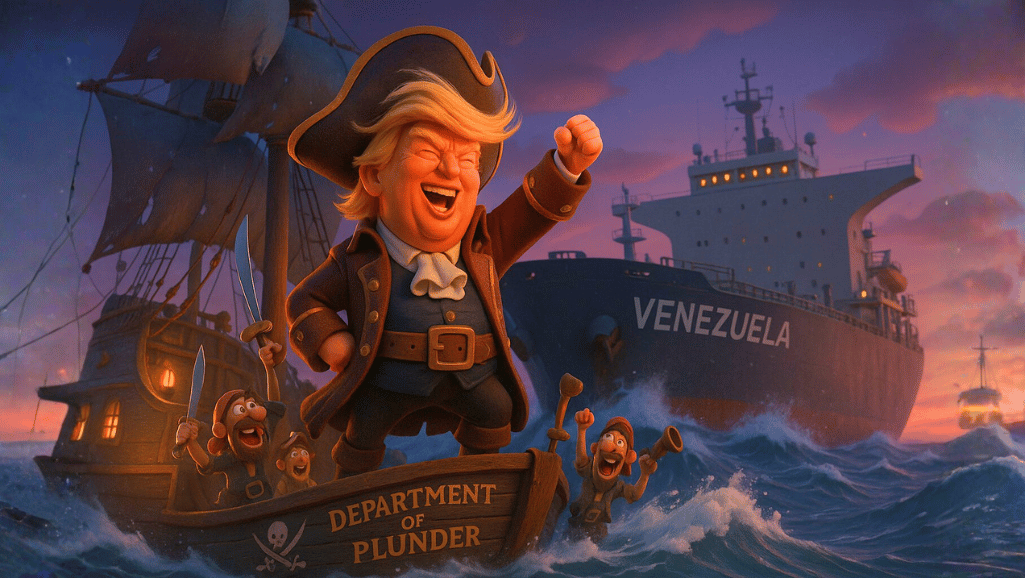
This week lurched from crisis to cartoon and back again, playing out like the cosmic forecast promised: a world cracking under its own weight while its leaders cosplay their way into the underworld.
The week began with Donald Trump being chosen as the effigy to burn in Guatemala’s annual ritual of torching the “devil” before the year ends - a job description he continues to fill with startling enthusiasm. Thousands gathered to watch the sitting President of the United States go up in smoke.
While Guatemala held its presidential bonfire, the rest of the world spent the week trying to digest Trump’s new National Security Strategy - a document that calmly declared the post–WWII world order deceased. Europe sidelined. NATO optional. Russia gently misunderstood. Migration recast as an existential threat. Climate science treated as a practical joke. U.S. business interests elevated to the status of diplomacy. Europe called it the end of the transatlantic alliance, and even the Pope chimed in to say Trump was actively trying to break apart the U.S.–Europe bond. The Kremlin, naturally, adored it and said so declaratively. Nothing says “totally normal global leadership” like Moscow being your only fan club.
Back in Washington, the administration spent the week dodging accusations that their boat-bombing adventure in the Caribbean might actually be a war crime. Bipartisan lawmakers crept toward subpoenas, the Pentagon did its best impression of a brick wall, and Defense Secretary Pete Hegseth insisted the President can blow up whatever he wants without checking with Congress. Trump, for his part, abandoned last week’s promise to release the bombing footage and instead attacked the press, zeroing in on yet another female journalist and calling her “the most obnoxious reporter in the whole place.” Meanwhile, the House introduced a defense bill threatening to freeze Pentagon travel funds until the video is produced - apparently accountability now requires financial extortion.
Not to be outdone by himself, Trump then ordered U.S. forces to seize a sanctioned Venezuelan oil tanker - again without congressional authorization, again without offering a single coherent reason why. Venezuela called the move “robbery and piracy,” and Trump seemed genuinely flattered. Fully embracing his Pirate of the Caribbean era, he escalated further by attacking the International Criminal Court, demanding blanket immunity for the United States and threatening sanctions unless the ICC rewrites its founding treaty to guarantee it never investigates or prosecutes him or his inner circle. Very normal demands from a man who definitely hasn’t done anything wrong.
Underneath all this theatre, every scandal is simply camouflage for the last one.
The threats against the ICC distract from the war crimes, the war crimes distract from the citizenship-for-sale scheme, the citizenship scheme distracts from the bandaged hands, the mysterious MRI and cognitive tests, which distracts from the demolition of the White House and the architect quitting in disgust, and that distracts from every other thing in this expanding funhouse of chaos we are all now forced to live inside.
Mounting a distraction of her own, Marjorie Taylor Green appeared on 60 Minutes this week, revealing that Trump was “extremely angry” at her for signing the discharge petition to release the Epstein files. According to Greene, Trump warned her it would “hurt people.” She also blamed him directly for the surge of death threats against her family. Naturally, Trump demanded an apology from CBS for airing the segment, and naturally, Greene then went on CNN and said, “I feel very sorry for Trump. It has to be a hard place for someone who is so hateful, who constantly tells lies about people to get his way. He has ripped our country apart.” When Marjorie Taylor Greene is the one delivering the moral clarity, you know the frequency of the timeline is getting weird.
Meanwhile, rumors are swirling that Greene is quietly plotting a coup to oust Speaker Mike Johnson before she retires in January, because why leave Congress quietly when you can toss a grenade on the way out? She’s not alone in her exit, either. Twenty-three House Republicans have already announced they won’t seek re-election or are fleeing for other offices, and aides are warning that another wave of retirements could drop any week now. The party of “law and order” is suddenly looking like the last ten minutes of Titanic, minus Celine Dion (their hearts will not go on).
As Time Magazine crowned the architects of AI their “Person of the Year,” and Disney set off fireworks by dropping a casual $1 billion into OpenAI and allowing its iconic characters to be used by its image generating program, Sora, Trump responded by signing an executive order to block state-level AI regulations and impose a single federal “rulebook.” A bold move, considering he does not technically have the authority to do that.
Then came this week’s presidential pardons, and not the competent kind. Trump pardoned Democratic Congressman Henry Cuellar and his wife after they were indicted on federal bribery and conspiracy charges, and immediately complained that Cuellar hadn’t switched parties to show proper gratitude. Apparently the presidential pardon power now comes with a loyalty rewards program. Highly ethical, as always.
Next, he pardoned Tina Peters, the election-denying clerk who tried to help him steal the 2020 election. Unfortunately for Trump, Peters was convicted on state charges, meaning his pardon is worth as much as a coupon for a store that no longer exists. She remains exactly where she was: in prison, pondering her life choices.
Meanwhile, Alina Habba - Trump’s former personal attorney turned acting U.S. Attorney in New Jersey - stepped down after a federal appeals court concluded her appointment was unlawful. Her interim term had expired without Senate confirmation, meaning she’d been playing U.S. Attorney the way kids play house: with enthusiasm, but absolutely no legal standing. Shortly afterward, Trump was caught on a hot mic berating Republicans for blocking confirmations, whining that he “can’t appoint anybody” because his picks keep expiring. A relatable problem, if you happen to run your administration like a rotating cast on The Apprentice.
From Florida to Georgia, Democrats delivered yet another shockwave this week, flipping Georgia’s House District 121 - a district Trump won by 12 points last year - and then pulled off a political resurrection in Florida, electing a Democrat as Miami’s mayor for the first time in nearly three decades. For a party supposedly in disarray, lately Democrats seem remarkably good at winning elections Republicans thought they owned.
Trump responded to the GOP wipeout with a social media tantrum that read like a diary entry from a nine-year-old sent to bed without dessert. He lashed out at multiple news outlets for reporting on his increasingly obvious cognitive and physical decline, including his recent habit of dozing off during meetings. He called the reporting “seditious, perhaps even treasonous,” right before casually admitting he’d recently been given yet another cognitive exam, the kind typically reserved for people showing signs of dementia.
With his popularity sagging, Trump hit the road for a string of rallies, each one smaller and stranger than the last. He rambled about whatever wandered through his mind, declaring, “I got the biggest vote with Black people,” before adding, with breathtaking tone-deafness, “they know a scam better than anybody!” Then he pivoted to praising his press secretary Karoline Leavitt, admiring “that beautiful face” with “lips that don’t stop like a little machine gun.”
Shifting to the economy, he insisted the affordability crisis was a Democrat hoax and suggested Americans simply buy fewer pencils, dolls, and toys, prompting Chuck Schumer to observe, “it takes a special kind of delusion to tell parents to buy their kids fewer toys and pencils while bragging about building a new White House ballroom and gold in the Oval Office.” Indeed.
Trump then defended his widely hated tariffs by arguing that his proposed $12 billion bailout for farmers wouldn’t be possible without them - critics noted the bailout wouldn’t be necessary without the tariffs either. Voters, according to polls, remain unconvinced that the economy is “just great,” no matter how many times Trump insists it is, or that if it isn’t it must still be Joe Biden’s fault.
Meanwhile, the Supreme Court sent up a mixed signal flare saying it may put limits on Trump’s tariff powers, but it also may expand presidential authority in other areas. Several justices appeared sympathetic to Trump’s argument that he should be able to fire independent agency board members at will, because nothing says stability like turning watchdogs into disposable staff.
A federal judge granted a motion to unseal Epstein grand jury transcripts in the Ghislaine Maxwell case, meaning more revelations are on their way. Congress, not wanting to be left out of the fun, released additional Epstein-related materials ahead of next week’s mandated deadline for Trump’s DOJ to finally hand over the full Epstein files. Among the newly released items were images featuring Steve Bannon, Bill Gates, Bill Clinton, and Larry Summers and a photo of what appear to be condoms with Donald Trump’s face printed on them.
Epstein survivors and multiple Democratic Senators immediately called for a third-party audit to ensure Trump’s DOJ hasn’t tampered with, deleted, or “misplaced” anything ahead of the release of the files next week. A reasonable concern, given the administration’s track record with inconvenient documents.
Ahead of the World Cup, the Trump Administration announced a new requirement that foreign tourists must hand over five years of social media history, plus DNA, biometrics, a decade of email addresses and phone numbers, and information about your family members before being allowed to step foot in the country. Tourism has already cratered by $29 billion since Trump took office, and this latest surveillance fever dream is set to sink it even further. The U.S. is on track to lose another $12.5 billion in international visitor spending this year - a jaw-dropping 22.5% decline - making it the only major country in the world whose tourism sector is shrinking.
When news broke that an active shooter was roaming Brown University this week, Trump announced the shooter was in custody, only to immediately contradict himself by saying the suspect had not been apprehended, causing unnecessary and dangerous confusion. The chaos ended with 2 dead and 9 wounded - one of the students on campus, Zoe Weissman, had already survived the Parkland massacre when she was 12. Two school shootings in one lifetime - welcome to America.
Then came more legal antics. After Trump pardoned former Honduran president Juan Orlando Hernandez - a man convicted of helping traffickers move multi-ton shipments of cocaine into the United States - Honduras promptly issued a new arrest warrant and fresh criminal charges against him. And for the second time in a week, Trump’s DOJ failed to secure an indictment against New York Attorney General Letitia James, and Trump was found to have engaged in the same species of “mortgage fraud” his loyalists have been trying to weaponize against her. The projection is so loud at this point it practically echoes.
The first articles of impeachment against RFK Jr. were formally introduced this week, right as the nation battled a major measles outbreak in South Carolina - an outbreak directly fueled by his reckless anti-vaccine policies. Hundreds were sent into quarantine. Over at the State Department, Marco Rubio outlawed the use of Calibri font, reversing a Biden-era accessibility policy designed to help visually impaired employees. Meanwhile, the National Trust for Historic Preservation sued the Trump Administration for literally destroying the East Wing of the White House, which, to be fair, is the most honest architectural metaphor of this presidency so far.
Kristi Noem appeared before Congress and immediately got caught lying about deporting military veterans. During the same hearing, Trump officials were asked to identify where Antifa is headquartered, since they keep insisting it’s America’s largest domestic terror threat. They couldn’t answer, because Antifa is not an actual organization. It was like watching adults try to locate Narnia on a map. A Catholic priest stood up mid-hearing, pointed at Noem, and shouted, “The power of Christ compels you!” while condemning her ICE raids. He was compelled out of the room minutes before Noem fled too, claiming she had another meeting, which turned out to be, of course, another lie.
Senate Republicans followed this performance by blocking an extension of Affordable Care Act subsidies while preserving massive tax cuts for the wealthy in the very vote Democrats agreed to hold in order to end the recent government shutdown. Congress then voted to overturn Trump’s executive order gutting union rights for two-thirds of federal workers, proving that even in this hellscape, the labor movement occasionally gets a plot twist.
And because the week wasn’t surreal enough, Palantir co-founder Joe Lonsdale publicly suggested bringing back public hangings for repeat offenders, framing it as a return to “masculine leadership.” Switzerland promptly rejected Palantir’s software, citing fears that sensitive data could end up in U.S. or Israeli hands. And Denmark went further, declaring the United States a national security threat to both itself and Greenland.
Tucker Carlson triggered a full-blown MAGA meltdown this week after announcing he’d purchased property in Qatar - a country his audience likely couldn’t find on a map even if you circled it and handed them a flashlight. He then told listeners, “The most depressing thing about the United States in 2025 is that we’re led not just by bad people, but by unimpressive, dumb people.” Meanwhile in Minnesota, Governor Tim Walz said people have been driving past his house shouting the “R” word - a direct echo of Trump using the same slur against him.
The widow of murdered journalist Jamal Khashoggi filed a complaint in France seeking a judicial inquiry into Pegasus spyware allegedly used to hack her phones and those of Khashoggi’s associates. At the same time, Representative Eugene Vindman revealed that during Trump’s first term, he reviewed a disturbing phone call between the Saudi Crown Prince and Trump immediately after Khashoggi’s brutal murder and dismemberment - and he publicly called for the call’s release.
Ukraine released dramatic footage this week showing what appears to be precision strikes that destroyed a major Russian drone warehouse and an adjoining fuel depot - a hit that landed hard in both symbolism and strategy. UK Prime Minister Keir Starmer announced that Britain, along with European partners, is close to finalizing a plan to deploy up to £100 billion in frozen Russian assets to support Ukraine. The deal isn’t sealed yet, but clearly Europe is done playing mediator and is now moving into full accountability mode.
Meanwhile, the European Union reached a historic agreement to permanently end all Russian gas imports by autumn 2027, officially closing the book on a 57-year energy relationship that Moscow once believed would give it permanent leverage over Europe. Adding to the pressure, Zelenskyy revealed new Ukrainian intelligence showing Russia has become so dependent on China that it is effectively ceding pieces of its sovereignty to Beijing - a humiliation even Putin can’t spin as strength. Analysts estimate that Russia has now lost casualties equivalent to roughly 1% of its entire pre-war fighting-age male population, and despite the staggering cost, its territorial gains amount to just 1.45% of additional Ukrainian land. Russia is bleeding men, money, and influence for what now looks like a geopolitical footnote.
Yet another war Trump claimed to have “ended” demonstrated it is very much ongoing, as fighting erupted again along the Thailand–Cambodia border. Thai airstrikes and artillery fire triggered rising casualties and mass displacement, and in the political chaos that followed, Thailand’s parliament was dissolved after the prime minister bowed out following just three months in office.
Meanwhile, Spain, Ireland, the Netherlands, Slovenia, and Iceland all announced they will boycott Eurovision 2026 over Israel’s inclusion, and Nemo, the 2024 winner, returned the winner’s trophy entirely. In response, Israel approved a $725 million budget allocation for international PR and “public diplomacy,” though critics noted it would have been infinitely cheaper to simply not bomb Palestine into rubble in the first place.
Australia, not wanting to be left out of the “historic moves” category, enacted the world’s first nationwide ban on social media accounts for under-16s, requiring platforms to prevent young teens from having profiles or face hefty fines. Colombia went the opposite direction, drawing global praise after declaring its entire Amazon biome off-limits to new oil drilling and large-scale mining - a landmark decision protecting roughly 42% of the country.
And because Mother Nature likes to remind us she’s still in charge, the Ring of Fire erupted with a magnitude-7.0 earthquake near the Alaska-Canada border and a 7.6 quake in Japan. And in a rare moment of pure delight, legend of the silver screen, Dick Van Dyke, turned 100 years old. A small miracle in a week full of everything else.
By the time we reach the bottom of a week like this, it’s tempting to treat the headlines as random shards from a world that’s lost its mind. But this wasn’t random at all. This week was exactly the kind of fracture-field the sky mapped out: truth breaking open, systems buckling, leaders overplaying their hand, and the old scaffolding of “business as usual” giving up the ghost. The week didn’t just descend into madness - it followed the script.
But beneath the noise, there’s a deeper pulse running through everything: a fear-built world trying desperately to hold its shape at the very moment the universe has already decided that frequency is obsolete. What we’re feeling isn’t the collapse of meaning - it’s the collapse of distortion. And the more the old world thrashes, the clearer the new rhythm becomes.
This isn’t just a wild news cycle. This is the decade turning. It’s the front edge of the a decade of disruption - the long descent before the rise, the underworld chapter every myth warns us about, the tunnel between the world that was and the world trying to be born. And we won’t survive this passage by clinging to fear, or outrage, or the fantasy that someone will put the old shape back together again.
We survive it - we grow through it - by learning how to walk differently. Not from panic or reactivity, but from presence, from clarity, from the heart level that remains unshaken even when the ground reorganises itself beneath our feet.
So if you want to understand what’s actually happening right now - why everything feels like rupture, why the pressure keeps spiking, why the world is shaking off the stories that used to hold it together - and more importantly, how not to lose your footing inside the turbulence of this decade…..
Then read on, dear friend.
Let’s make meaning out of the madness.
Let’s track the architecture beneath the chaos.
Let’s chart the path through the underworld, and toward whatever rises after it.
**The cosmic insights shared here are mapped to the real movements of the heavens during the past week. If you want to know more about planetary pattern recognition, read about it here**

Life’s Like a Movie
All too often these days, life feels like we’re living inside a movie, and not a particularly good one. Some days it’s a disaster film with bombs levelling buildings, innocents being killed, and nations stumbling into war. Other days it’s a political thriller, with spies, hidden documents, covert deals and political coverups.
These last few weeks, we’ve all found ourselves in some sort of unhinged, upside-down Disney adventure, where the President of the United States and his crew stopped pretending to be an administration and fully committed to becoming the Pirates of the Caribbean, blasting boats out of the water and seizing an oil tanker like a band of lawless thugs.
In this warped remake of Pirates, Trump has cast himself as Captain Barbossa - the greedy, chaotically evil pirate who believes he’s the rightful ruler of everything he sets foot on, endlessly rewriting the rules to serve his ego. He may fantasise about being the hero, but he’s not the protagonist in this telling of the story. He’s the destabilising force that shoves everyone else into an unwanted quest across a Caribbean where the old order collapses, curses break, alliances rot, and the sea drags hidden truths to the surface.
It’s a threshold world - the kind every quest demands - and it mirrors exactly where we stand now: a lawless moment dragging the rest of us out onto the poop deck whether we’re ready or not. Humanity’s most beloved tales all revolve around this same pattern: an unwitting hero thrown into a quest far bigger than themselves, forced out of comfort and deep into discomfort in order to restore balance.
It’s the spine of Harry Potter, the series the world devoured, snapping up 600 million copies, because we recognised the tremor of reluctant destiny.
It’s the heartbeat of The Lord of the Rings, a story so universal its film trilogy hauled in nearly $3 billion at the box office and still sits in the global psyche like a myth we somehow remember.
It’s the soul of The Wizard of Oz, that great American fable that became a book, a film, a musical, and a a cultural archetype stitched so tightly into the nation’s imagination it sits right alongside baseball and apple pie.
And long before them all, there was The Pilgrim’s Progress, one of the oldest quest narratives in the Western world, a blueprint from which so many modern tales quietly borrowed their bones.
Over and over, we tell ourselves the same tale: an ordinary person is hurled out of their familiar world and into a journey that terrifies them, but that ultimately transforms them into someone capable of reaching the destination. The quest is the crucible, the discomfort is the engine, and the path itself levels them up.
We love this story. We love to hear it and cheer for it, like it’s something we’re trying to subliminally remind ourselves of. But when we find ourselves inside it - when the camera pans and we realise we are the protagonist - well, that’s a very different story altogether.
The Eternal Quest
Humanity has been mythologising the quest tale for millennia, dressing the same story in different clothes over and over again, as if we knew instinctively it was something we’d forget unless we kept repeating it. There is something we desire - something we must become - and the only way to bridge that distance is to leave where we are and walk straight into discomfort.
The quest is the teacher.
The journey is the initiation.
The obstacle is the gateway.
We pretend these tales are fiction, but they’re really biography. We keep rewriting the same plot because it explains why we’re here in the first place. We didn’t come to this realm, this body, this lifetime just to kick back and enjoy the view. The human journey is an initiation. Earth isn’t Club Med - it’s a crucible, a climb, a curriculum designed to grow us from one state of being into another.
We are not meant to leave as we arrived.
Expansion is the assignment.
The soul comes here to stretch, to deepen and to evolve, but it does so within a human vessel, and the body - the ego, the identity we build around ourselves - it clings to comfort and grasps at stability, and resists anything that threatens the familiar. The spirit yearns for change, but the body yearns to remain parked exactly where it is.
So we tell ourselves quest stories. We mythologise them and retell them in every culture, every language, every generation, not because they entertain us, but because they remind us that we came here to grow, to shed skins, to level up, to become more than we were. The soul incarnates into a body precisely because the body resists, and that resistance becomes the friction that makes expansion possible.
The story is the reminder.
The quest is the mirror.
The body yearns for heaven but forgets what the soul knows: the path to heaven runs straight through hell. There is no bypass and no shortcut, no secret tunnel behind the waterfall. You walk the underworld, you meet its teeth, you lose what you cannot take with you, and you rise because you’ve earned your ascent.
That’s the truth beneath all the quest tales and that’s why we keep telling them.
Long before Bunyan sent his pilgrim out of the City of Destruction, before Tolkien cloaked the same archetype in hobbits and rings, before Baum wrapped it in ruby slippers and a yellow brick road, before J.K. Rowling put a wand in its hand and a lightning scar on its forehead or Disney conjured Jack Sparrow, the ancient Sumerians carved it into myth 4,000 years ago, in what has always been the most illuminating definition of the human quest ever put into words.
The tale of Inanna’s Descent to the Underworld….
Inanna and the Underworld
Before Harry, before Frodo, before Dorothy - long before any hero ever dragged themselves through the underworld and came back changed - there was Inanna.
She was the most complex goddess the ancient world ever imagined: love and war, sex and sovereignty, justice and passion, all fused into one being who made no apology for the voltage she carried. And one day, without warning, she chose to walk into the underworld to visit her sister, Ereshkigal, Queen of the Dead.
Myths never explain this choice in tidy prose. Inanna didn’t set out on this quest because she was bored or curious; she went because every being of great light is eventually compelled toward the place where their shadow lives. She descended because all power must one day face its opposite. She went because transformation required it.
As she set out on her journey, she adorned herself with seven sacred items - each one a symbol of her identity, her status, her divine authority - and approached the first of the seven gates of the Underworld. When she knocked, the gatekeeper demanded her name and Inanna answered like someone who had never once been denied: “I am Inanna, Queen of Heaven. Open the gate.”
Word reached Ereshkigal, and the reply came back like velvet wrapped around steel:
“Let her in. But strip her at each gate.”
And so Inanna’s descent began, and at every gate, a piece of her power was removed. First her crown, then her jewels, then her robe, then her weapons, then her symbols of rule. Gate after gate, she walked forward - less adorned, less armoured, more naked than she had ever been - until finally, she stood before her sister with nothing left to hide behind.
And that’s the underworld moment every quest story echoes - when everything you think you are is taken off you, and all that remains is the part you don’t want to see.
There was no speech, no duel, and no dramatic showdown. The judges of the underworld simply struck Inanna dead, and - just like that - the Queen of Heaven became a lifeless body hung on a hook.
Above ground, everything dimmed. Without Inanna’s heat, her joy, or her fire, the world wilted. Crops failed, desire faded, and vitality drained from the living. Life noticed she was gone.
Meanwhile, Ereshkigal remained in the dark underbelly of the Underworld - alone, grieving and furious, writhing in a pain she could neither express nor escape. She had killed her sister, but really she had killed the mirror she could no longer bear to face.
When Inanna didn’t return, her loyal servant Ninshubur begged the gods for help. Every god refused except Enki, but Enki didn’t respond with armies or force. He didn’t break down the gates of death. Instead he scraped the dirt from under his fingernails, mixed it with sacred water, and created two tiny beings made entirely for empathy - Kurgarra and Galatur - and gave them a simple mission to enter the underworld and witness Ereshkigal’s pain. They were not to attempt to fix it, but simply to mirror it.
When they reached her, they found Ereshkigal thrashing in agony - screaming, shaking, and clutching her belly as if birthing the grief of centuries. No one in her realm dared come near her. She was the queen of the land of unspoken pain, and unspoken pain destroys anything that tries to approach it, but these two tiny beings sat beside her and said only:
“Your pain - we feel it.”
“Your cry - we hear it.”
“Your grief - we see it.”
And for the first time, the Queen of the Dead was not alone in her suffering. And in that softening, that tiny crack in her isolation, she granted what no force could take: the return of Inanna.
“Take the corpse,” she said. “Let Inanna rise.”
And so she did - revived and renewed, Inanna rose, but not the same woman who had strutted in wearing jewels and confidence. She came back with death woven into her bones. She came back with shadow stitched into her light. She came back initiated.
But every rebirth has a price, and to return, Inanna had to send someone else in her stead. When she found her husband, Dumuzi, lounging on her throne, celebrating her absence rather than mourning her loss, she pointed to him, and the demons dragged him down below, so he could take the journey she had just taken herself.
Humanity’s Divine Journey
The ancient tale is harsh and complex and psychologically raw, which is exactly why this myth has survived for four thousand years. It’s not a morality tale. It isn’t about good guys and bad guys. It’s the oldest story of power meeting its own undoing.
Of grief becoming monstrous when it goes unheard too long.
Of empathy opening a door no force can break down.
Of light discovering it cannot be whole without facing its shadow.
Of rebirth demanding something real in exchange.
It is the first recorded story of a soul being stripped of everything it thinks it is, forced to confront what it most wants to avoid, and rising not in spite of that encounter, but because of it. It’s the heartbeat that echoes through A Pilgrim’s Progress, Harry Potter, Narnia, The Hunger Games, The Wizard of Oz and hordes of modern tales all playing on that same theme.
And this is where the myth stops being ancient and becomes instruction, because this is the map for the human journey on Earth. It’s the reminder of what we actually came here to do.
We must face ourselves in the dark place.
We must surrender the identities, protections, and illusions we cling to.
We must walk through the discomfort we spend our lives trying to outrun.
Everything we think defines us must fall away so we can remember who we actually are.
We must pass through the illusion of fear, lay down the armour we built from old wounds, and step out of the safety we created to hide from the truth that we were safe all along. We cannot be killed in the ways we fear - only diminished by avoidance - and it is through empathy, through the recognition that all is one, through the remembrance that I am you and you are me, that rebirth becomes possible.
That is what Inanna teaches. It’s humanity’s oldest map of the path every one of us eventually must take, or die trying to avoid it. It’s what every quest story is pointing to - from Hogwarts to Narnia to Middle Earth to Oz - and it’s the journey the world is on now.
A User’s Guide to Tribulation
Humanity keeps telling this tale over and over because it’s the story of why we’re actually here, and the reminder of how we are best to navigate trials and tribulation.
Right now, our world is shaking under the weight of collapsing systems; democracies are wobbling on bad hinges and an entire nation (and to a large extent, the whole world) is being held hostage by a man who treats reality like an optional extra. Everyone can feel the ground moving, and everyone wants out of the chaos, and everyone is yearning for a return to comfort, as if comfort is where transformation ever came from.
But this is the part of the story where we descend into the Underworld to face our shadows so we may rise. Whether we like it or not, we’ve all been pushed onto this quest. Not the quest our body planned, but the one our soul signed up for, and the one this moment demands.
This is the chapter where safety gets stripped away, where the familiar dissolves, where the armour we thought was “us” turns out to be nothing but garments we were never meant to keep. As we walk from challenge to challenge, more and more of us is required, and we are forced to hand over all the things we have put around us to keep us safe. The reminders we horde around us to remind us of who we think we are. The barricade we build around ourselves to protect us from the imagined other.
We cannot evolve whilst clinging to the version of ourselves that has not grown yet.
We don’t level up by staying small, by clutching to the very things holding us back. We can’t do what our soul came here to do by staying comfortable. We must walk through the fire, forge our way through the fear, and the act of doing so is what stamps our passport, and permits us entry to the next level, the next realm, the world that comes after the Underworld.
Careening Through Collapse
As a species, that’s where we all are now. On a collective descent. A forced initiation. A stripping away of everything we once used to feel like ourselves - the political order, the cultural norms, the economic assumptions, the belief that adults are in charge of the world and know what they’re doing. One garment after another, falling away at each gate.
And still, we cling, and rail against the collapse. We demand the old world back, the old leaders, the old stability, the old illusions, even though deep down we know that clinging is exactly how we lose the plot.
This quest isn’t a punishment - it’s the point.
We didn’t come for comfort - we came for transformation.
We came to walk this exact passage at this exact moment in history and be shaped by it.
The world isn’t falling apart right now because it’s failing. It’s falling apart because the next world is trying to be born and the scaffolding of the past can’t support it. This is the underworld chapter - the gate-by-gate surrender. This is the moment where we drop the garments we’ve outgrown and walk forward anyway.
And yes, it’s frightening, and destabilising, and it feels like hell, but if you know the old stories, you also know what comes next.
The hero never stays underground.
Inanna doesn’t remain dead.
Dorothy doesn’t live forever in the land of witches and flying monkeys.
And Frodo doesn’t die on the slopes of Mount Doom.
They transform.
They rise.
They return changed.
We’re not walking toward ruin - we’re walking through initiation, and the sooner we stop resisting the descent, the sooner the ascent begins.
We didn’t come here to stop the collapse - we came to ensure it. It’s the only way to something better, something truer, something lighter, something brighter. We must face the shadow, and only then can we rise.
This is what we came for.
2026: Through the Gates to the Underworld
What makes the story of Inanna (and all the others that followed) matter now - as we stare straight into the mouth of 2026 - is that we are no longer reading the myth. Right now, we are inside it.
Everything written in the sky next year points to the same truth the ancient tales always tried to warn us of: the descent always comes before the rise. The collapse is not an error in the system - it is the system resetting itself.
In February 2026, for the first time in nearly 6,000 years, Saturn and Neptune will meet at the very first degree of the zodiac, the raw, uncarved beginning of everything. It marks the start of a hundred-year swing away from mind-dominance and back toward heart coherence, the original human frequency we abandoned millennia ago.
Atlantis. Lemuria. The golden ages spoken of as myth. They were not fantasies - they were memories, and the frequency we lost then is beginning to return now.
But a return to coherence always starts with rupture.
Before the world stabilises, it shakes.
Before clarity, calamity.
Before the rise, the underworld.
We’ve been collectively walking through the initial gates of the Underworld for quite a few years now, but the first quarter of 2026 will bring us deeper than before, to a critical integrity test where anything built on distortion will crack, and anything rooted in truth will strengthen. And by late April, when Uranus enters Gemini, the frequency will flip. Communication, consciousness, technology, perception - all of it will shift from linear to quantum. It’s the kind of change that makes the old world look medieval overnight.
Then the ignition deepens through May and June, when Uranus and Sedna trigger the nodes, and the collective nervous system gets jolted awake. And by July, when Uranus, Pluto, and Neptune pulse around the same degree, the heart-led frequency will become undeniable. Leadership, creativity, intuition, biology - everything will be rewritten from the inside out.
First Release, and Then We Rise
This journey we’re on feels like collapse, because it is. It feels like chaos, because it is. It feels like the world is being dragged downward, because it is. We must descend before we can rise. This is humanity passing through the gates.
As we walk from this year into the next, as each gate appears, as we pass each new threshold, this is not the moment to resist discomfort or cling to the familiar or try to save the things that are meant to fall away.
If it’s falling away, it was never meant to stay.
We cannot walk into a new world dressed in the garments of the old one. Every identity, every illusion of safety, every outdated belief we cling to at each gate becomes the very thing that keeps us from passing through it.
2026 is not the year to hold on - it’s the year to let go.
This is humanity’s initiation - the Underworld chapter, the meat hook moment, the naked, exposed, terrifying still point before rebirth. And yet, as Inanna reminds us, that is the moment before we rise - not after everything is fixed, not once the world is comfortable again, but right there, at the bottom, stripped, surrendered, and undone.
We are not walking into ruin. We are walking into remembrance. And we do not navigate this by fighting the collapse, patching the old world, or clutching the garments we’ve already outgrown. We navigate it by walking forward without fear, anchored in the heart, anchored in truth, knowing that nothing essential can be taken from us. We cannot be killed in the ways we fear. We can only be diminished by trying to avoid the journey we came here to take.
This is the gate.
This is the descent.
This is the initiation.
And this - exactly this - is the moment before we rise.
If you’re feeling fearful about the road ahead, this is the moment to anchor into the stillness of your own heart. You cannot clutch the external world for security on this journey - the external world is the thing being stripped away. The only stability that survives an underworld passage is the stability you carry within.
You are your own comfort.
Not your house, or your money, or your job.
Not your possessions, your routines, or even the people you love.
All of that lives outside the gates, and none of it is guaranteed, but you - the you beneath the identity, beneath the armour, beneath the history - that you is untouchable.
Not the vessel, but the contents.
Not the outer, but the inner.
Not the personality, but the presence.
At the level of your soul, you are enough.
You are safe, strong, held and unkillable in every way that matters.
That is where we must anchor to take this quest. Not in the collapsing world, but in the consciousness that is watching it collapse. Not in the garments that will come off at the gates, but in the essence that walks through them.
If we can hold that - even a little - the descent stops feeling like failure and starts feeling like what it actually is: the beginning of our rise.
May we lean out of fear and into love as we step toward the next gate, shedding what was never ours to carry as we present ourselves to the threshold and traverse the terrain our soul came to traverse.
This is the path. Yes, this is the way.
See you next Sunday, friends. Until then, have COURAGE, and stay kind, stay fierce, and stay human.

PS: - If you want support letting what’s falling fall, come join me in the Daily Lighthouse. I’ll be there, each day with you, or if you prefer it in an audio listening format, head over to the Resonance Room


Literally we are in an abusive relationship with spongebob
Writing so Amazing, Beautiful, Coherent. Thank you.❤️